Description Before Extinction — A New Malagasy Millipede
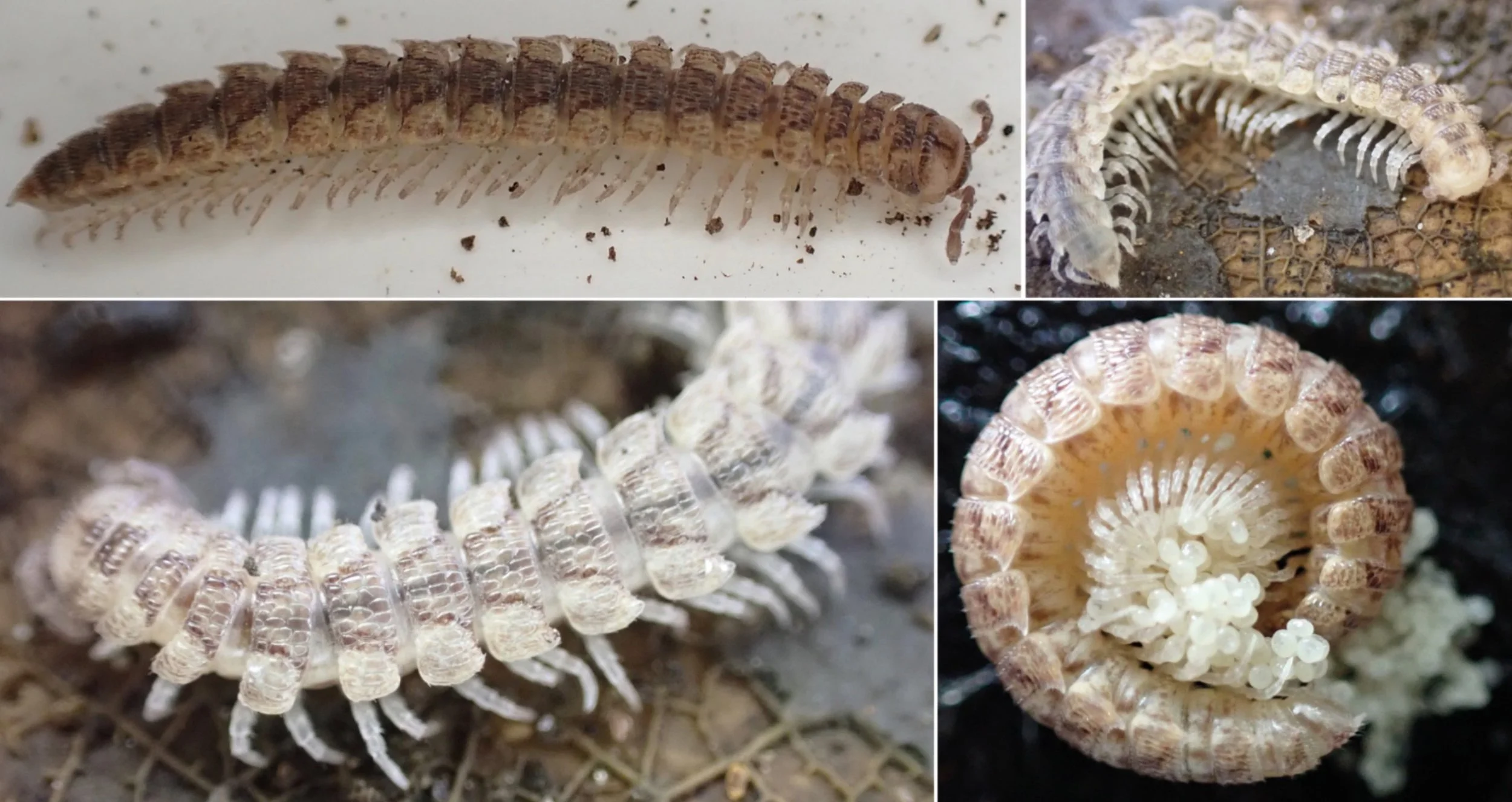
Alafanahydesmus lavasoa, a new millipede species from vanishing forest fragments in Madagascar.
Golles, T., Yoo, J. & Wesener, T. (2026) Description before extinction: a new genus and ninth species of indigenous Polydesmida from Madagascar (Polydesmida: Dalodesmidae). Zootaxa, 5807 (1), 109–124. https://doi.org/10.11646/zootaxa.5807.1.4
Fifteen millimeters long — about the length of your thumbnail — it tip-taps across your palm with its many, many translucent legs. The armour covering its twenty segments flares out slightly over the sides of its body like the eaves of a house, each segment a scaly gradient of browns.
It's probably confused right now. Its short antennae try to feel out its environment, but its entire sensory world barely extends beyond its own head.
At its tail end, barely visible, small pairs of bristles sit on tiny raised knobs. This anatomical detail, so minute you’d need a scanning electron microscope to fully appreciate it, sets this species apart from every other millipede on Madagascar.
———
Alafanahydesmus lavasoa was first collected back in 2007, although it didn’t have that name back then. It didn’t have any name yet.
It came from the Lavasoa-Ambatotsirongorongo Mountains, squeezed between spiny desert and coastal forest in the extreme southeast of Madagascar. Specifically, this new millipede was found in a fragment of forest known as Grande Lavasoa. But the researchers only found females and juveniles, with not a single mature male collected, and so they couldn’t officially describe it as a new species.
But they could tell that this new “flat-backed” millipede belonged to the order Polydesmida.
A Polydesmida millipede hatches into an underground soil chamber — on Madagascar this means it’s protected from the dry season’s blazing sun and heat. It starts its life with as few as seven body segments, and like any arthropod, it has to moult its outer exoskeleton to grow and develop. With each successive moult it grows in size and gains in segments until it reaches its adult form, and then never moults again. It emerges into the downpour of the rainy season. It mates, lays eggs, and dies after a few weeks.
In 2007, the researchers were looking during the early dry season. It wasn't until a new expedition in 2025, in the middle of the rainy season, that mature males were finally discovered, allowing the species to finally be described: Alafanahydesmus lavasoa gen. nov., sp. nov.
These taxonomic qualifiers mean: “new genus, new species.” A. lavasoa was not only a new species, but was unique enough that a whole new genus was created for it. What made it so special?
Anatomically, males possess a highly unique, five-branched ‘gonopod’ (reproductive organ). This includes a ‘retrorse,’ or backward-pointing branch which is a feature entirely unique among Malagasy members of its family (Dalodesmidae).
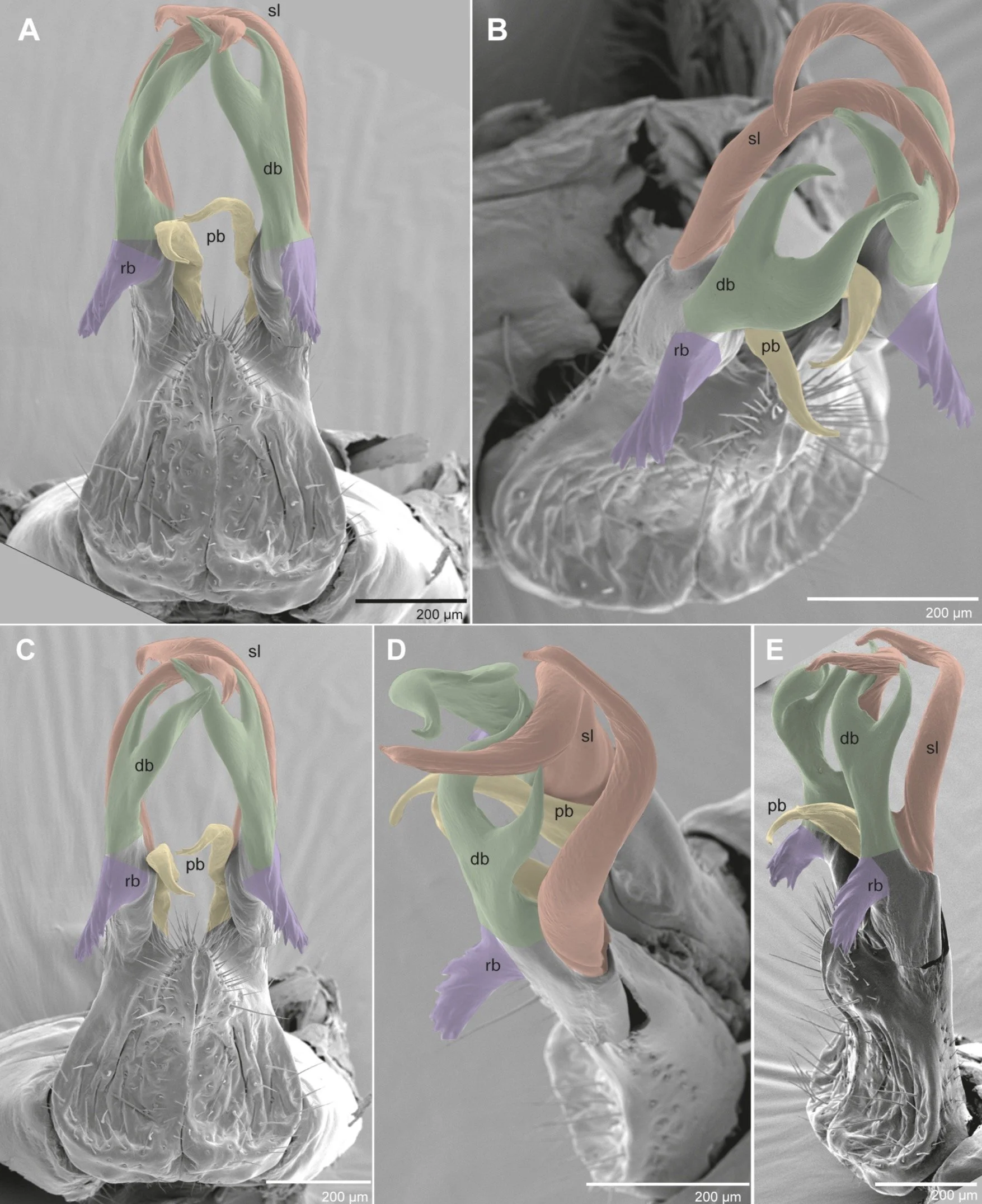
“Alafanahydesmus lavasoa gen. nov., sp. nov., holotype male (ZFMK MYR14588).
SEM images of gonopod: A.
Posterior view; B. Distolateral view; C. Posterior view (slightly tilted); D. Distolateral view (opposite side); E. Lateral view.
Scale bars: 200 µm.
Abbreviations: db = dichotomous branch; pb = paramedian branch; rb = retrorse branch; sl = solenomere
branch.”
The researchers also photographed egg parental care in this species. Adult females were seen protectively coiled around egg masses containing roughly 200 to 400 eggs — and while this isn’t unique among millipedes, it is usually the males who’ve been recorded doing this.
Being a Polydesmida millipede, A. lavasoa is part of the largest order of millipedes in the world. It has over 5000 described relatives, found in every region save Antarctica. They are often some of the most abundant and common millipedes in any given area: the common flat-backed millipede in Europe, the yellow-spotted millipede in North America, the invasive long-flanged millipede in Australia.
A. lavasoa is one of only nine known Polydesmida species in Madagascar.
And it's not that the island is lacking in millipedes. Madagascar is home to the giant pill-millipedes (order Sphaerotheriida), cylindrical millipedes (order Spirostreptida) that can grow to nearly 30 centimeters long, and round-backed (order Spirobolida) “fire-millipedes” named for their bright-red-and-black segments. A single 2009 study described 37 new Malagasy millipede species!
Millipedes are plentiful in Madagascar, it's just that Polydesmida millipedes seem to be exceptionally, unexpectedly rare — they were “only 4% of the 936 millipede specimens found” at Lavasoa.¹
———
Alafanahydesmus lavasoa was named from the Malagasy words ala, meaning “forest,” and fanahy, meaning “spirit, soul, or inner essence.” It is the “spirit of the Lavasoa-Ambatotsirongorongo forest.”
In 2025, three A. lavasoa males were collected from the Grande Lavasoa fragment, and one female was found inside Bemanasa, another fragment. None were found in the Ambatotsirongorongo fragment.
You see, Lavasoa-Ambatotsirongorongo “forest” was once an actual forest; one continuous stretch of trees that covered these mountain slopes. Now it’s three isolated forest fragments — Grand Lavasoa, Bemanasa, and Ambatotsirongorongo — each sitting on a separate slope.²
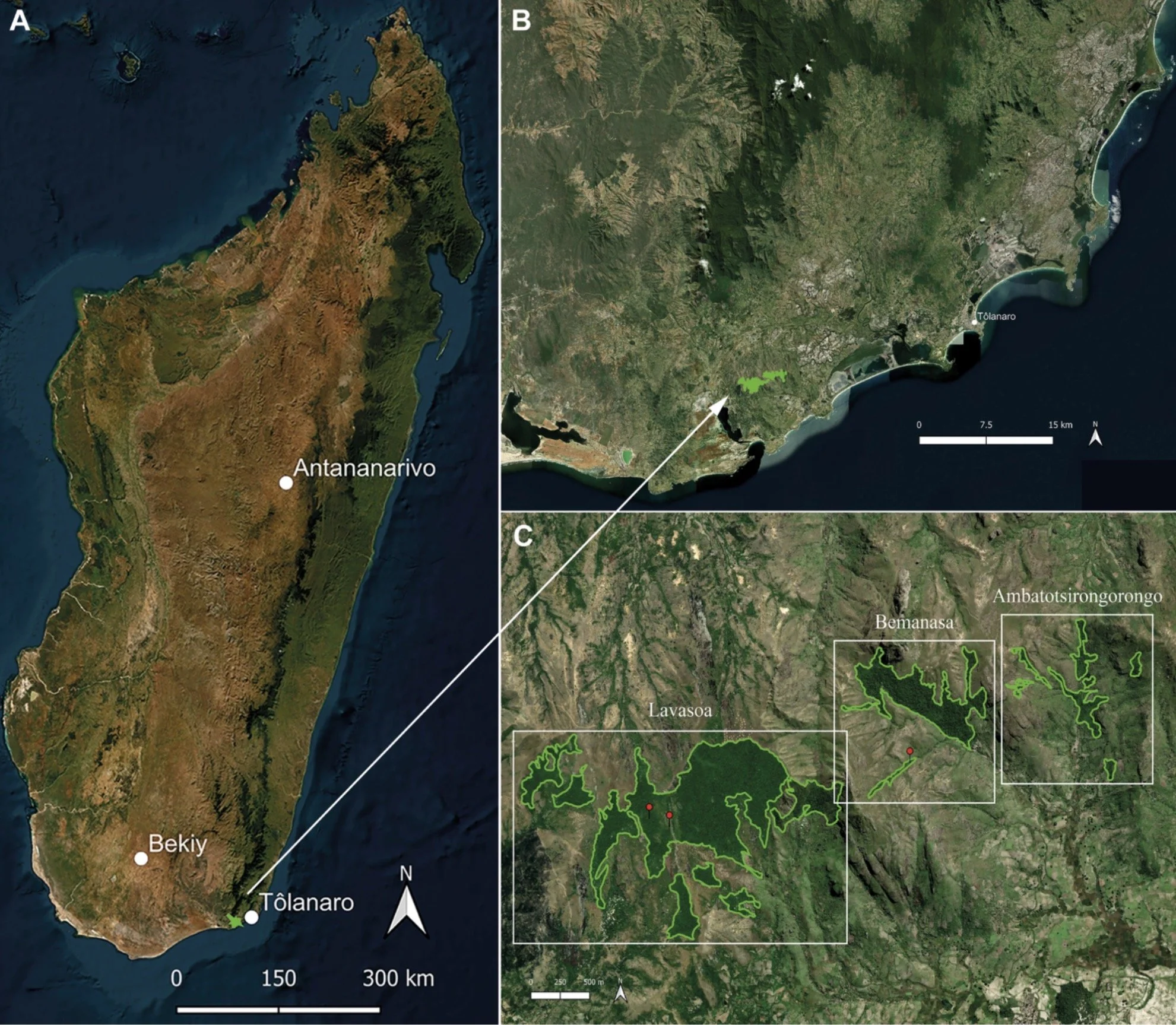
“Location of surveyed forest fragments in southeastern Madagascar. Location of the study area near Tôlanaro (Fort Dauphin) is shown relative to Madagascar, with major cities indicated. A. Overview map of Madagascar showing the position of the study area. B. Regional view of southeastern Madagascar highlighting surveyed forest fragments. C. Detailed map showing forest boundaries (Lavasoa, Bemanasa, and Ambatotsirongorongo) and Alafanahydesmus lavasoa gen. nov., sp. nov. collection sites (red pins), delineated on ESRI World Imagery basemaps from January 2026.”
To get to one of these fragments you’d first have to trek through extensive farmland, then climb up via the irrigation ditches that redirect stream water from the forests to the rice terraces below. From the edge of one forest fragment, you could clearly see the next. You could clearly see the recently cut forest along its borders.
“Between the mid-20th century and the early 21st century, Madagascar experienced a loss of 40–45% of its original forest cover…”
As of 2026, the three forest fragments of Lavasoa-Ambatotsirongorongo combine to cover an area of 92 hectares. For some perspective, London’s Hyde Park is about 1.5 times larger, and New York’s Central Park is nearly four times the size of these combined forest fragments.
And the fragments continue to shrink. The Lavasoa forest fragment “is under great human pressure from charcoal extraction and tree felling and has lost another 50% of its area in 2021-2024” (LIB, n.d.), while, “In recent years, and notably during the Covid-19 pandemic, the forest fragment Ambatotsirongorongo has been greatly diminished and now exists as just a small cluster of trees…” (Roberts, et al., 2024)
These fragments aren’t just home to millipedes. The Lavasoa-Ambatotsirongorongo range is one of a few rare locations in Madagascar where dry, spiny forest species meet humid forest species: where ring-tailed lemurs and Verreaux’s sifakas meet southern bamboo lemurs and aye-ayes. According to the 2026 study that described A. lavasoa, “…the remaining 54 ha of the Lavasoa forest fragment [the largest fragment] alone harbours an exceptionally high lemur density, surpassing that of the much larger Andohahela National Park [to the north], and hosts narrowly endemic taxa…” including the Critically Endangered Microcebus manitatra, or the Bemanasy mouse lemur.
———
The 2026 paper describing A. lavasoa is titled “Description before extinction…”
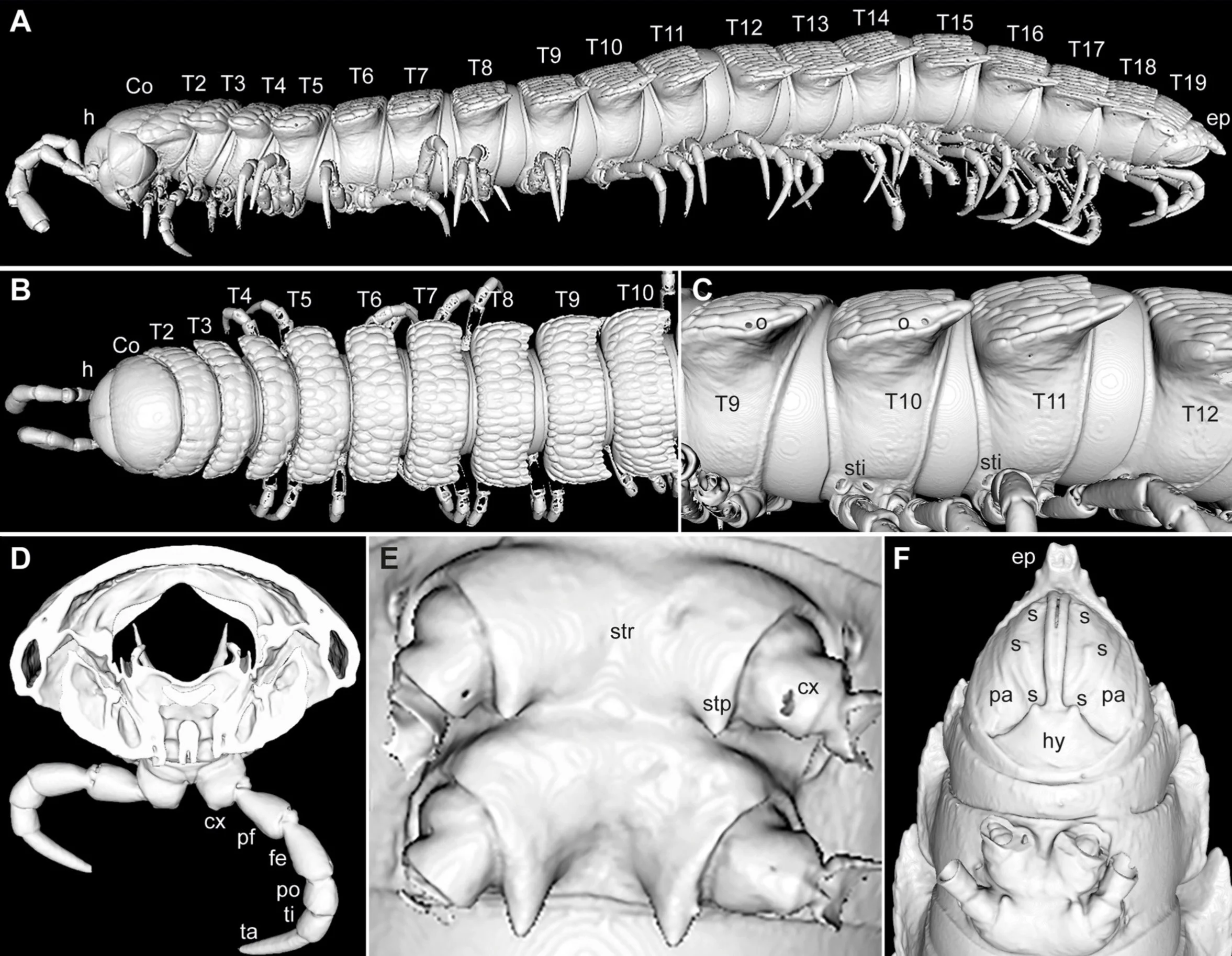
The researchers used every available tool to examine and record this new species: micro-CT scanning, scanning electron microscopy, multilayer photography, DNA barcoding.
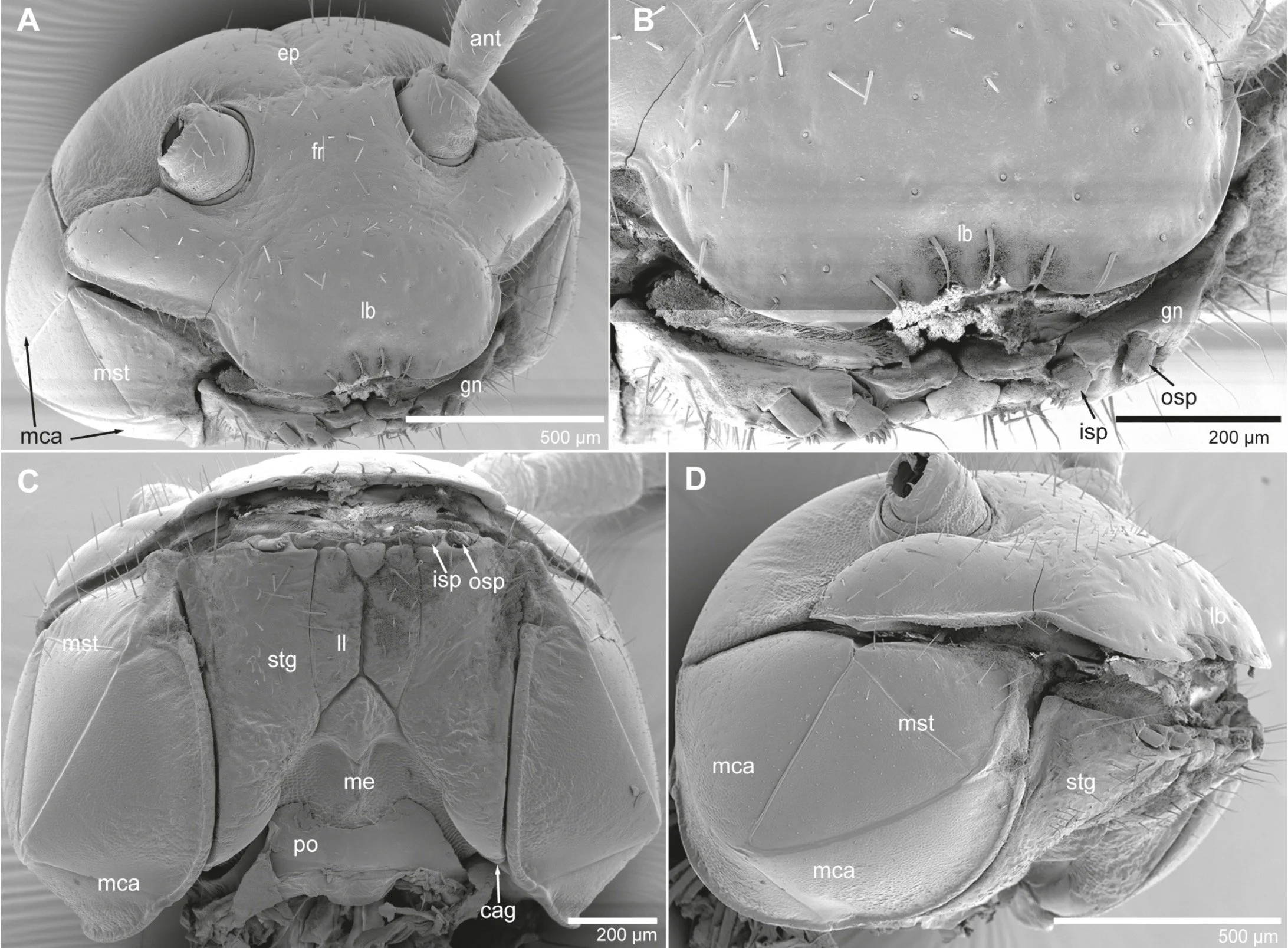
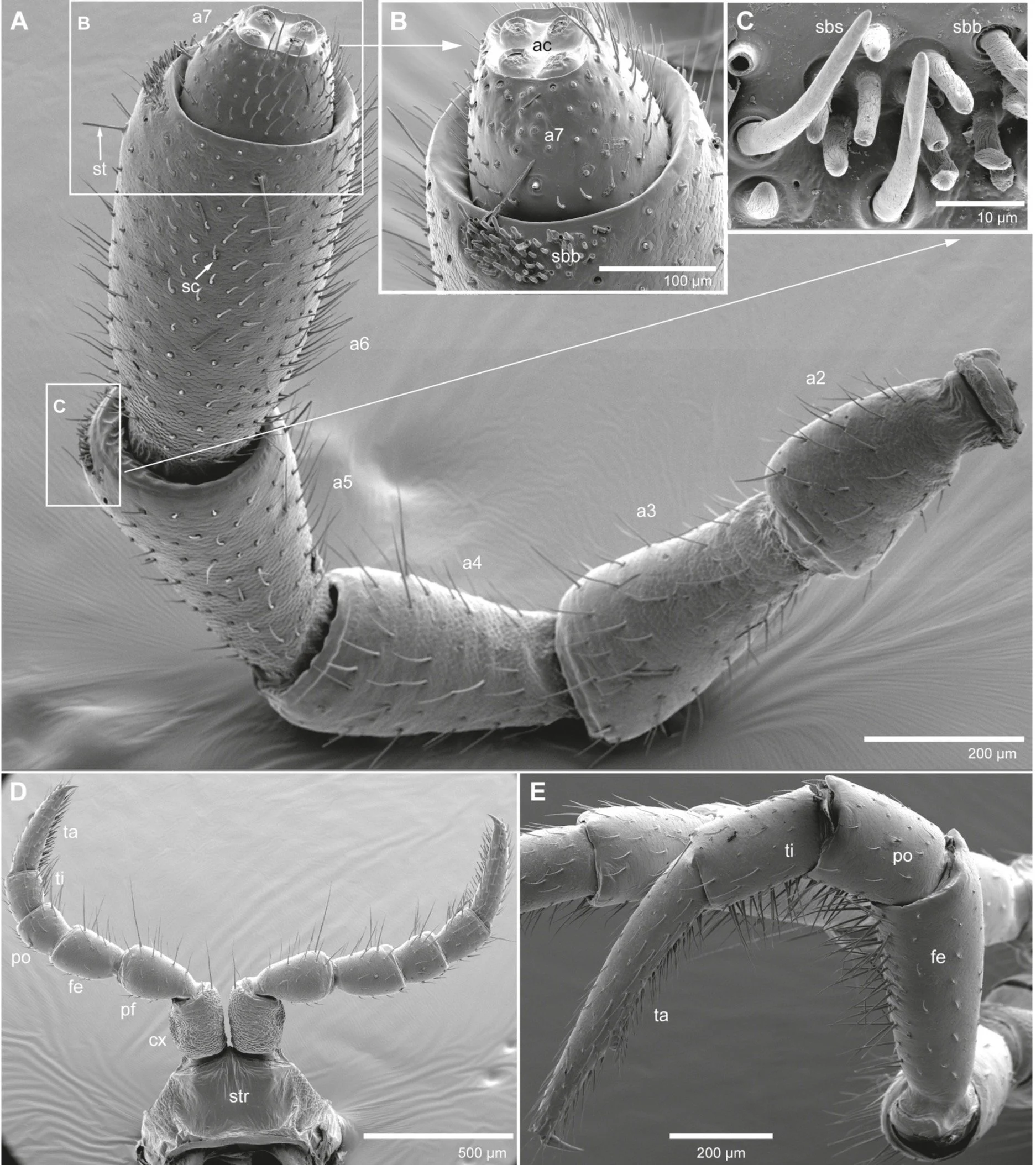
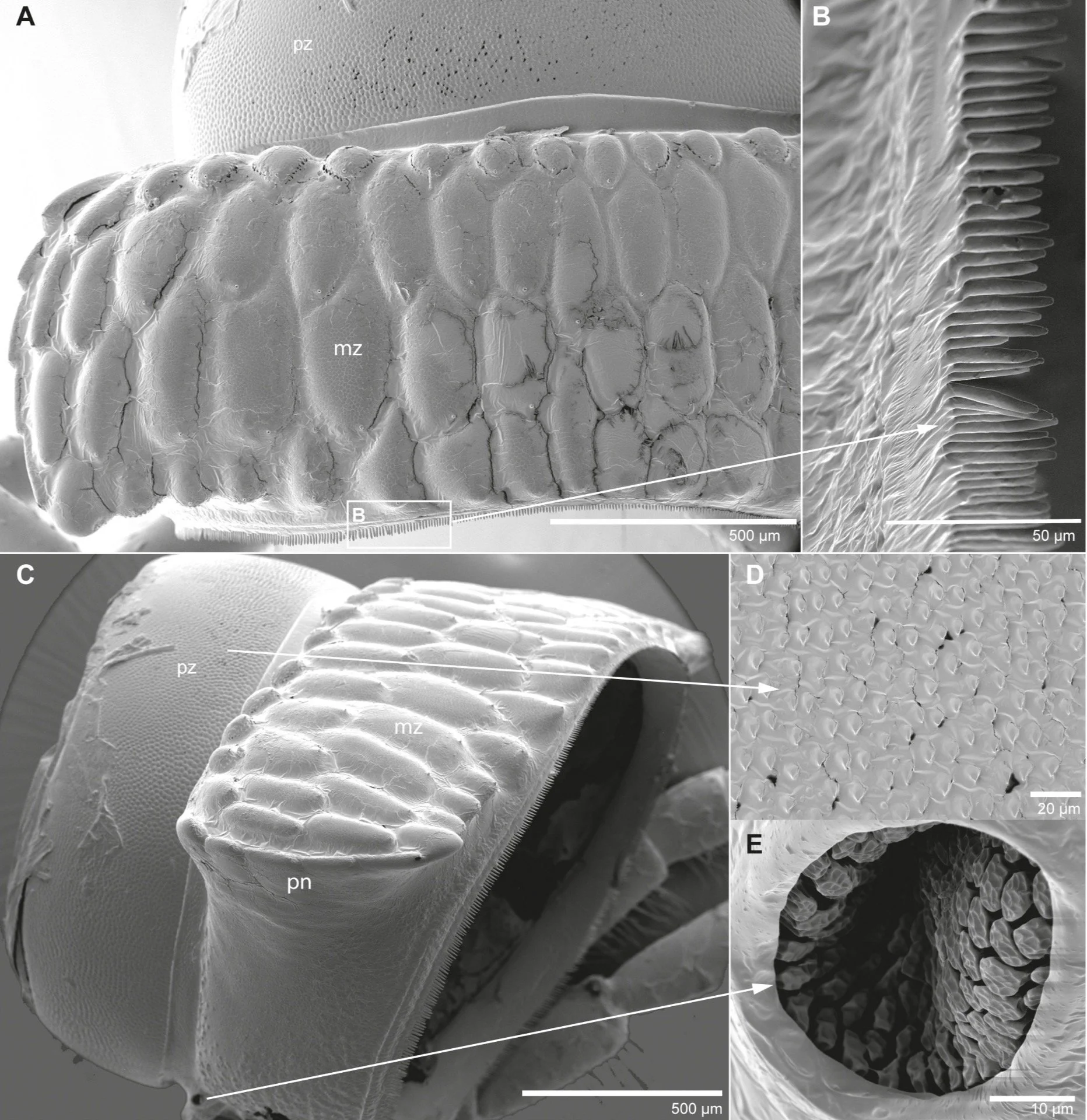
They uploaded “the first known molecular data of a member of the [Dalodesmidae] family from Madagascar.” That data can’t even be analyzed yet because no comparable Dalodesmidae sequences exist globally, but they uploaded them anyway — “they will hopefully be useful for future studies on this biographically interesting family.”
Three other millipede species from Lavasoa-Ambatotsirongorongo are already designated Critically Endangered.³ The 2026 study expresses that an “ IUCN assessment of this species [A. lavasoa] is urgently needed, so that its threat status can be monitored.”
It’s clear that no one may ever get another chance to study Alafanahydesmus lavasoa.
¹ “The low Polydesmida diversity (only 4% of the 936 millipede specimens found) observed at Lavasoa, reflects the known species lists of Madagascar, in which the Spirostreptida [cylindrical millipedes], Spirobolida [round-backed millipedes] and Sphaerotheriida [giant pill millipedes] are dominant groups, together accounting for 90% of the known species.”
² Grand Lavasoa is “further divided into four fragments that are all in relatively close proximity.” (Eppley, et al., 2020)
³ “The unique and highly threatened fauna of the Lavasoa massif also includes diverse habitat-restricted millipede species, among them the IUCN critically endangered Sphaeromimus lavasoa, Granitobolus endemicus, and Zoosphaerium alluaudi, underlining the conservation importance of these forest patches for Malagasy Diplopoda.”
-
David, Jean-François. (2009). Female reproductive patterns in the millipede Polydesmus angustus (Diplopoda: Polydesmidae) and their significance for cohort-splitting. European Journal of Entomology. 106. 211-216. 10.14411/eje.2009.027.
San Diego Zoo Wildlife Alliance: Science Blog
Eppley, Timothy & Refaly, Ernest & Tsagnangara, Cedric & Ramanamanjato, Jean Baptiste & Donati, Giuseppe. (2020). Urgent action needed: the forgotten forests of the Lavasoa-Ambatotsirongorongo Mountains, southeast Madagascar. 22. 30-32.
Myriapodology — external anatomy of Polydesmida
Wesener T, Akkari N, Golovatch SI (2025) Revision of the millipede family Dalodesmidae in Madagascar, with descriptions of two new Malagasy species of Dalodesmus Cook, 1896 (Diplopoda, Polydesmida). ZooKeys 1223: 185-220. https://doi.org/10.3897/zookeys.1223.139346
Petra Sierwald, Jason E. Bond. 2007. Current Status of the Myriapod Class Diplopoda (Millipedes): Taxonomic Diversity and Phylogeny. Annual Review Entomology. 52:401-420. https://doi.org/10.1146/annurev.ento.52.111805.090210
Wesener T, Akkari N, Golovatch SI. Revision of the millipede family Dalodesmidae in Madagascar, with descriptions of two new Malagasy species of Dalodesmus Cook, 1896 (Diplopoda, Polydesmida). Zookeys. 2025 Jan 8;1223:185-220. doi: 10.3897/zookeys.1223.139346. PMID: 39822655; PMCID: PMC11736306.
Wesener, Thomas & Enghoff, Henrik & Sierwald, Petra. (2009). Review of the Spirobolida on Madagascar, with descriptions of twelve new genera, including three genera of 'fire millipedes' (Diplopoda). ZooKeys. 19. 1-128. 10.3897/zookeys.19.221.
New genetic evidence from the Ambatotsirongorongo / Petriky complex in southeast Madagascar calls for an immediate re-evaluation of conservation strategies focusing on the Bemanasy mouse lemur (Microcebus manitatra) by Roberts, et al., 2024
Wisconsin National Primate Center — mouse lemurs
IUCN — Bemanasy Mouse Lemur Microcebus manitatra
Leibniz Institute for the Analysis of Biodiversity Change — Unique in the world and highly endangered, the millipedes of the Lavasoa-Ambatotsirongorongo forest in Madagascar
Any quote without an in-test citation comes from: Golles, T., Yoo, J. & Wesener, T. (2026) Description before extinction: a new genus and ninth species of indigenous Polydesmida from Madagascar (Polydesmida: Dalodesmidae). Zootaxa, 5807 (1), 109–124. https://doi.org/10.11646/zootaxa.5807.1.