The “Sesame Seed” Sea Slug
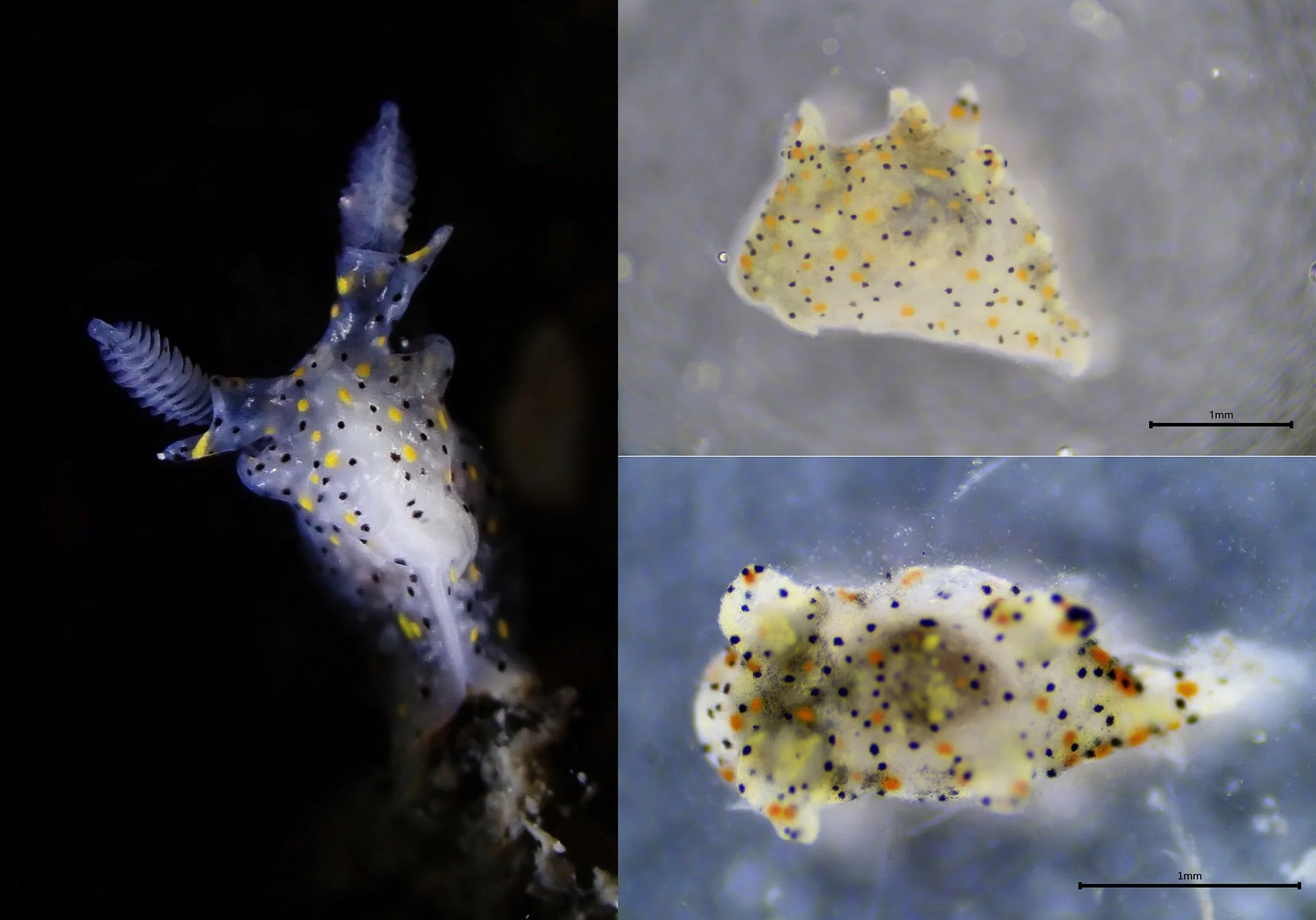
Thecacera sesama, a new nudibranch species discovered off the coast of Taiwan, measuring less than 3 mm (0.1 in) long — about the size of a single sesame seed.
Chan H-Y, Lee C-L, Chen W-C, Chang C-H, Shao Y-T, Pang K-L (2026) Thecacera sesama sp. nov. (Nudibranchia, Polyceridae) from Taiwan, evident from morphology and phylogenetic analyses of the 16S rDNA and cytochrome c oxidase I gene. ZooKeys 1279: 269-284. https://doi.org/10.3897/zookeys.1279.184298
Off the coast of north-eastern Taiwan, a team of researchers search for sea slugs.
They put on their wetsuits and dive into the waters of Mother Rock Bay, descending to depths between 18 and 30 metres (59–98 ft). The environment down here is covered in intricate colonies of bryozoans. These tiny animals, each about 0.5 millimetres (0.02 in) long, form forests of frilly fan-like structures that consume detritus floating in the surrounding water.
Through these forests hunt tiny predators: sea slugs, or nudibranchs. Or rather, they don’t so much hunt through the forest, as prey on them. They are specialised bryozoan hunters — tiny predators hunting miniscule colonial prey.
“The western Pacific region, including the waters around Taiwan, represents a biodiversity hotspot for marine gastropods…” There are bright yellow sea slugs, their appendages tipped with neon blue; pale sea slugs lined and spotted with black, and accented in orange; and several less aesthetic species, mottled in various shades of orange and brown. “…yet the nudibranch fauna of this region remains poorly documented compared to other marine biogeographic provinces.”
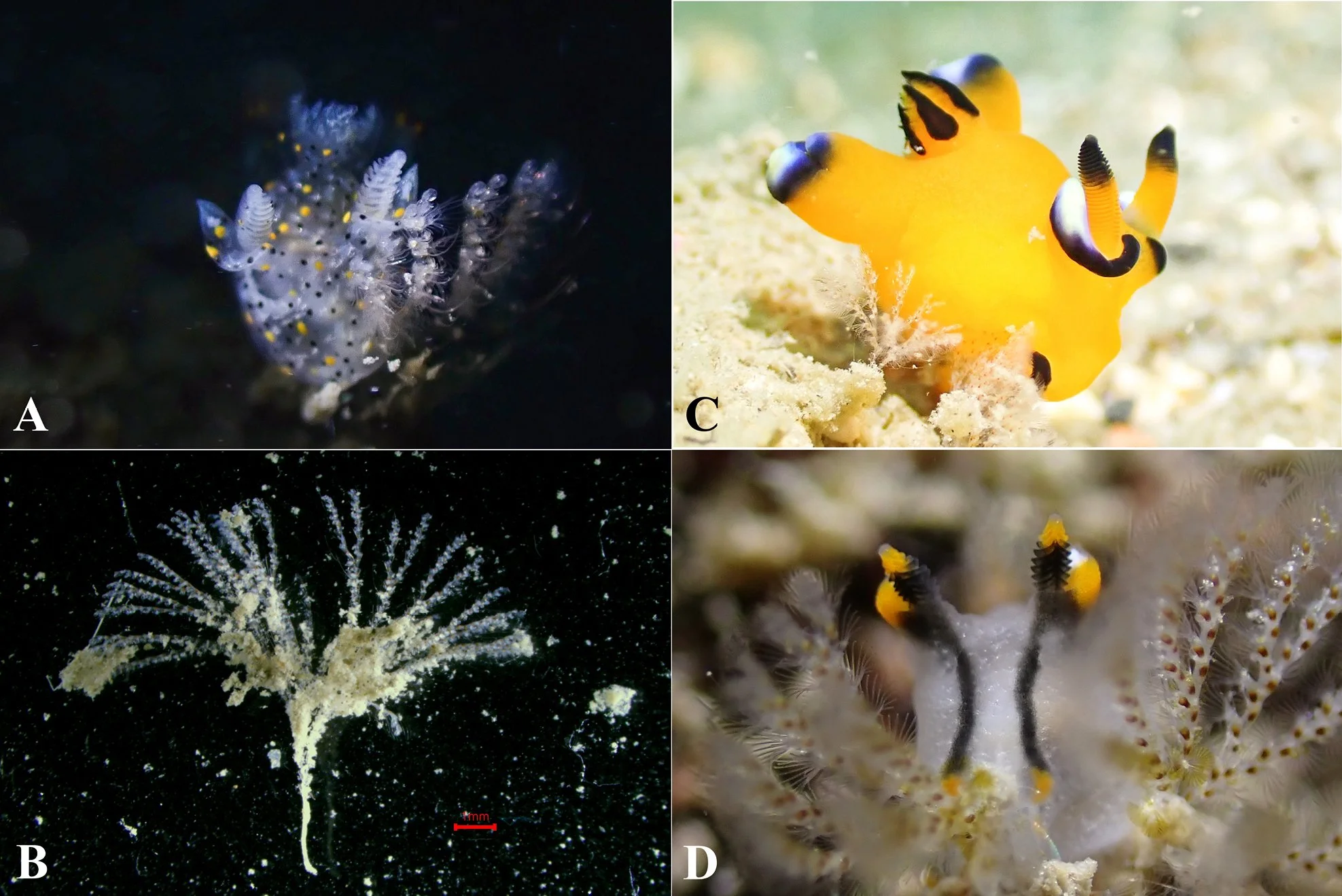
“Living specimens of bryozoan with Thecacera species. A. T. sesama sp. nov. feeding on a bryozoan; B. Bryozoan, ASIZ0100005; C. T. pacifica feeding on a bryozoan; D. T. picta feeding on another bryozoan. Scale bar: 1 mm (B).”
The researchers diving off Taiwan’s coast are looking to document that diversity, starting with a new species of Thecacera sea slug.
The Thecacera genus was first established in 1828 with Thecacera pennigera, and it has since grown to include six species from all across the world: Thecacera darwini from Chile, Thecacera boyla from Australia, Thecacera picta from Japan, etcetera.¹ The researchers are searching for the seventh.
Between October and April, these seas turn cold and harsh, while typhoons buffet the coast between May and September. The researchers dive whenever the weather permits. It takes them four years — with multiple dives between May 2021 and June 2025 — to collect six specimens.
———
Thecacera sesama was described in May of 2026, marking the first formal addition to the genus in nearly three decades.²
This species gets its specific name, sesama, from the yellow and black spots that cover its entire translucent body like sprinkled sesame seeds. Between these “seeds” it is speckled with tiny white “snowflakes.” Its rhinophores — the rod-like “ears” on its head that detect chemical signals in the water — emerge from flared sheaths, appearing like two spirals, and the frilly gills on its back are flanked by two fin-like appendages. It's a very charming slug.
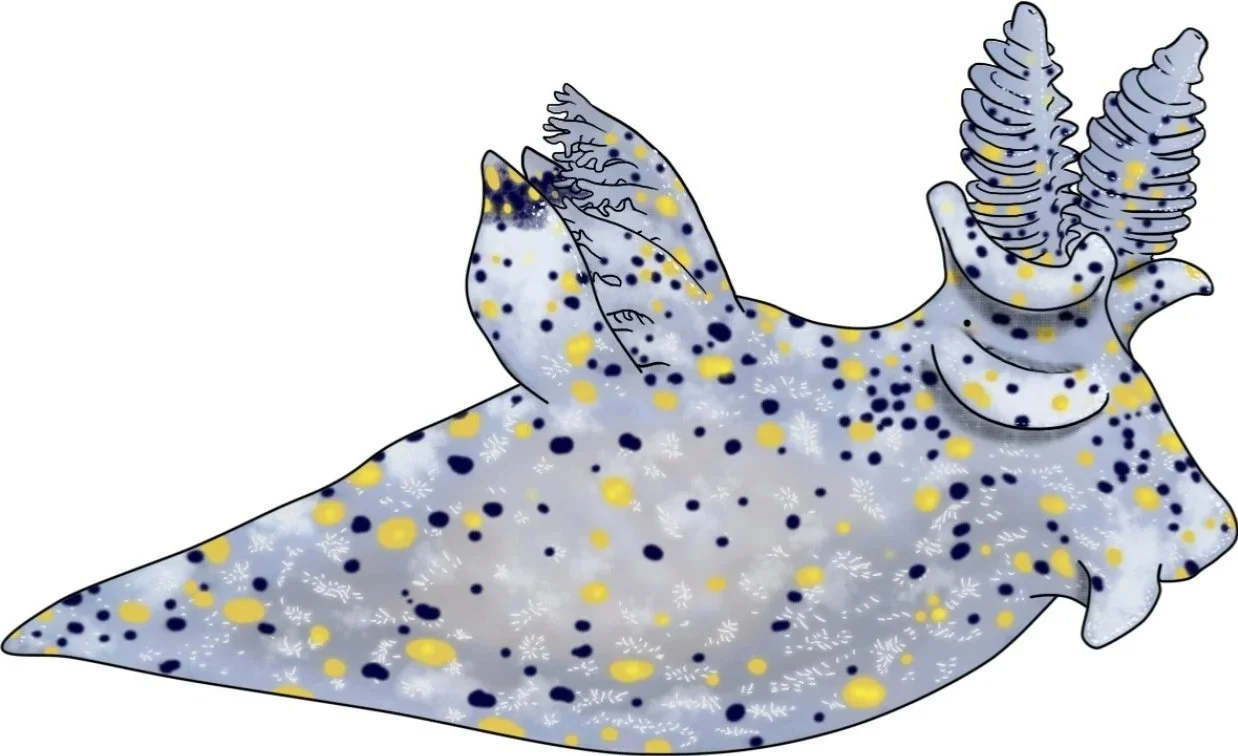
“This is a small species of Thecacera that has the body covered with a snowflake-like pattern of pigments…The most striking characteristic of this species is the dense coverage of discrete, circular, small, black spots…and larger yellow spots.”
T. sesama’s sister species, T. picta, can grow to be up to 20 millimetres (0.8 in) long.³ And while most people wouldn’t call that large, T. picta is quite a bit bigger than T. sesama, which measures in at under 3 millimetres (0.1 in) — fittingly, about the size of a single sesame seed.
During their dives, the researchers took photos of T. sesama in its natural environment, exhibiting its natural behaviour; that is, feeding on bryozoans. Like many nudibranchs, T. sesama heavily specialises in a single kind of prey. In this case, a single species of bryozoan.⁴
In fact, across eight years of observing Thecacera sea slugs in the area, all of the species were observed feeding on just two different species of bryozoans. That includes the known Thecacera species — T. sesama, T. pacifica, and T. picta — as well as five other entirely undescribed Thecacera species.⁵
These tiny bryozoan forests are bustling with nudibranchs. In the words of the authors: “the resulting high species diversity within a limited ecological niche is remarkable.”
¹ …Thecacera vittata from the Indian Ocean, Thecacera pacifica from the Pacific, and Thecacera pennigera with a cosmopolitan distribution.
² To establish T. sesama as a new species, the researchers compared a genetic marker (the COI gene) from the mitochondrial DNA of different species, finding a genetic distance of 14.17% between T. sesama and T. picta — “within the typical threshold for species level divergence in Nudibranchia (10–15%).”
³ The largest nudibranch species, such as the Spanish dancer, can grow to an enormous size of 600 millimetres (23.6 in). Most of the 3,000+ sea slug species, however, average around 20 to 120 millimetres (~1 to 5 in).
⁴ T. sesama has so-far only been confirmed along the north-eastern coast of Taiwan, from where it was described, and Kenting National Park in the south of the island. It’s possible that it lives further afield, but its range is likely limited by its extremely close ecological relationship with its single bryozoan prey-species.
⁵ The authors note that the collection site “is not a protected area,” despite its diversity of nudibranch species. The more species that are officially described — with some perhaps being exclusive to the area — the more likely the area is to receive protection. Thecacera sesama is a step towards that.
———