Chalcides mauritanicus
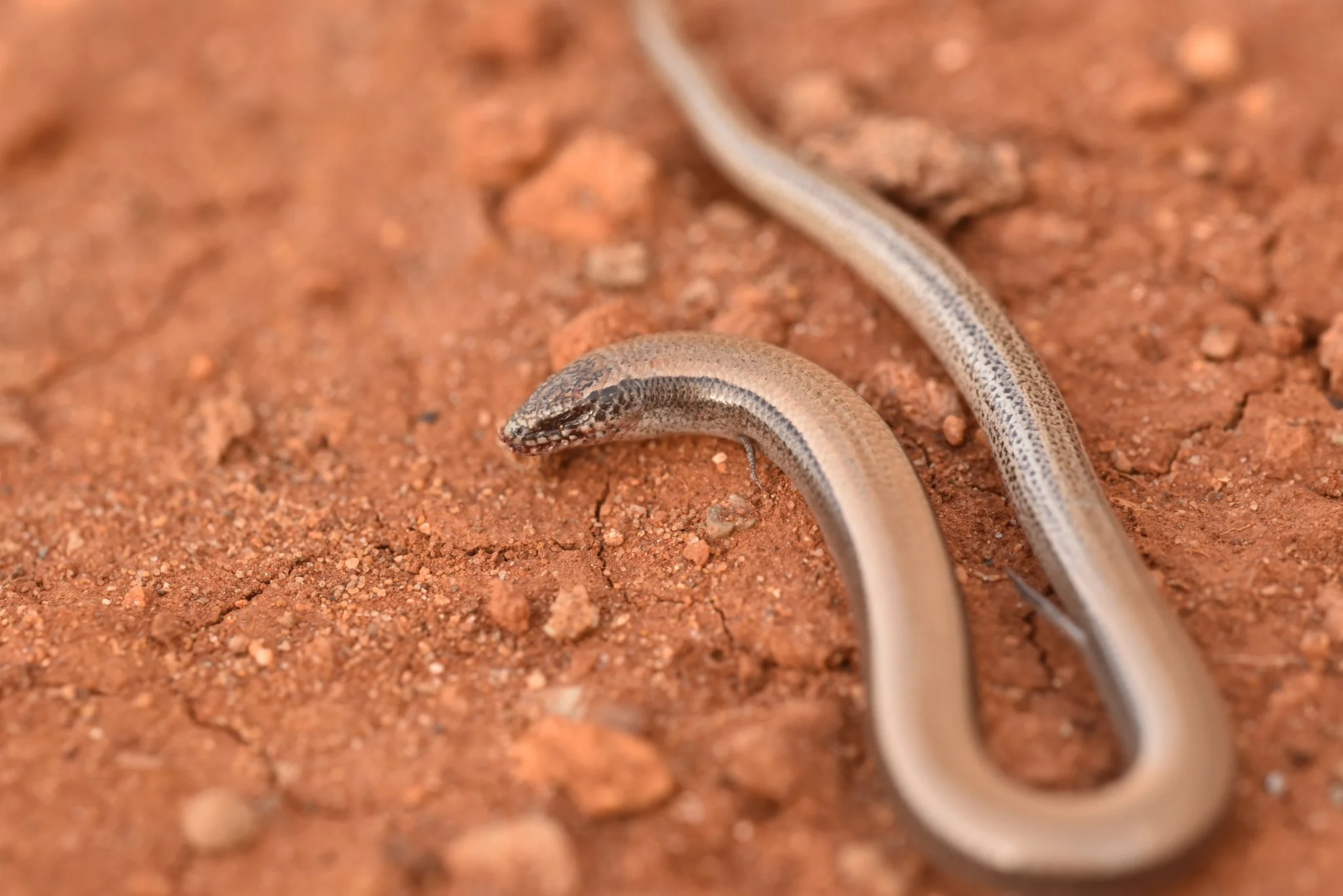
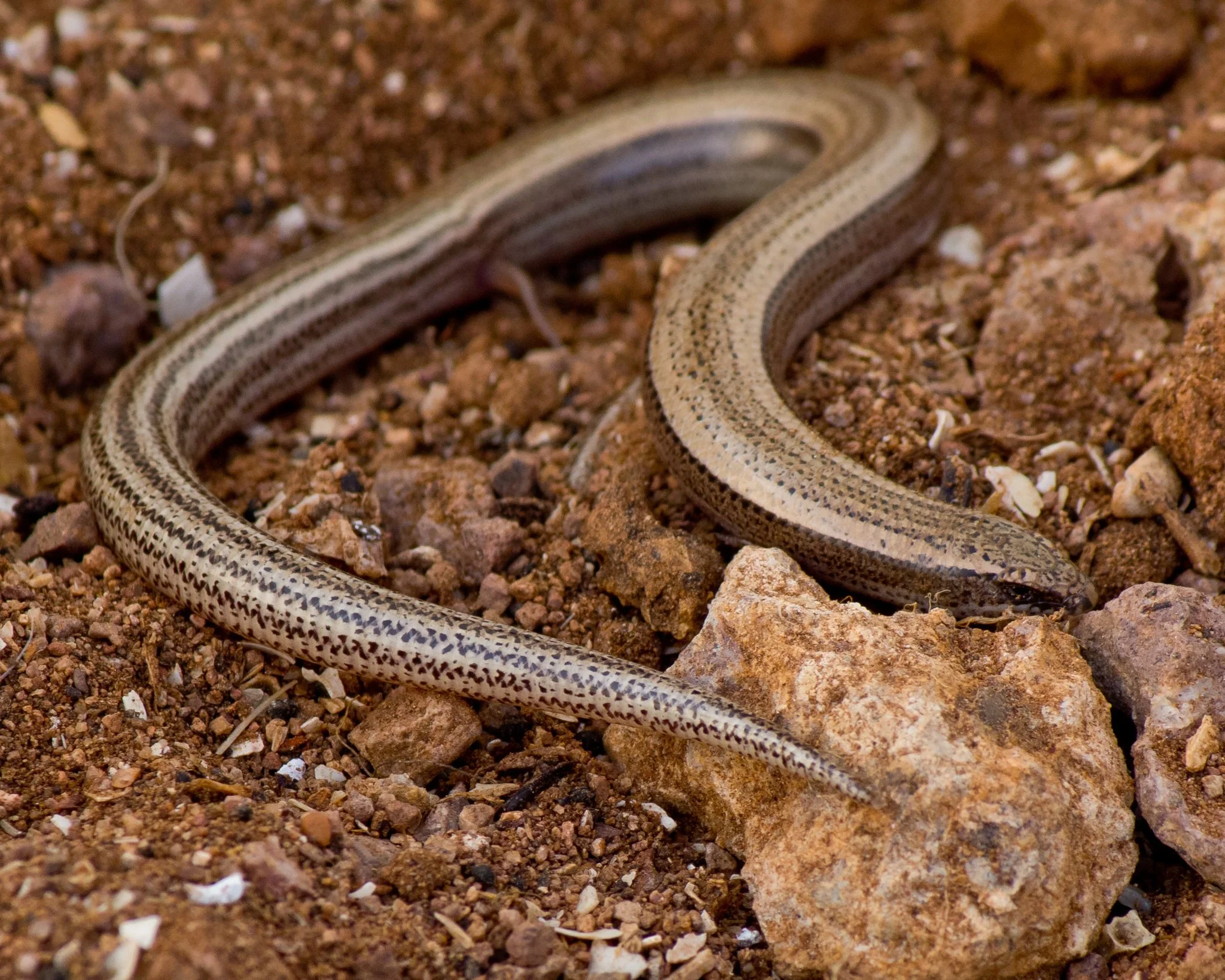
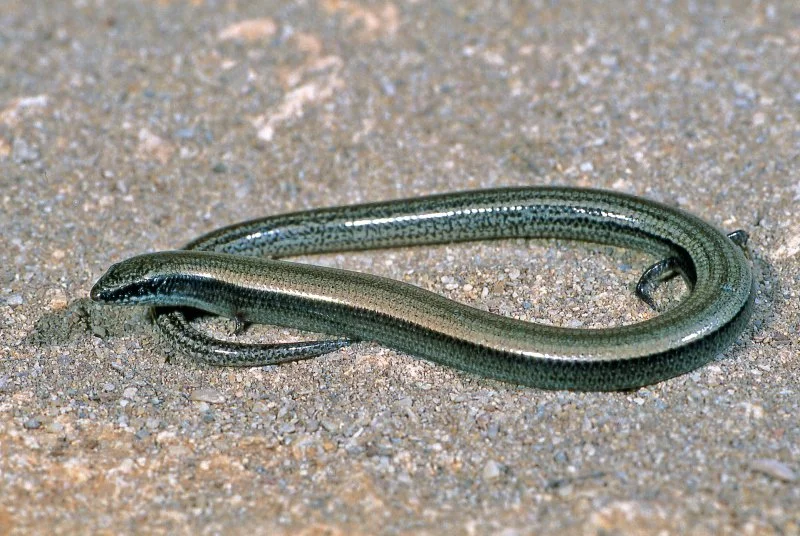
The two-fingered skink is a ‘sand-swimmer’ with reduced limbs, closed ear holes, and a streamlined body — allowing it to move through sand at speed. It is rarely seen above the surface.
In biological evolution, less is more, if the “more” is offspring.
Evolution usually does not hold onto the unnecessary. Eyes, teeth, limbs — if you don’t use them for a few million years, you might just lose them.
If doing less helps you survive and reproduce, then subtract, subtract, subtract.
———
Compared to most lizards, skinks are already quite simplified: most of them lack pronounced necks, they don’t have any crests, frills, or dewlaps, and their limbs are relatively reduced. And while skinks — along with all four-legged vertebrates — inherited five digits on each hand and foot from a common ancestor, that doesn’t mean they’ve kept them.
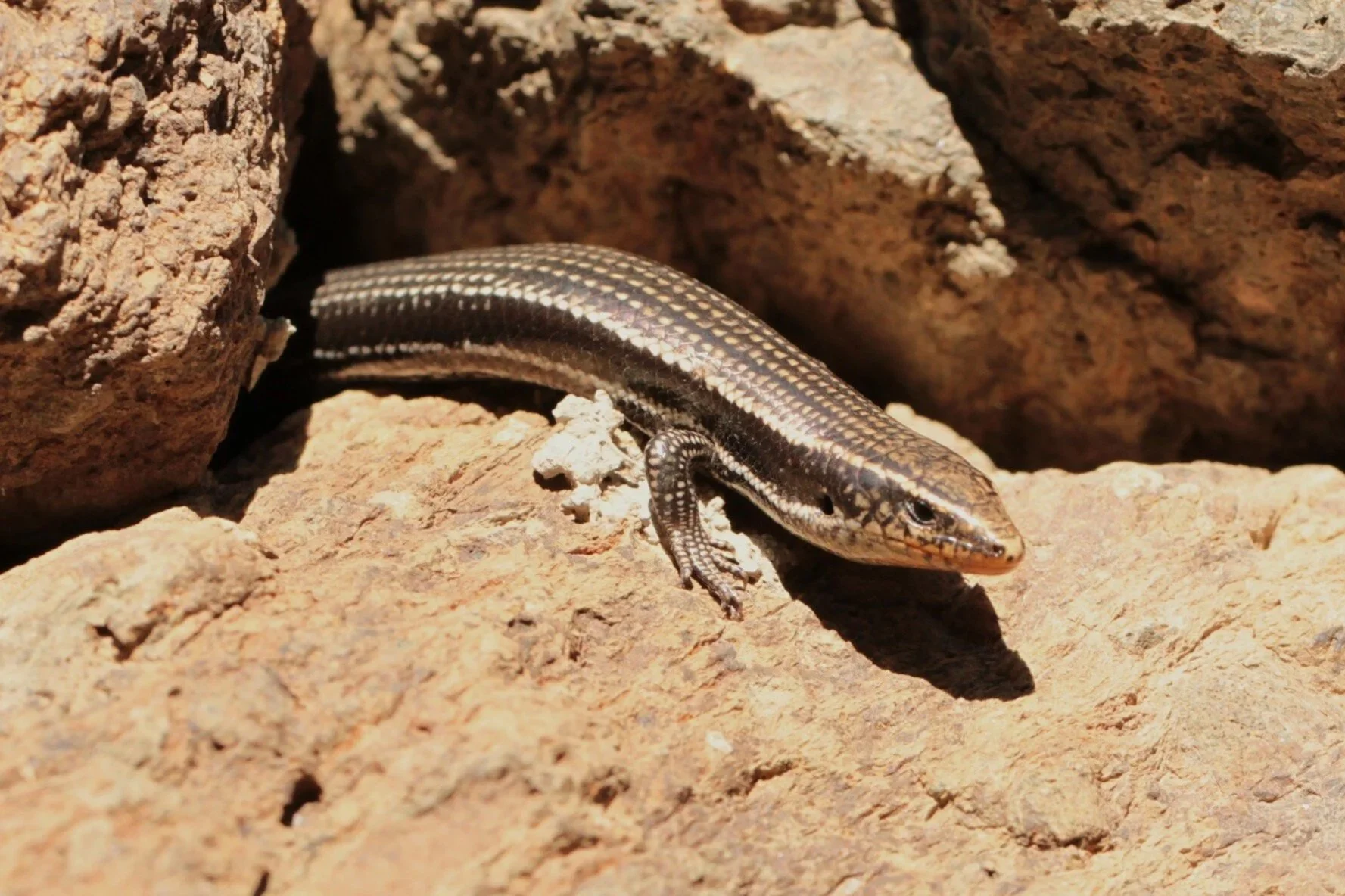
Some of the thirty-or-so species of cylindrical skinks, in the genus Chalcides, have relatively normal-sized limbs, with five digits on each foot. The Gran Canaria Skink (C. sexlineatus), for example, scrambles across stone walls and clings to volcanic rock with its twenty sharp-clawed toes.
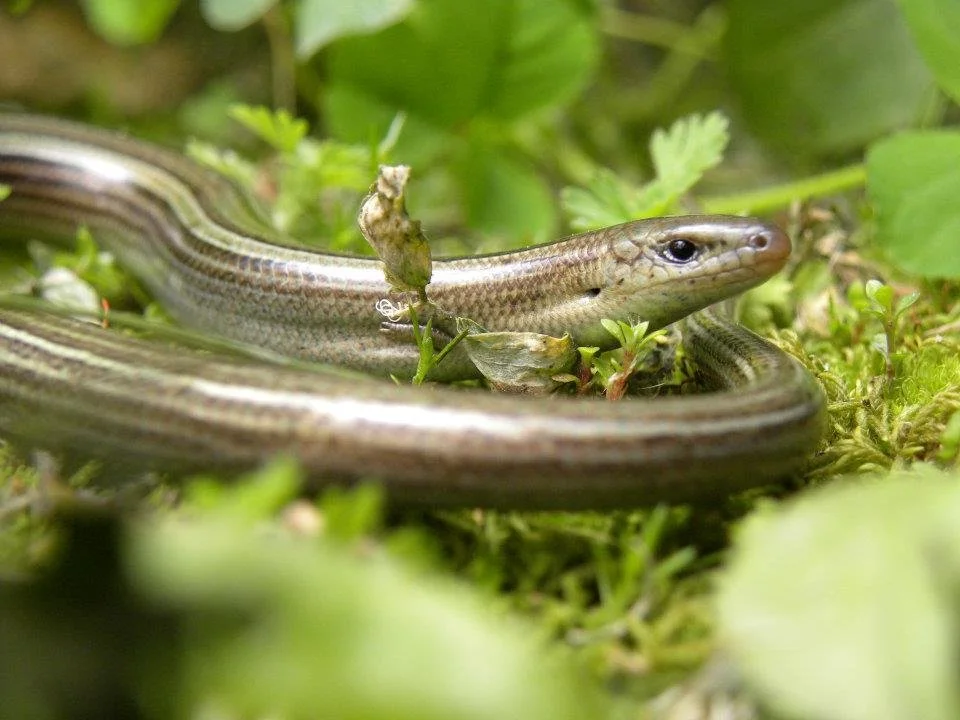
Other cylindrical skinks have limbs so tiny they look like they’d struggle to be of any use at all. Species like the Italian three-toed skink (C. chalcides) and the Algerian three-toed skink (C. mertensi) have lost their outer digits entirely, leaving only three toes on each of their comically tiny legs. These skinks are ‘grass-swimmers.’ They dive through dense vegetation, undulating their cylindrical, serpentine bodies to slide between blades of grass and through woody tangles, only using their little legs to stabilise themselves when they stop.
A few species have evolved to be even more minimalist.
Around 10 million years ago, one group split from the grass-swimmers. While its cousins remained near the surface, touching grass, this divergent lineage dove underground.
Sand, a much finer substrate, required more streamlining. This skink’s snake-like body became narrower, allowing it to slip through sand with minimal resistance. It lost its external ear-holes to prevent sand from entering and damaging its auditory canal. And, with nothing to grab onto beneath the sand, its limbs were even further reduced: while it kept three toes on its hind limbs, its front limbs each lost a finger.¹
The result is the two-fingered skink (C. mauritanicus).
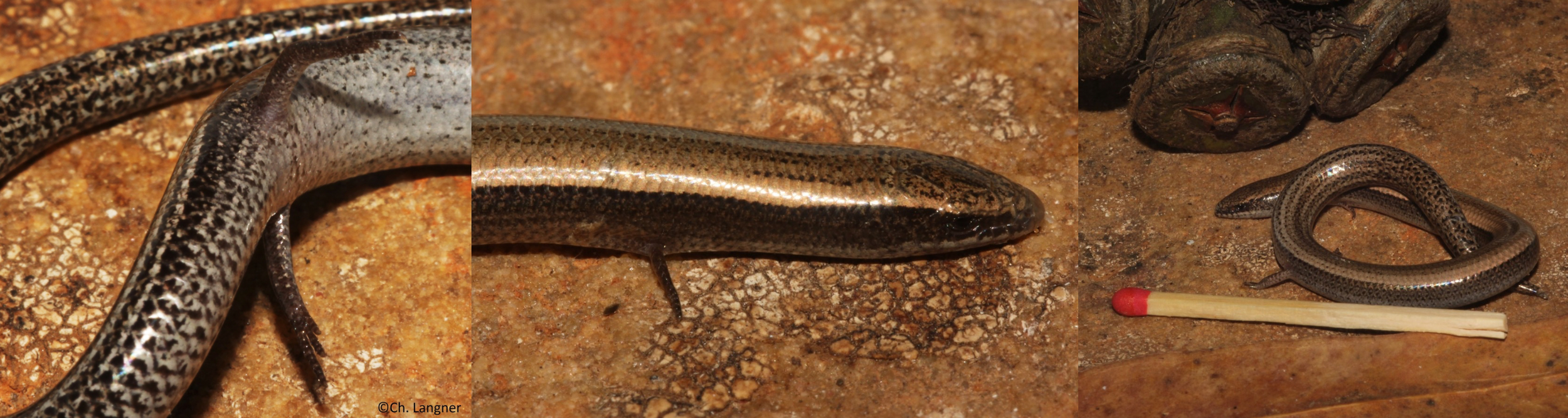
Found in the dunes along the Mediterranean coast of North Africa, these skinks rarely, if ever, move along the open surface. Instead, like tiny versions of the sandworms from Dune, they travel only beneath the surface of the sand, occasionally surfacing to ambush insect prey.
An early account from 1901 describes the species as being more agile than other skinks, noting how it “dives” into the sand, and swims “with the agility of a fish in water.” This skink’s subterranean swimming can, however, shift the loose sand on the surface, leaving behind a trace of its travels. This is probably how predators, such as gulls, find it.
Subtraction isn’t only an evolutionary strategy. Caudal autotomy, the technical term for self-amputation of the tail, is a classic lizard defence. Juvenile two-fingered skinks even have bright vermilion or orange-red tails, likely to draw a predator’s attention away from their vulnerable bodies. By the time a two-fingered skink grows up, and the colour of its tail fades to the same bland-brown as the rest of its body, it has likely already lost its tail at least once.
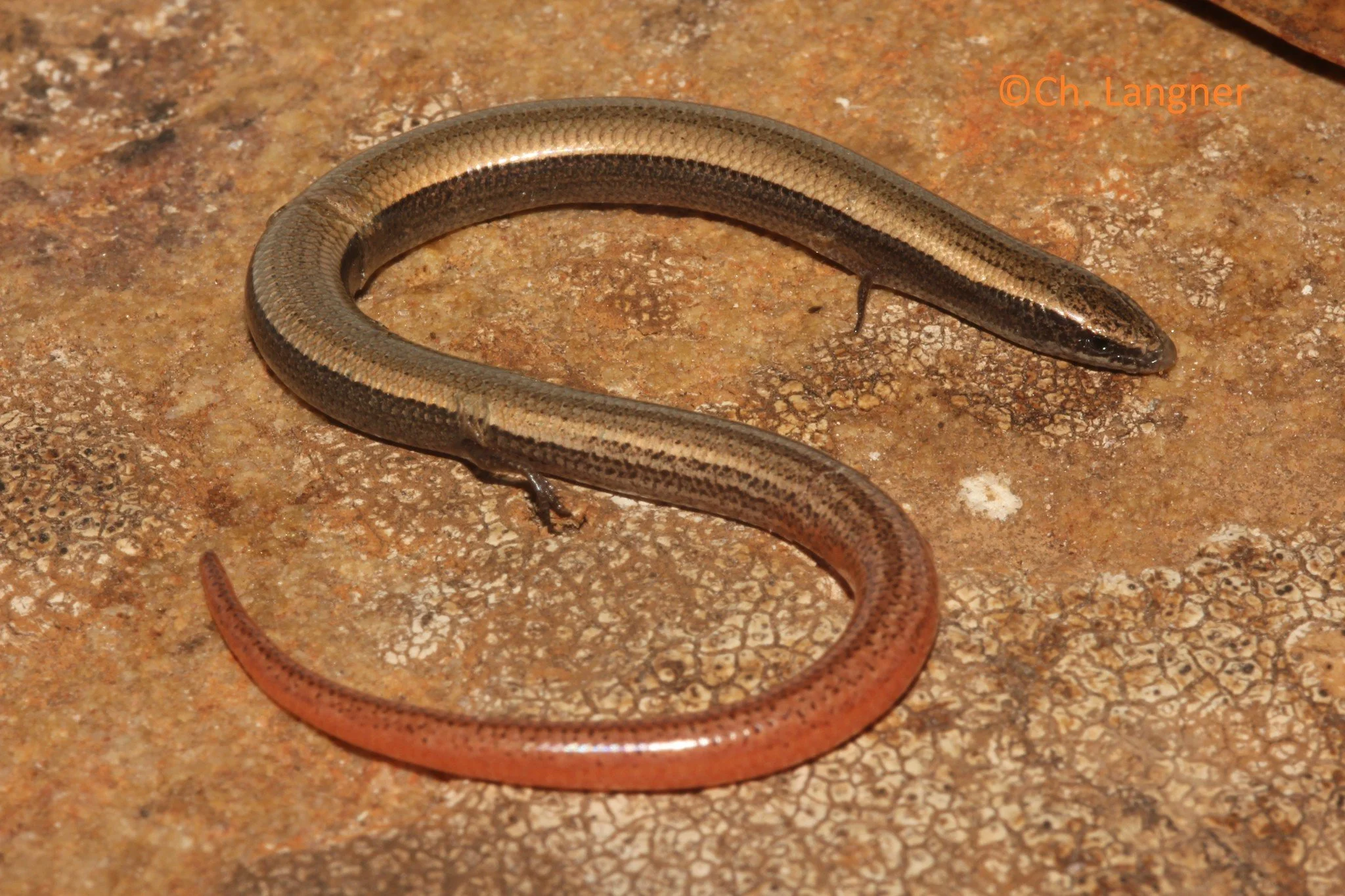
(© Christian Langner / iNaturalist)
In one study, carried out on Congreso Island off Morocco’s northern coast, over 85% of adults in a population had regenerated tails, suggesting that most individuals have survived at least one near-death encounter. This immediate loss is a trade-off — it takes energy to regrow a tail, and the new tail often ends up imperfect — but if it buys the skink survival, then the loss is worth it.
To catch a two-fingered skink, you either have to be fast or smart; you have to “plunge the hand with speed into the sand,” to withdraw both the animal and the surrounding earth at the same time, or else it just “disappears immediately" into the sand.
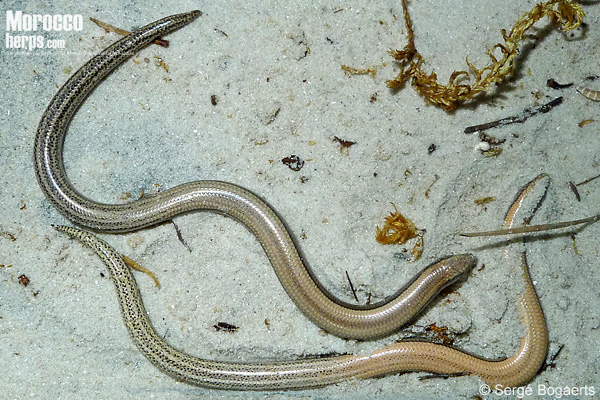
(© Sergé Bogaerts / Moroccoherps.com)
Today, researchers tend to use less aggressive techniques. As the 1901 account notes, "it is very rare to take an intact animal" because the tail is "excessively fragile" — even just sexing the adults, which requires carefully examining the cloaca and everting the hemipenis of males, is frequently avoided due to the high risk of stress-induced tail autotomy. Often, instead of grasping at sand, researchers will turn over driftwood to find two-fingered skinks resting underneath.²
Between 2013 and 2016, several targeted searches were carried out in the coastal areas of Algeria. And yet, despite "many visits to its historical range," not a single two-fingered skink was found. This lack of skinks was attributed to "massive habitat transformation and fragmentation."
You see, the two-fingered skink lives in a very particular kind of habitat: loose, poorly developed substrates that reduce the energetic costs of “swimming.” On the uninhabited Congreso, for instance, the species occupies just ∼1% of the island's surface because only that tiny area meets the necessary conditions to host the skink. It is a fluid animal, living in a fluid, constantly shifting environment of waves, winds, dunes. But when a coastal habitat is developed — be it into a coastal resort or military base — it is made rigid and compact, permanent and impermeable.
Saïdia, a coastal town on the Mediterranean, is one of only four documented localities for the two-fingered skink in Morocco. Historically it has been a critical environment for the species. Go on Google Earth, wind the clock back to 2004, and you'll see Saïdia as a small town surrounded by largely intact dunes. Look at the satellite imagery now, and most of those dunes are gone — replaced by new housing complexes and holiday villages.
And as development encroaches onto the coast from one direction, the sea creeps up from the other.
As sea levels rose in the past, the ocean didn’t just swallow coastal dunes; instead, the wind and waves naturally pushed the sand further inland, allowing the habitat to slowly migrate. But coastal developments act as an immovable anvil, and the advancing waves become a hammer, battering the dunes until they vanish completely.
For the two-fingered skink, this is just loss, pure and simple.
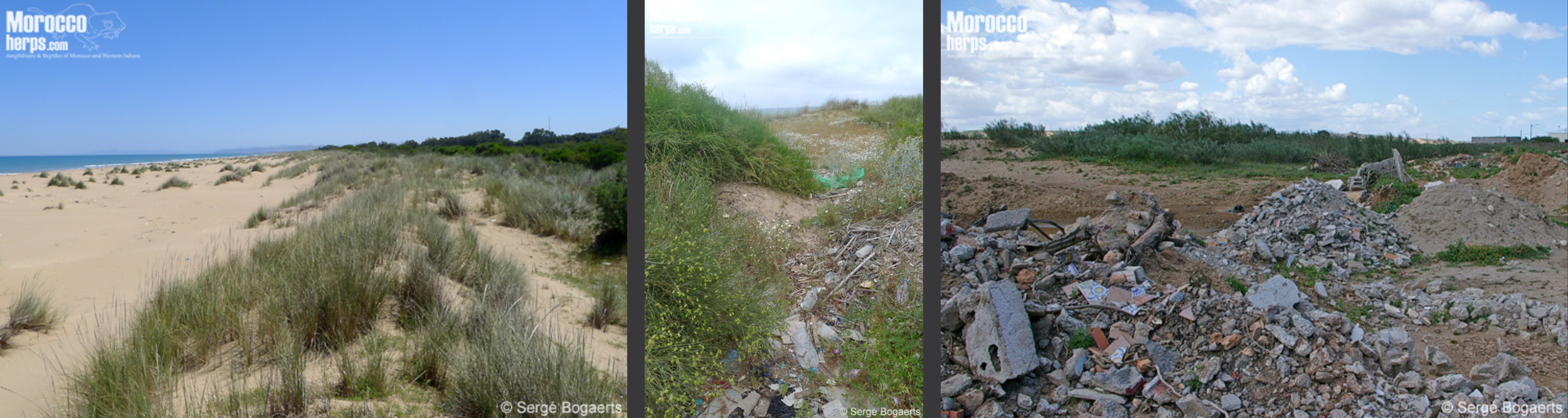
The two-fingered skink’s habitat in Morocco. (© Sergé Bogaerts / Moroccoherps.com)
As coastal dunes contract and compact, the skink’s last bits of refuge are taken as people collect the strewn driftwood to use for fire. During surveys conducted in April 2009 and April 2013 along the Moroccan coast, two-fingered skinks were “found only by turning over rubbish like old clothes, cardboard, plastic etc.” Similarly, in 2020, “the largest numbers [were] found in areas with high accumulations of rubbish.” The species now literally shelters in our refuse.³
———
The two-fingered skink is a species defined by loss. Across evolutionary time, its limbs shrank, and it lost its toes. Across its lifetime it loses the youthful colour of its tail, and, more often than not, it loses its tail entirely. And now it’s losing its habitat to humans and the sea.
The next step — if we fail to protect the skink’s coastal habitat — will be the loss of the entire species.
¹ It’s just a few more steps until you get a snake. In fact, Günther’s cylindrical skink (C. guentheri), in the same genus, has zero digits, because it lost its limbs completely. “Snakes” — limbless lizards — have evolved independently at least 25 times.
² Because they are so difficult to observe, researchers have set up specialised terrariums with deep sand substrates housing small groups of two-fingered skinks for study — this is how they were first confirmed to be viviparous (giving birth to live young).
These captive skinks never became ‘tame,’ however. While some of its relatives, such as Spanish Skink (Chalcides bedriagai), would become “very tame in captivity and would beg for food,” the two-fingered skinks never did, refusing to be fed by hand or even tweezers.
³ The fingered-skink is known to exist in a few protected areas in Morocco and none in Algeria. However, in Algeria, the species itself is protected. How effective that protection is, is another question, given that many of the authorities tasked with enforcing that protection aren’t even trained to recognise the species.
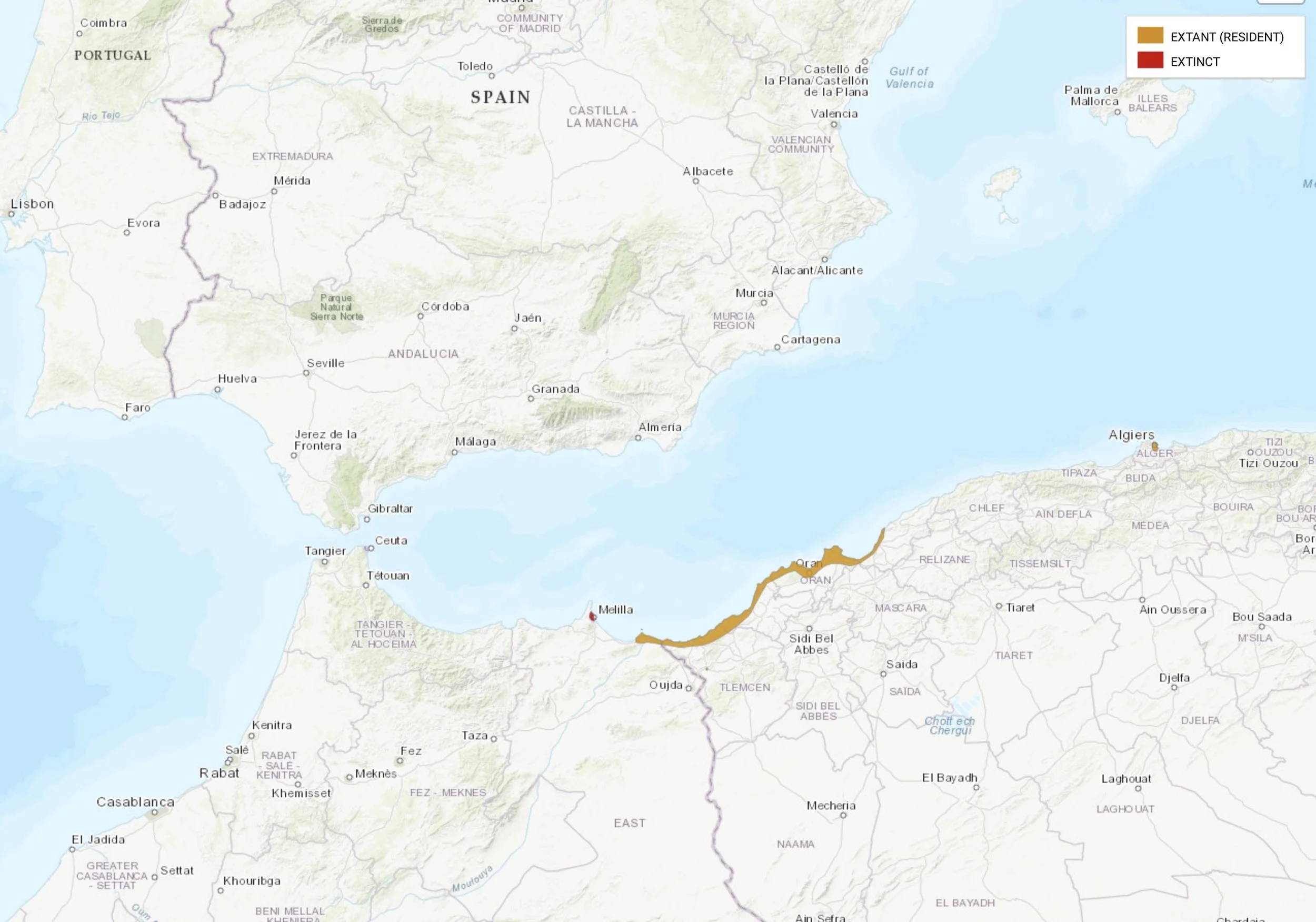
Where Does It Live?
⛰️ Coastal dunes with loose substrate.
📍 North African Mediterranean coast; northwestern Algeria northeastern coastal Morocco, Melilla (Extinct), and Congreso Island in the Chafarinas Islands.

‘Vulnerable’ as of 15 May, 2024.
-
Size // Small
Length // Up to 155 mm in total length (6.1 in)
Weight // 1.6 g - 3.6 g
-
Activity: Likely Diurnal ☀️
Lifestyle: N/A
Lifespan: 10 years (in captivity)
Diet: Carnivore (Insectivore)
Favourite Food: Insect larva 🐛
-
Class: Reptilia
Order: Squamata
Family: Pseudoxyrhophiidae
Genus: Langaha
Species: L. madagascariensis
-
As per its name, the two-fingered skink has only two digits on each of its comically tiny front limbs (and three on its hind). Its lineage diverged from its relatives — ‘grass-swimmers’ like the Italian three-toed skink — around 9.9 million years ago. Other species in its genus (Chalcides), like the Gran Canaria skink, have five digits on each foot, while Günther’s cylindrical skink has no limbs at all.
Native to the sand dunes of the North African coast, the two-fingered skink is incredibly difficult to spot. It spends most of its life swimming beneath the sand, surfacing occasionally to ambush insect prey. Despite this, it remains a frequent target for keen-eyed predators like gulls.
In one study, over 85% of adult skinks in a population had regenerated tails, suggesting that most individuals have survived at least one near-death encounter. This species is known for its hasty autotomy, dropping its tail at the first sign of danger. Juvenile two-fingered skinks even have bright red tails, likely to draw the attention of predators away from their bodies.
This tendency to drop-and-run means that researchers have to be especially careful while handling a two-fingered skink — sexing the adults, which requires carefully examining the cloaca and everting the hemipenis of males, is frequently avoided due to the high risk of stress-induced tail autotomy.
To find these skinks, researchers often flip over beach debris like driftwood, beneath which they can sometimes be found resting. Unfortunately, the skinks are now more likely to be found under human litter: during surveys conducted in April 2009 and April 2013 along the Moroccan coast, two-fingered skinks were “found only by turning over rubbish like old clothes, cardboard, plastic etc.”
As the two-fingered skink’s specific coastal habitat shrinks due to coastal development and rising sea levels, the species’ range is squeezed into a smaller and smaller sliver of coastline. As of the last IUCN assessment in May of 2024, it is a considered a Vulnerable species.
-
Beddek, M. (2025). Chalcides mauritanicus. The IUCN Red List of Threatened Species 2025: e.T61479A137848063. https://dx.doi.org/10.2305/IUCN.UK.2025-2.RLTS.T61479A137848063.en
Bogaerts, S. (2013). Chalcides mauritanicus (Duméril & Bibron, 1839). In G. Martínez, R. León, O. Jiménez-Robles, J. P. González De la Vega, V. Gabari, B. Rebollo, A. Sánchez-Tójar, J. R. Fernández-Cardenete, & J. Gállego (Eds.), Moroccoherps: Amphibians and Reptiles of Morocco and Western Sahara. https://www.moroccoherps.com/en/ficha/Chalcides_mauritanicus/
Bogaerts, S. (2020). Keeping and breeding the Two-fingered skink Chalcides mauritanicus (Duméril & Bibron, 1839), and the first proof of its viviparity. Pod@rcis, 11(1), 17–25.
Boulenger, G. A. (1891). Catalogue of the reptiles and batrachians of Barbary (Morocco, Algeria, Tunesia) based chiefly upon notes and collections made in 1880-1884 by M. Fernand Lataste. Transactions of the Zoological Society of London, 13(3), 93–164.
Čerňanský, A., Syromyatnikova, E. V., Kovalenko, E. S., Podurets, K. M., & Kaloyan, A. A. (2020). The key to understanding the European Miocene Chalcides (Squamata, Scincidae) comes from Asia: The lizards of the East Siberian Tagay locality (Baikal Lake) in Russia. The Anatomical Record, 303(7), 1901–1934. https://doi.org/10.1002/ar.24289
Doumergue, F. (1901). Essai sur la faune erpétologique de l'Oranie : avec des tableaux analytiques et des notions pour la détermination de tous les reptiles & batraciens du Maroc, de l'Algérie et de la Tunisie. L. Fouque.
Duméril, A. M. C., & Bibron, G. (1839). Erpétologie générale, ou, Histoire naturelle complète des reptiles (Vol. 5). Librairie Encyclopédique de Roret.
Martín, J., García-Roa, R., Ortega, J., López, P., Pérez-Cembranos, A., León, A., García, L. V., & Pérez-Mellado, V. (2015). Occurrence and ecological aspects of the two-fingered skink Chalcides mauritanicus in the Chafarinas Islands in North Africa. African Journal of Herpetology, 64(1), 67–79.
Pleguezuelos, J. M., Márquez, R., & Lizana, M. (Eds.). (2002). Atlas y Libro Rojo de los Anfibios y Reptiles de España. Dirección General de la Conservación de la Naturaleza-Asociación Herpetológica Española.
-