The Teardrop White-eye
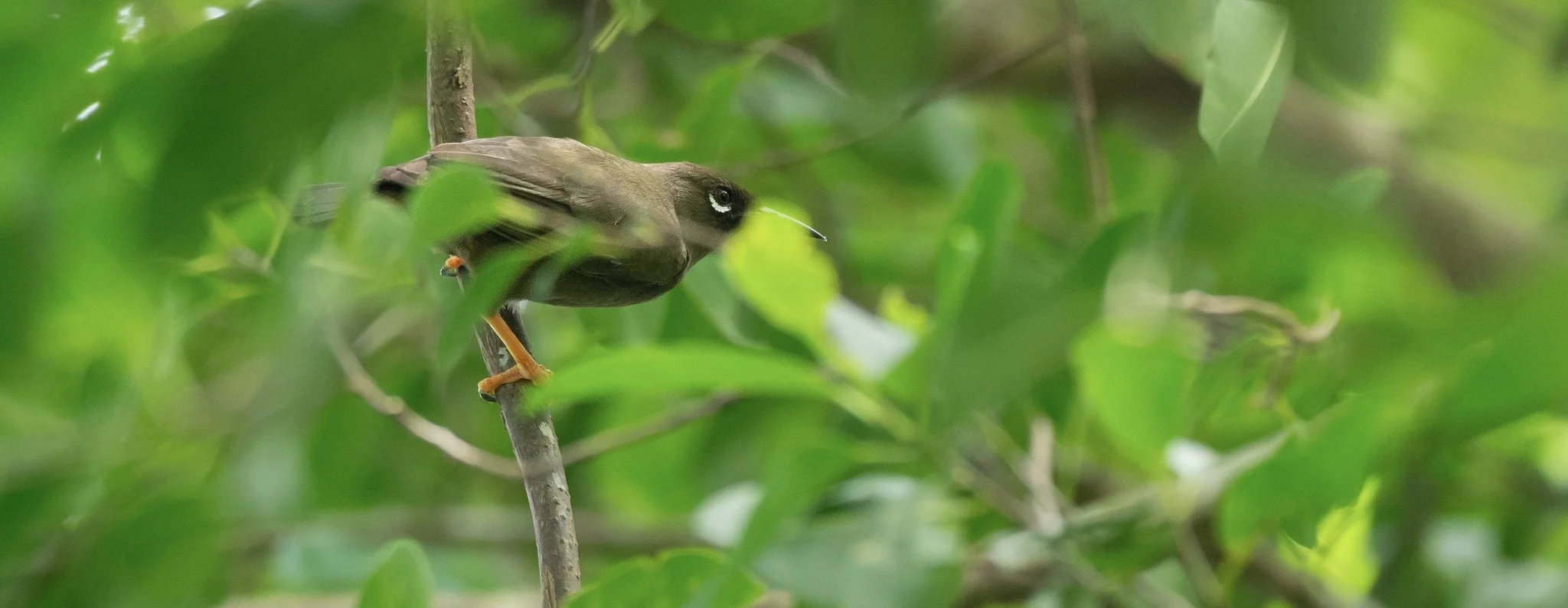
A teardrop white-eye, Rukia ruki. (© Doug Whitman / iNaturalist)
A man stands on a small rock jetty, barring the way.
From a boat just offshore, Peter Kaestner can see a knife in his hand.
“This is not a machete. This is not a work implement,” Kaestner recalls, “This is a killing kind of a knife.”
A few hours earlier, Kaestner and his wife had set out on a charter boat from the island of Weno. Their destination was another island in the same group called Tol, and their goal on Tol was Mount Winipot. On its summit, Kaestner hoped to find a very specific bird.
Mt. Winipot looms above the main village of South Tol. To climb up it from here you’d have to scale an almost vertical face. However, if you could get around the backside, and dock there at a smaller village, you’d have a much gentler climb.
After a couple of hours’ sailing, Kaestner’s charter boat reached South Tol, and the boatman pulled straight into the main village.
“No, no, no, no, we can't climb straight up this cliff,” Kaestner told the boatman, “We have to go around to the back.”
“We can't do that,” the boatman replied. “They'll kill me if we go around there.”
Kaestner had been warned that the villages on opposite sides of Mt. Winipot had a complicated relationship, so he had specifically arranged for a boatman who was not from the main village. Evidently, that’s exactly where the boatman was from.
After a bit of yelling and feigned outrage, the boatman finally relented, and sailed for the smaller village around the backside of the mountain — where they were greeted by a man on a small rock jetty holding a knife.
“I couldn't tell whether he was mad at me or mad at the driver who was from the other village,” recalls Kaestner, “But it was very clear that this guy was not going to let us land.”
A minute or two into this standoff, Kaestner heard a pa-pa-pa-pa-pa-pa-pa. A little boat emerged from the mangroves, carrying a very nicely dressed man. In beautiful English, he asked, “Can I help you?”
“Yes,” said Kaestner, “well, we're trying to climb up to the top of the mountain to see a rare bird.”
“Well, I'm the chief of the village here,” the man replied. “And you certainly can go see it.”
A word from the chief sent the man with the knife retreating to the village, and the next thing they knew, Kaestner and his wife were accompanied by four or five willing guides.
As soon as they stepped ashore, however, the boatman they hired sped off, abandoning them on this side of the mountain with no ride back.
There was no way now but up.
This was the easier route up the mountain, but it was no pleasure stroll. The trail was barely a trail. In places it was so overgrown they had to get down on all fours and crawl beneath the vegetation. They made it about 80 percent of the way up before the guides stopped.
Another group of locals was waiting for them. This group came from the village on the other side, and they had climbed up the steep side of the mountain to meet Kaestner’s group. The boundary between the villages, it turns out, lay somewhere below this side of the summit. So the first group handed Kaestner and his wife over to the second — the exchange was entirely amicable.
And so they continued higher into a forest of poison trees, crossing village borders, climbing this specific mountain on this specific island in the middle of the Pacific, in search of a specific species of bird.
———
An endemic, by definition, is found in one place on Earth, and one place only.
The flightless kākāpō is endemic to New Zealand, the giant panda to China, the axolotl to Mexico.
But there are different levels of endemism. Geographic borders are specified through a series of concentric circles: continent, country, region, province, county, and so on and so forth, becoming increasingly granular. The smaller the circle a species is confined to, the more narrowly endemic it is.
A species found only within the “bullseye” is known as a microendemic.
The teardrop white-eye, Rukia ruki, is endemic to the Western Pacific. Within the Western Pacific it is restricted to Micronesia. Within Micronesia, to the Caroline Islands. Within the Carolines, to Chuuk Atoll. Within Chuuk, only the Faichuk island group.
For most of its history it was known from a single island.
“The people of Tol Island have stories of this bird,” says Marcellus Akapito, executive director of the Chuuk Visitors Bureau. “It is believed that the bird only lodges on Tol, particularly on the highest point at Mount Winipweet [Winipot]” — its bullseye.
Western Pacific
The teardrop white-eye, Rukia ruki, is endemic to the Western Pacific.
———
This white-eye was first described in 1897 by the German ornithologist Ernst Johann Otto Hartert.
The majority of white-eyes belong to the genus Zosterops, a sprawling group of small, yellow-green birds found across Africa, Asia and the Pacific, many of which are difficult to tell apart by appearance alone.
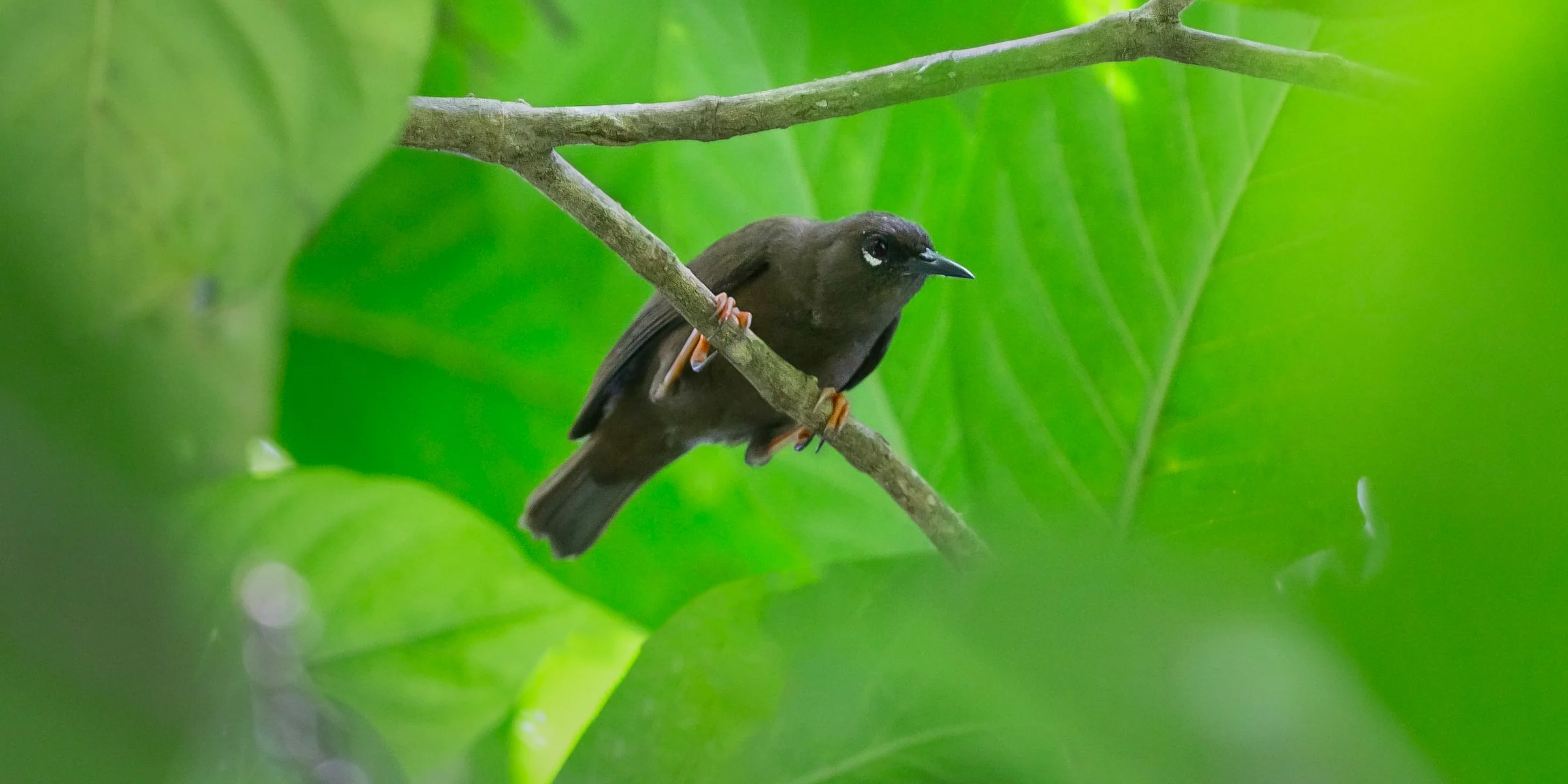
Noticeably larger than its Zosterops cousins, the teardrop white-eye is draped in somber, olive-brown plumage, making its bright orange legs appear almost fluorescent. And unlike most white-eyes — which wear circular spectacles — R. ruki has, beneath each eye, a crescent of white feathers, like permanent teardrops.
Three years after Hartert described the species, he wrote in the journal Novitates Zoologicae, “It is most peculiar that the late J. Kubary, who was an excellent collector, and who spent more than fourteen months on Ruk [Chuuk], did not obtain this bird.”
Johann Kubary was indeed an excellent collector: a pioneering Polish naturalist who spent much of his life exploring the Pacific. During his nearly 30 years in Micronesia, he documented the rare Caroline Islands ground dove and the Pohnpei fantail. But Kubary never found the white-eye of Chuuk.
“It is probably not numerous,” speculated Hartert, “and occurs only on a certain secluded spot not visited by Kubary.”
———
Following its initial description in 1897, the bird went largely unrecorded until the 1980s.
In the forests atop Mt. Winipot, at an elevation of 350 metres (1,150 ft), researchers Pyle and Engbring documented the first, and so far only recorded nest of the teardrop white-eye ever observed by science: a thin-walled cup, finely woven from bark strips, moss filaments, and dried plant fibers. They found it 20 metres above the ground, in a terminal leaf cluster of a Semecarpus kraemeri — also known as a Chuuk poison tree.
Along with figs, these poison trees dominate the upper canopy of Mt. Winipot’s forests. They are named for their highly toxic sap, which causes severe allergic contact dermatitis in humans: painful swelling and blistering skin eruptions. For the white-eyes, however, this caustic canopy serves as a sanctuary.
Deforestation and agroforestry stripped the lower and mid-elevation forests of Tol, but, historically, the toxic forest on Winipot’s summit remained mostly untouched. It is perhaps telling that the teardrop white-eye, at least in part, owes its continued existence to a tree that humans cannot touch.
———
“It’s likely that the tree plays an important role in its survival,” says Mark O’Brien, a conservation ornithologist at BirdLife International. “However, the white-eye occurs elsewhere, where the tree is absent, suggesting the species is not entirely dependent on it.”
When Engbring, Pyle, and their colleagues surveyed these Micronesian islands for birds in 1984, they were surprised to find restricted populations of the teardrop white-eye across all four micro-islands of Faichuk.
But “restricted” is the key word here: they estimated 382 individuals on Tol, 93 on Polle, and just 19 on Onei.
On Paata, the researchers spoke with a group of older residents who were familiar with the bird — which was known to them as the Nimesounupwin. They told them that the species was normally spotted in small flocks, but had become difficult to find following a severe drought that occurred the year before. Researchers counted 32 birds on the island, all in a single flock in a single moist valley.
Those same 1984 surveys estimated that the white-eye’s total known range was only about one square kilometre — less than a third the size of Central Park.
There are records of the teardrop white-eye surviving beyond the summit of Mt. Winipot, just barely, within some native-plantation forests. The species likely once ranged more widely across Tol and Faichuk as a whole.
———
Species can become more narrowly endemic. They can move, or more often be forced into increasingly small circles of distribution — their range collapsing into microendemism. This can happen on land or water, on islands or continents. It can be driven by natural causes, like a climatic shift, and decidedly unnatural ones.
Take the axolotl as an example.
Wild axolotl populations were historically found throughout the interconnected lakes south of Mexico City. As the city swelled, however, those lakes were gradually swallowed up, until this unique amphibian could only be found in Lake Chalco and Xochimilco. Then those lakes were drained to reduce flooding; Chalco all but dried up, leaving the axolotl restricted to the remnants of Lake Xochimilco. The axolotl collapsed into smaller and smaller rings of the concentric circle. It is, today, a microendemic.
And it is by no means unique. Our modern world is full of microendemics.
The Hainan gibbon, endemic to one national park on its namesake island. The Galápagos pink land iguana, endemic to the slopes of an active volcano on the Galápagos island of Isabela. The Devils Hole pupfish, endemic to a single, sizzling pool in Nevada’s Death Valley.
Whether or not they live on a literal island, every microendemic is an insular species — isolated within a lake encircled by a rising city-sea, or on a forested mountaintop above the rising tideline of human habitation.
———
The Chuuk poison tree, only found atop Mount Winipot, is itself a microendemic. Historically, it has been protected from exploitation by its own toxicity, and, in turn, it appears to have protected the teardrop white-eye.
However, as the human population grew on Tol, and as more and more land was needed, these trees began to be cut down. The toxicity that once protected the Chuuk poison tree, ironically, made it a nuisance that is best rid of.
There seem to be no formal protected areas or targeted conservation actions currently in place for the forests of Winipot, or the poison tree. “I had been involved in conservation planning in other parts of Faichuk, the region that includes the island of Tol,” says Akapito. “Conserving the tree might be possible, but it will be a huge challenge.”
The teardrop white-eye needs rich, old-growth stands of native forest to survive, wrote Engbring and colleagues in their 1990 report. “This habitat is virtually gone from Chuuk. Even on Mt Winipot, large native trees at 350 metres above sea level on the southern slope, have been girdled and burned and agricultural crops subsequently planted.”
But if the tree is endemic to Winipot, what has protected the teardrop white-eye on the other Faichuk Islands? What protects it now? Does it even survive outside Tol?
“Other Chuuk islands are not aware of this species,” says Akapito. “We do not even know the local name for it.”
According to the most recent assessment by the IUCN Red List, sites where the teardrop white-eye was previously found haven’t yielded any recent detections. No calls were detected during acoustic surveys on Onei in 2022. Other sites haven’t been searched at all since the 1984 bird surveys.
“Indeed there are few/no records for either Onei or Paata on eBird for any species,” says O’Brien, “let alone the Teardrop White-eye.” There is a single record of the teardrop white-eye on Paata from 2007, and nothing on Onei.
Even on Tol, recent information has been hard to come by. Because the last IUCN assessment took place during the COVID-19 lockdowns, O’Brien had to rely on people already on Chuuk to try to place acoustic recorders at the same locations surveyed in 1984.
“They failed to get permission to put any recorders anywhere on Faichuk,” says O’Brien. “The local communities just point-blank refused…The fieldworkers never managed to get anywhere near Mt Winipot.”
“The mountain is a very controversial place,” says Akapito, “as many families claim ownership of Mount Winipweet.”
O’Brien’s fieldworkers were not the first to struggle in reaching the teardrop white-eye. Peter Kaestner had discovered how difficult it could be less than two years earlier.
After the misunderstanding with the boatman, being threatened with a knife, and scrambling up the mountain on all fours, Kaestner finally reached the summit of Mt. Winipot. There, he quickly spotted a pair of teardrop white-eyes and snapped a couple of photos.
With no way back by boat, Kaestner and his wife had to descend the mountain’s steep side. In places, there were hundred-metre cliff faces so vertical that they had to use ropes to climb down to the main village.
“We were able to get down and, of course, the boatman is there to greet us,” says Kaestner, “because we're in his village and everything was happy.”
The whole ordeal seemed absurdly large for a single, little bird with such a tiny range.
———
A species limited to one country, one archipelago, one atoll, one island group, found exclusively on one island, endemic to a single summit. Eventually the confines of the circle become so small that a single drought, disease outbreak, or new invasive species is enough to turn local extinction — on Onei, Paata, and Polle — into global extinction, if that last population blinks out on Tol.
The range of a species is a dynamic thing. Over time, it can shift, shrink, and sometimes grow again.
In fact, most species are “born” as endemics — known as neoendemics. They begin as populations evolving in isolation, before spreading further afield; expanding outwards through the concentric circles of geography. Even the most widespread of species today — the house sparrow, the red fox — began on an “island.”
Ours was somewhere in East Africa. Go back some 300,000 years and you might find Homo sapiens as an incipient species, a neoendemic, living across a small swath of savannah. From our bullseye, we expanded into greater and greater circles of distribution, until we conquered the globe.
So the bullseye is where a species begins and where it, eventually, ends. The real question, then, is when and how?
———
Since Peter Kaestner saw the teardrop white-eye in 2018, more and more observations have been added to eBird and iNaturalist. “I’ve been contacted by four or five people since,” he says, all looking for information on how to see the bird themselves.
There have been sightings of the species in 2019, 2023, and 2024. The most recent observation, as of writing, was in June of 2026.
Adrian Burke, Jory Teltser, and Sébastien Pitot posted a joint list to eBird from their journey into the Tol old growth forest — “well below the summit of Winipot,” they noted.
Two local guides with machetes cleared a path through the Japanese knotweed and other invasive plants that clogged the lowlands. But soon the tangled understory gave way to old-growth, primary rainforest dominated by massive trees.
The guides played a brief recording of the bird’s melodic song, and several inquisitive white-eyes, with dark olive-brown plumage and white “teardrops” beneath their eyes, appeared in the branches above them.
“They behaved much like spiderhunters of Southeast Asia,” Teltser recalls, “creeping along thin vines and branches searching for insects. They were often vocal and would fly around us from tree to tree, occasionally stopping to preen and socialize with one another. It was particularly special to watch a group of 4 individuals flying all around us, singing and calling amongst these massive trees.”
———
An endemic, by definition, is found in one place on Earth, and one place only. But there are levels to endemism: a series of concentric circles that can shrink and grow over time.
We know the teardrop white-eye once lived on four of the Faichuk islands. We know it survives on Tol — around Winipot, in the old-growth forest below the summit.
We don’t know whether the teardrop white-eye still persists beyond Tol.
We don’t know how far its bullseye has shrunk on Tol.
More than a century after Johann Kubary failed to find this bird on Chuuk, researchers are still struggling to reach the places where it might live.
And yet, the teardrop white-eye seems to be enjoying more attention today than it has in a long while. People are going out looking for it, and they are finding it, even if only on Tol.
“Pictures do not do this bird justice,” says Teltser. “Seeing them in person made them feel so much less like a white-eye. There are so many species of small, yellowish white-eyes in the world, and this species felt so unique and specially adapted to this remnant habitat atop this mountain.”
Species Featured
Hello, World!