A Web of Evidence
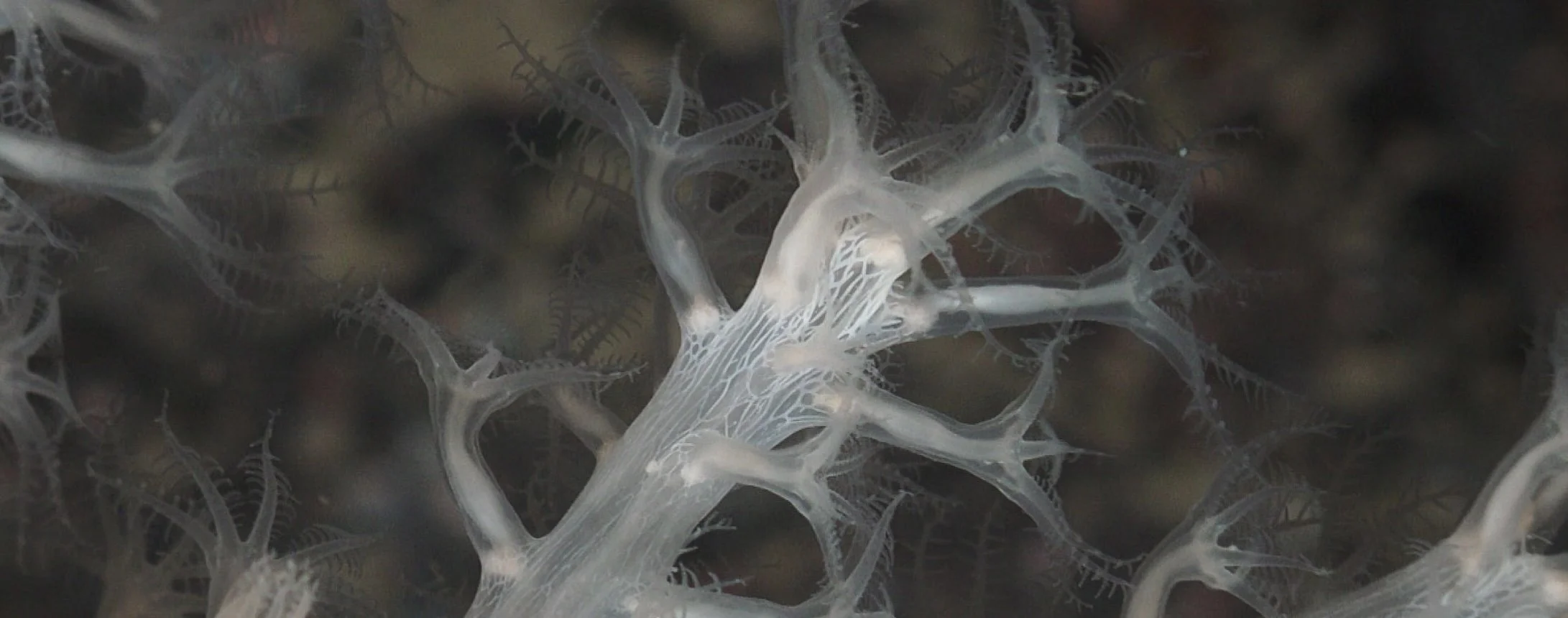
Within the frigid waters off Fiordland, southwestern New Zealand, a remotely operated submersible stretches its robotic arm towards a vertical rock-face. Illuminated by its beams of light is a translucent life form, ghost-white and tree-like, and appearing to be covered in spider-webs.
More than 200 metres above, on the water’s surface, a research team led by Severin Korfhage monitors the submersible’s live feed, guessing at the identity of this creature.
It is an octocoral, that much is clear — its arborescent structure built by countless little anemone-like polyps, each with eight tiny tentacles. But there are over 3,500 known octocoral species, and likely many more unknown. To what family does this one belong, to what genus?
“In general,” says Korfhage, “very few octocorals can be reliably identified to species level during an ROV dive.”
With its manipulator arm, the submersible gently grabs the coral, removes it from its rooted spot, and places it into its collection box before beginning its ascent back to the ship.
“I was very excited and could hardly wait to carry out the first morphological and molecular analyses,” says Korfhage.
———
The research team also discovered a second specimen of this unidentified coral. When they opened the collection box, they found an unexpected passenger: a deep-sea squat lobster sheltering among its branches.
This species of squat lobster, Uroptychus tomentosus, was described back in 1974. The paper detailed a carapace “slightly broader than long,” a rostrum “triangular in shape,” and a body “thickly covered with fine setae” — accompanied by hand-drawn, black-and-white illustrations of its various body parts.
Over the past fifty years, the process of describing a new species has both stayed remarkably consistent and changed radically.
The late 1960s was a period of intense debate for taxonomy, as different schools argued how best to discern relationships between animals. Despite the varying methods each school advocated for, they all shared a single foundation: morphology. To describe an animal, you had to know the minutest details of its anatomy — from scale patterns and dental formulas to bone density, limb proportions, and, very often, the precise appearance of its genitalia.
Then came the genetic revolution, and with it, a new way of describing life.
This was taxonomy’s sleek, digital revolution: pristine labs and neat vials, rather than dusty museums and jars of bodies. Far from just an aesthetic update, this revolution was, well, undeniably revolutionary.
Morphology, it is well known, can be misleading. And few groups exemplify that better than crustaceans. Take our deep-sea squat lobster, for instance. It is actually a closer relative of hermit and mole crabs, rather than “true” lobsters. Conversely, porcelain crabs, which very much resemble “true” crabs in their shape, are, in fact, squat lobsters.
An animal’s shape — its parts external and internal — diverges and converges based on what works in its environment. Its physical form is under constant selection pressure. Much of its genetic code, however, is free from such direct pressure. These stretches can accumulate changes without dramatically altering the animal’s form, leaving behind a record of changes unique to a particular lineage.
Molecular taxonomy was not without its skeptics, of course. It was new, and very different. Carl Woese, whose work was essential in turning genetic sequences into evidence for organising life, once lamented: “I point at the moon and they focus on my finger.”
Many taxonomists were so preoccupied with how unfamiliar these tools and methods were, how detached the molecular code seemed from the animal itself, that they missed what it could show them about the evolutionary structure of life. But, eventually, they would look up and see the moon.
———
By the 1990s, genetic data were being used regularly to describe new species. New ways of using those data, new methods were popping up here and there. One of them was DNA barcoding.
While there is a complex process involved in pulling pure DNA from tissue, and complicated mathematical models used to sort and interpret that code, the underlying concept of DNA barcoding is actually quite simple.
Genetic barcoding doesn't require knowing an organism's entire genome. Instead, scientists use a specific short snippet of DNA that tends to change quickly enough to reveal differences between closely related species, yet remains stable within a single species.
Many of these kinds of genes are found in mitochondrial DNA (mtDNA).
Billions of years ago, mitochondria are thought to have been free-living bacteria that were engulfed by another cell. Rather than being digested, they settled in and became essential components of their host cells. They still carry their own small genomes, however, separate from the rest of the genome — from the nuclear DNA (nDNA) — to this day.
That peculiar history has made mtDNA particularly useful for barcoding. It is passed down as a single, unbroken block from mother to offspring and, in most animal groups, happens to evolve five to ten times faster than typical nDNA.
One mtDNA snippet that is widely used to barcode animals is ‘cytochrome c oxidase subunit I’ — mercifully shortened to COI. In most animals, the complete gene is around 1,500 to 1,550 base pairs (As, Ts, Cs, and Gs) long, but standard DNA barcoding uses a partial segment of just 650 base pairs.
What you do is acquire a COI snippet from a specimen, align the sequences so their corresponding positions match up, then compare that sequence to the COI snippets of known species stored in databases like GenBank — enormous digital libraries containing genetic sequences from organisms around the world. Then, comparing the similarities and differences between those sequences, an algorithm creates a most-likely tree of relationships, or a phylogeny.
To identify the new coral specimen, Korfhage and his team looked at a different marker: mtMutS.
Like COI, it is also found in mitochondria, and at nearly 3,000 base pairs long, it is unusually massive (occupying around 16% of an octocoral’s entire mitochondrial genome). It is also completely exclusive to octocorals — you won't find this odd gene in any other group across the entire animal kingdom.
When they sequenced the mtMutS gene of their cold-water specimen from Fiordland, and compared it to the snippets stored in GenBank, they found that it matched the mtMutS sequence of another species perfectly: Aquaumbra klapferi, an octocoral from the tropical waters of Costa Rica.
In other words, according to the mtMutS gene, these two species — inhabiting completely different environments and separated by more than 11,000 kilometres (6,800 miles) of ocean — were identical.
———
A key aspect of DNA barcoding is identifying the right markers to use. It’s not uncommon for one marker to indicate one relationship, while another indicates a different one. COI has proven effective across much of the animal kingdom, but the kingdom is large and varied. Different animal groups, and different parts of their genomes, evolve at dramatically different rates.
The mitochondrial genomes of those sac-like marine animals known as sea squirts, for example, evolve at a rate of about 50% faster than those of vertebrates like humans (and the mtDNA of one species of sea squirt, Oikopleura dioica, evolves at a rate twice as fast as that).
Octocorals sit at the opposite extreme. Their mitochondrial genomes evolve at an extraordinarily slow rate: some 50 to 100 times slower than those of most other animal groups. The rates at which their mitochondrial and nuclear DNA evolves are essentially flipped: while, in most animals, mtDNA evolves faster than nDNA, octocoral mtDNA evolves up to five times slower than their nDNA.
What could have caused such a reversal?
The answer seems to be mtMutS.
Every animal genome has ways of repairing mistakes that occur in their DNA during replication, preventing mutations from piling up (most mutations aren’t beneficial, after all). Of course, these repair mechanisms occasionally fail, and a mutation is retained and passed on to the next generation — thus introducing genetic variation, and making evolution possible.
mtMutS is an extremely meticulous version of those normal repair genes. It acts like an aggressive autocorrect for an octocoral’s mitochondrial genome, going around and correcting the “mistakes” — the mutations — in the code. The effect is that the code, the octocoral mtDNA, remains remarkably stable across millions of years.
Why would octocorals evolve such a fastidious repair gene in the first place?
“‘Why’ questions about evolution are hard to answer,” says Dr. Cathy McFadden, a leading expert on the evolution and genetics of octocorals. “Presumably they evolved stable, slow-mutating genomes because they fortuitously gained the mtMutS gene.”
And how does an organism gain such a gene?
“Apparently it got into the octocoral mitochondrial genome via horizontal gene transfer from a giant virus,” says McFadden. In other words, the mtMutS gene likely originated in a giant virus (or possibly bacteria) and, around 470 million years ago, became integrated into the mtDNA of the octocoral common ancestor.
In octocorals, then, it seems we have a case of an alien organelle (the mitochondria) incorporating an alien gene (mtMutS). To this day, it remains the only recorded instance of a foreign gene being successfully integrated into an animal’s mitochondrial genome.
The mtMutS gene was then passed along from the octocoral ancestor to all of its descendents. Its persistence is even more unusual given that DNA repair mechanisms are generally quite reduced in mitochondrial genomes. If mtMutS has survived in octocoral mitochondria for roughly 470 million years, it presumably provides some substantial advantage.
“The benefits of having this repair mechanism are probably that beneficial protein sequences that confer high fitness don't get disrupted/corrupted by deleterious mutations,” explains McFadden. “The flip side is that mutations that could be advantageous and further increase the organism's fitness may have a lower chance of persisting because they will be “corrected” along with the deleterious mutations.”
In other words, existing beneficial mutations may be more readily retained, but new mutations that could further increase the coral’s fitness may be erased by this “super spellchecker” gene.
So that’s what mtMutS might mean for an octocoral, but what did this alien gene mean for Korfhage and his team?
Well, its spellchecking qualities prevent the parts of the genome most useful for distinguishing species — the mtDNA — from fulfilling that role. At the same time, the mtMutS gene appears to be a kind of sponge for the mutations it corrects, accruing changes much faster than the rest of the mitochondrial genome it manages — a bit like how the only barber in town might have his own hair long and unkempt. The gene that prevents an octocoral’s mtDNA from mutating, itself mutates the fastest.
Korfhage and his team knew this. That’s why they used the mtMutS marker in the first place (instead of a standard mtDNA marker like COI). But even this more sensitive marker couldn't distinguish this new specimen from a species an ocean away.
Perhaps they really are the same species, distributed widely across the globe — just two disjunct populations.
One DNA snippet wasn’t enough to tell. So the research team used a marker called 28S rDNA, located in the nuclear, rather than mitochondrial DNA. While mtMutS showed no differences between the New Zealand specimen and the tropical Aquaumbra klapferi, the 28S rDNA analysis did: three base-pair substitutions.
Were these indeed separate species after all?
Well, the entire 28S rDNA gene marker was 738 base pairs long. A difference of three base pairs means that 99.6% of the genetic code in the snippets were identical between the New Zealand and Costa Rican corals. So a difference, but no more than a hint.
“The small number of base substitutions may suggest that these are relatively young species,” explains Korfhage. This New Zealand coral and A. klapferi may have diverged from one another somewhat recently.
But this was hardly enough data to prove that. While three differences are more than zero, it still placed the New Zealand and tropical specimens into a nearly indistinguishable cluster on the phylogenetic tree.
———
Octocorals aren’t the only animals with “difficult” genomes.
Hexacorals, the sister group to octocorals, share some of the same genomic conservatism. While they don’t have the mtMutS gene in their mitochondria, hexacorals possess a different repair gene in their nucleus which happens to correct their mitochondrial DNA. Because of their slow evolution, up to 40% of closely related species in some stony coral groups share identical COI barcodes.
Certain sea squirts present the opposite problem. Because species accumulate mutations so rapidly, their DNA sequences can quickly lose resemblance to those of their closest relatives. Some groups, like the record-holding Oikopleura, have extremely plastic genomes that are described as “almost randomly scrambled.”
Genomes like those of the hexocorals create false closeness: distantly related species end up appearing identical. While those like the sea squirts create false distances: close relatives end up appearing unrelated. With groups like these, standard genetic techniques rarely work. What, then, can be done?
“While genetic methods can be used to determine how often and how much genetic exchange occurs between populations,” says McFadden, “I think it will always be necessary to at least consider morphology when defining species.”
To prove the Fiordland specimen was truly distinct from its tropical doppelgänger, Korfhage and his team turned to morphology. But they were no longer relying on hand-drawn, black-and-white sketches.
They dissected the coral specimen’s flesh to isolate its sclerites — microscopic, mineralised structures embedded in the tissue that provide structural support for soft corals — and inspected them using a scanning electron microscope.
Unlike Aquaumbra klapferi, whose sclerites were smooth or lightly textured, those of the New Zealand coral were highly irregular and densely covered in prominent, cone-shaped bumps.
Under the electron microscope, there was no mistaking one species for the other.
———
Relying solely on visible, physical structures — even microscopic ones — tends to impose a human sensory bias on nature.
“We happen to be very visual so we try to define other species based on differences we can see in their morphology,” explains McFadden. “But that's not how they distinguish one another. Different species don't owe it to us to look different if they can tell each other apart via sensory systems we can't access!”
Just because two organisms look identical to us doesn't mean they belong to the same lineage — they could be a result of convergent evolution, for instance, as seen in various “crabs” and “lobsters.” Conversely, just because their morphology or DNA differs doesn't mean they stop recognising each other as mates. Morphological and molecular features are ultimately just proxies: imperfect evidence of the real boundaries that organisms keep between themselves.
Whether chemical, auditory, or behavioral, the mechanisms that enforce reproductive isolation are the ultimate enforcers of boundaries. And boundaries are what make species.
Take the Mediterranean freshwater amphipod Echinogammarus sicilianus.
Standard COI barcoding initially suggested E. sicilianus was a complex of twelve distinct cryptic species — that is, species that are difficult or impossible to tell apart by appearance alone. Genetic distances between them reached a massive 20.3%, well over the threshold which would indicate full specieshood.
But when researchers observed mating pairs in the wild, they saw individuals from supposedly distinct genetic lineages intermixing freely, with 38% of guarding pairs consisting of partners from different COI groups. The animals themselves did not recognize the boundaries that existed between them, at least according to their mitochondrial DNA. Whatever methods these amphipods used to recognise their mates, observing their behaviour revealed something the COI data had missed, prompting the researchers to look again — deeper, or rather, more broadly this time.
To resolve the discrepancy between the behavioural and COI evidence, scientists deployed a technique known as ‘ddRAD-seq,’ which scans thousands of regions across the nuclear genome (the nDNA).
The nDNA data supported the view suggested by the amphipods breeding behaviour: ten of those twelve mitochondrial lineages were actively exchanging genes. In other words, they seemed to be one species. The deep COI splits were likely just ghosts of ancient geographic isolation lingering in the mitochondrial genome long after the populations had reunited. Relying on single-marker DNA alone would have artificially multiplied what appear to be just three cryptic species into twelve.
But just as morphological analysis has greatly advanced, molecular analysis never stopped evolving.
Created in 2012, the ddRAD-seq used on E. sicilianus is just one example of a new technique. Where full genome sequencing is reading an entire 1,000-page book, and standard barcoding is reading just one sentence on a particular page, ddRAD-seq uses molecular scissors (restriction enzymes) to snip out and sequence thousands of evenly spaced snapshots across the whole text.
“Methods that synthesize information from many different genes located throughout the genome are currently producing the most well-supported trees,” explains McFadden.
This approach is known as phylogenomics. Allowing researchers to look beyond the limitations of any single genetic marker, it is perhaps the most significant leap in identifying notoriously difficult groups.
———
No matter how advanced the tools become — whether new molecular techniques or more powerful microscopes — they are, in the end, just tools. They are the fingers pointing at the moon, not the moon itself. Each one gives us a different way of seeing the evolutionary relationships we are trying to reconstruct, while at the same time, limiting what we can see.
And because every method and tool has its blind spots, no single strand of evidence is ever as strong as the web woven from them all.
“The aim of modern species descriptions is for morphological and molecular methods to complement one another,” says Korfhage. This is the essence of integrative taxonomy.
An organism’s identity isn’t contained in one feature or one gene, any more than the coral’s structure is contained in a single branch or an eight-armed polyp. It’s not morphology versus molecules, it’s morphology and molecules. It is also geography, behaviour, and ecology.
It took connecting a whole web of evidence — a slight difference in the 28S rDNA marker, a great geographic distance, varying sclerite shapes — to describe this new “spider-webbed” specimen as a new species: Aquaumbra aranea sp. nov.