Madagascar to Sweden to France: A New Species of Hooktail Dragonfly
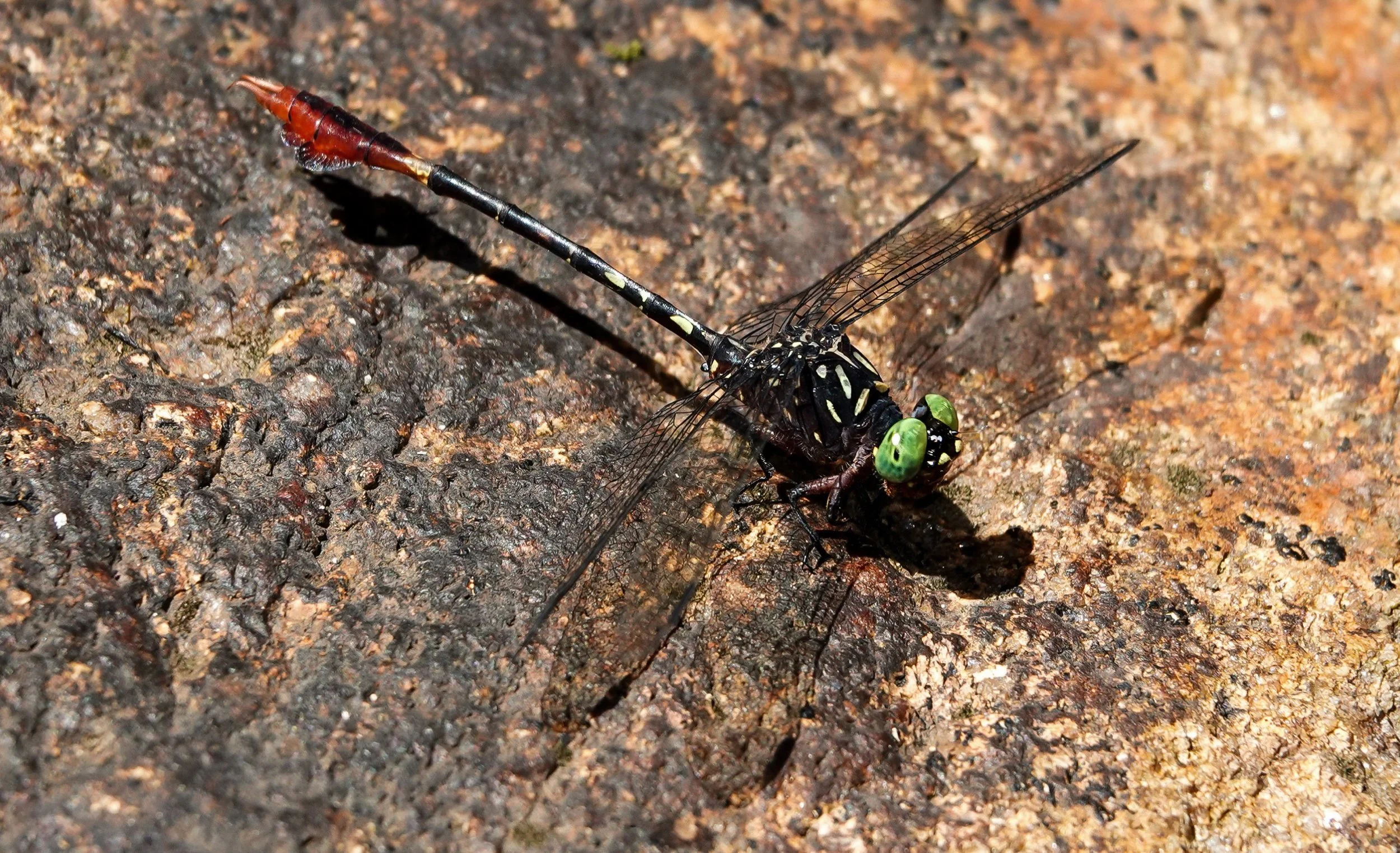
Paragomphus matroka, the dark hooktail, is known from three specimens: one caught in the wild, one found on the internet, and one unearthed in a museum archive.
Bedjanič, M., Bernard, R., Daraż, B. & Yu, K.-P. (2026) Paragomphus matroka sp. nov.—a new Hooktail species from the rainforests of eastern Madagascar (Odonata: Gomphidae). Zootaxa, 5821 (2), 219–235. https://doi.org/10.11646/zootaxa.5821.2.4
Madagascar
180 species. That is how many damsel- and dragonflies have been discovered in Madagascar, that island “paradise for biologists.”
Within Tsitongambarika Natural Resources Reserve, up a small, unnamed tributary of the Ampasy River, tucked away some 700 metres (~2,300 ft) northwest of the Ampasy Research Station, a Slovenian research team spot a dragonfly.
Fully 80% of those 180 Malagasy species are found nowhere else on Earth.
This one sits alone on a large, sunlit boulder, just above the water's surface. His hooked tail angles upwards, his eyes are bright grass-green, his body somber black marked with yellow. He takes off, and the researchers watch him patrol up and down a 20-to-30-meter stretch of shallow, crystal-clear river. They watch his “fairly rapid” flight through the shifting mosaic of light filtering down through the rainforest canopy. Then they catch him.
It is the 4th of December, 2024, the start of the hot and wet summer season in southeastern Madagascar. The researchers are in the field as part of a broader scientific expedition named the “Continuous Contribution to Understanding the Spider and Dragonfly Diversity in Madagascar,”¹ and now, with the dark, green-eyed hooktail in hand, they are tentatively confident that they’ve just discovered new dragonfly diversity in Madagascar. A number 181.
Sweden
On November 17, 2025, a user named arvid_dejong on the citizen science platform iNaturalist posted an observation of a dragonfly they’d seen earlier that year in Masoala National Park, in northeastern Madagascar.
Two other users, evidently well-versed in dragonflies, took notice of the unidentified observation, commenting: “Wow, what a cool species! This must be new to science, but related to P. fritillarius,” and “Indeed a new species. No description available.”
In the observation photo, the dragonfly is seen lying in a person’s hands, its body exceptionally dark, with jade-green eyes, and a scaly-looking hooked tail.
“Did you preserve the specimen?” the first commenter asked.
———
The Slovenian team had found only that single male individual on their expedition. And that single specimen would likely not have been enough for “conclusive determination” of a new species. So they turned to the internet.
With over 300 million observations posted by its 4 million+ registered users (as of May 2026), iNaturalist was the obvious place to look.² The researchers systematically searched through dragonfly observations, and found three that potentially matched their specimen.
One of them, posted in 2020 by user angelomg, was recorded just 22 kilometers (13.7 mi) northwest of where the Slovenian team found their original holotype. Another, posted more than two years earlier by ethankistler, was located farther up the coast in central-eastern Madagascar. But while both insects looked "strikingly similar" to the holotype, neither user had collected the dragonflies as specimens.
Then the researchers came upon arvid_dejong’s post.
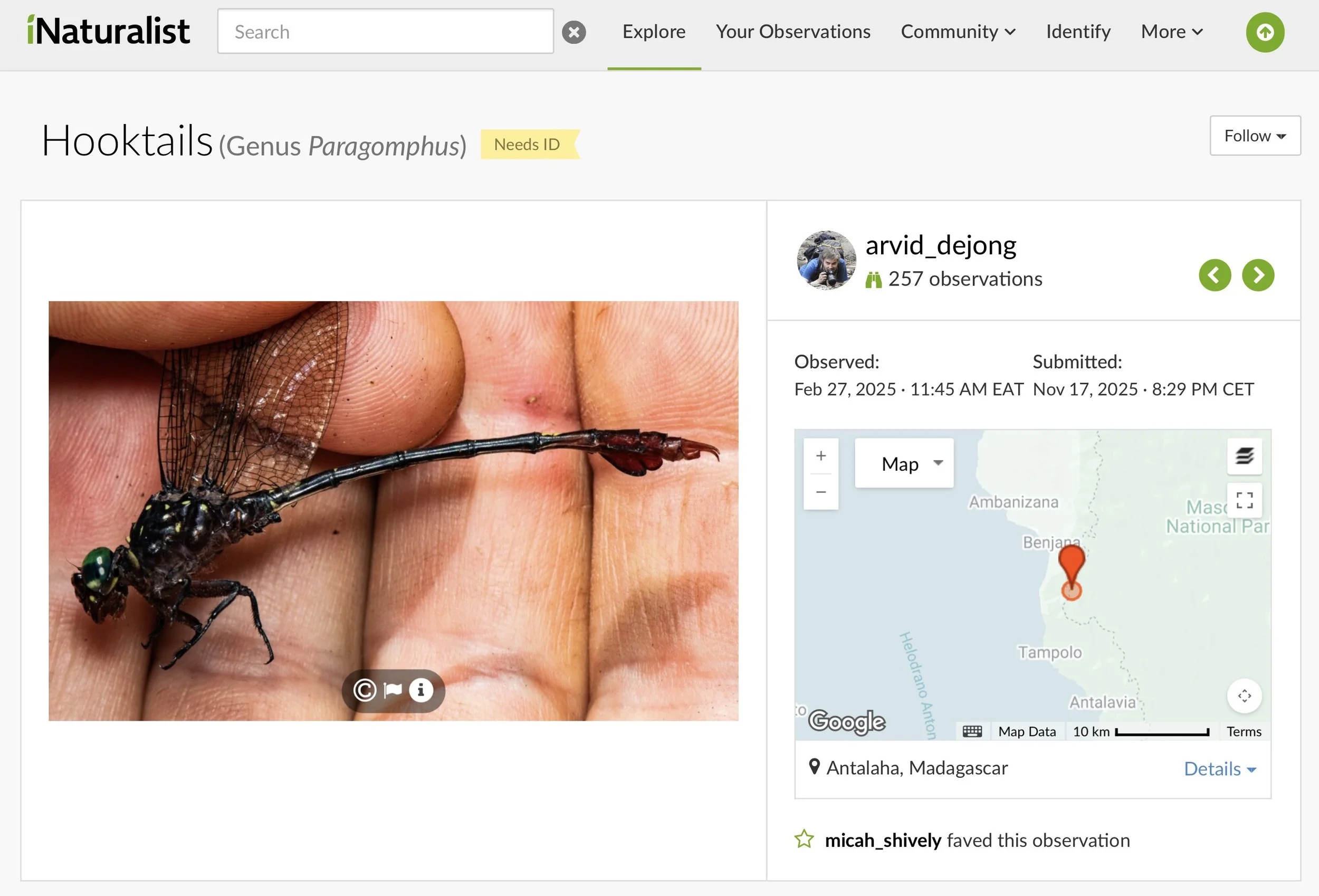
Arvid de Jong’s (arvid_dejong) observation of an unidentified Paragomphus dragonfly in northeastern Madagascar.
This unidentified dragonfly certainly looked like it could be the same species — its exoskeleton even darker than the original specimen. Without examining it in person, however, the researchers couldn’t be sure.
Fortunately, arvid_dejong did preserve their specimen. In fact, they had brought it to Sweden, where they gave it to the Swedish Museum of Natural History (Naturhistoriska Museet) in Stockholm. The museum's senior curator sent the researchers detailed photographs of its diagnostic features, allowing them to examine the insect up close, from afar. Inspecting its genitalia — a common way to tell insect species apart — they found the structure nearly identical to that of the holotype found in southeastern Madagascar.
If this was indeed the same species, as it seemed to be, its range had just expanded to cover a massive 1,033-kilometre (642-mi) stretch of Madagascar’s eastern coast.
France
But there was a larger problem, less to do with this specific species and more with the taxonomic state of its relatives.
This new species clearly belonged to the Paragomphus genus — closely related to its island neighbour Paragomphus fritillarius, the spotted hooktail, as one of the commenters on the iNaturalist post suggested. But the original historical descriptions and literature for the Paragomphus genus in Madagascar were incomplete. In some instances, historical illustrations appear to have been conflated, contributing to “persistent taxonomic confusion,” and ultimately delaying scientists from recognizing new taxa in the genus.
Taxonomy, even such specific taxonomy as a genus of dragonflies, is an inherently cooperative enterprise, across both time and space.
It was only when two Polish researchers, Bernard and Daraż, published new, detailed figures of P. fritillariusin February of 2026, that all the necessary taxonomic tools were finally available to describe the new species.
———
That very same month, Bernard and Daraż visited the Muséum national d’Histoire naturelle in Paris.
While sifting through the vast entomological archives, inspecting the museum's collection of Paragomphus dragonflies that they’d just worked on, they found a single Madagascan specimen of an undescribed species. Its body was “warm and ferrugineus-brown,” with yellow markings that were “hardly recognisable," its eyes a light ochre.
Was this a third specimen of the new hooktail species?
This particular specimen, it turned out, was over 25 years old, collected by the late French odonatologist Jean Legrand back in 1999 and housed in the museum's collections since.
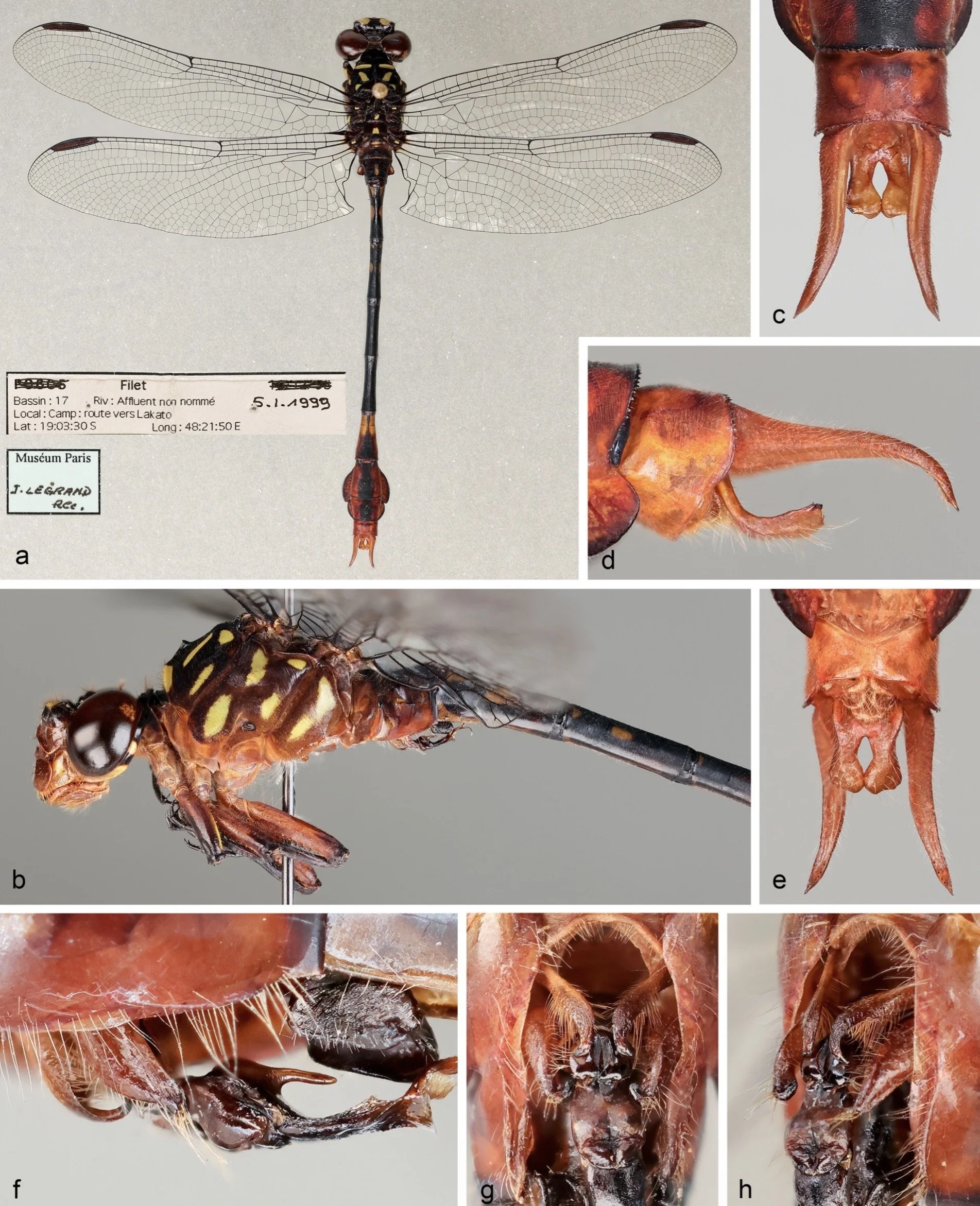
Photographs of the 1999 specimen from Muséum national d’Histoire naturelle in Paris. Collected by Jean Legrand. Photographs by Bogusław Daraż.
Its dark exoskeleton and bright eyes might have faded over time — indeed, the specimens from 2024 and 2025 completely lost their green eyes upon death. Its collection site was also noted as central-eastern Madagascar, near one of the unconfirmed iNaturalist observations, and about halfway between the other sites where the two confirmed specimens were found. If this was indeed another specimen, it would bridge the range of this new species.
The Polish researchers contacted the Slovenian team, and they began an “intensive information exchange”: comparing notes, sharing photographs, and matching measurements.
They concluded that they “were most likely dealing with the same species,” which had now been found three times, across three countries, in three different ways, by people of at least six different nationalities.
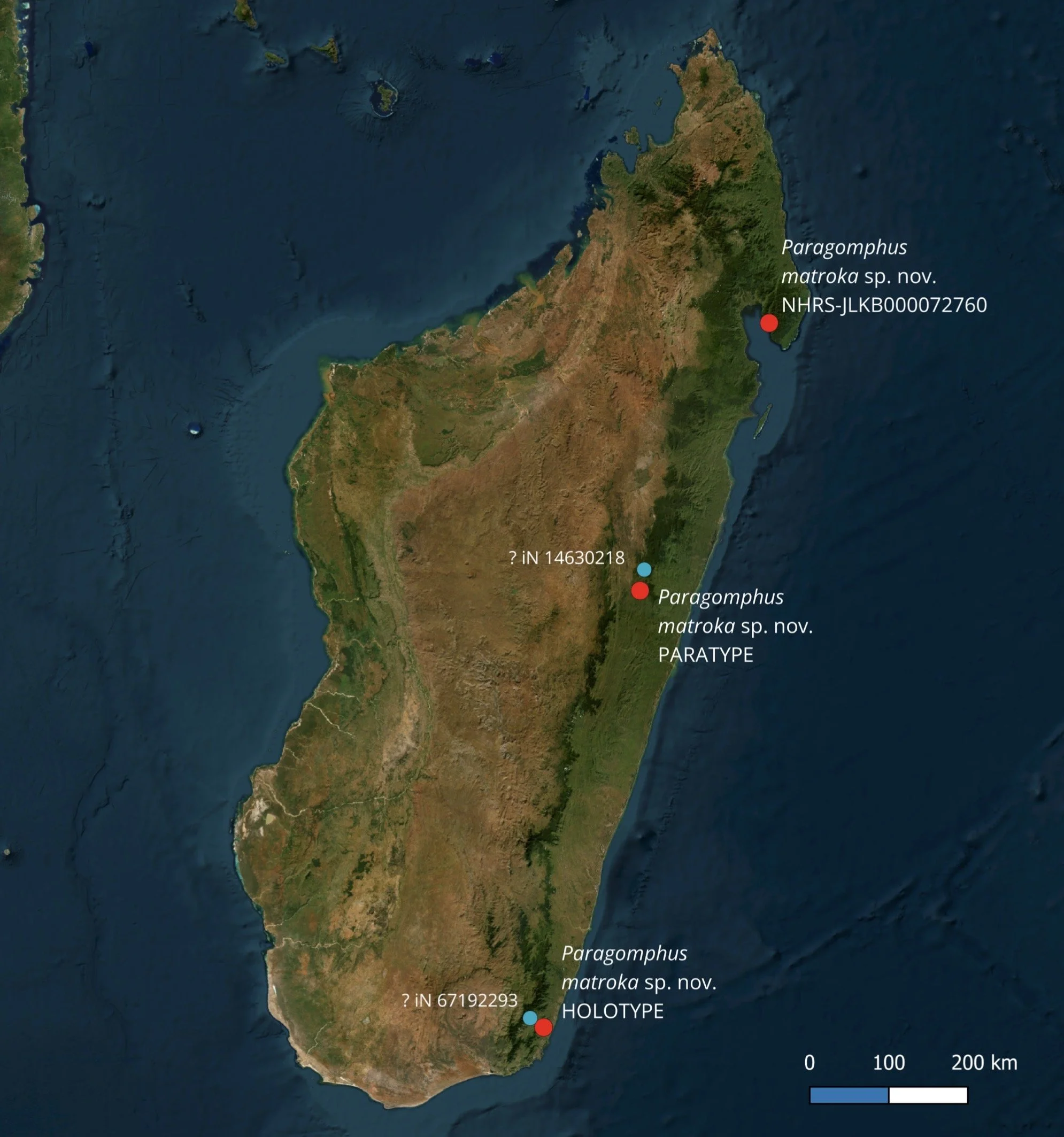
“Localities of Paragomphus matroka sp. nov. (red circles) and specimens likely conspecific but not verifiable (blue
circles) in Madagascar. The unconfirmed specimens from iNaturalist are indicated with their identification codes as used on the
platform. Map by Bogusław Daraż.”
With the specimen caught in the field, the specimen found on iNaturalist and traced to the Swedish museum, and the decades-old specimen discovered at the Paris museum, together, the Slovenian and Polish researchers finally described the new species…
Paragomphus matroka, the Dark Hooktail
Among Madagascar’s Paragomphus hooktails, matroka is distinct — not many insect species can immediately be flagged as a potentially new species in the field.
Where its closest relatives — such as fritillarius and sofiae ³ — are brightly spotted, yellow-and-black animals, matroka is much darker; a reduced constellation of small yellow markings on an otherwise blackish background. Indeed, its specific name comes from the Malagasy word for “dark-coloured.”
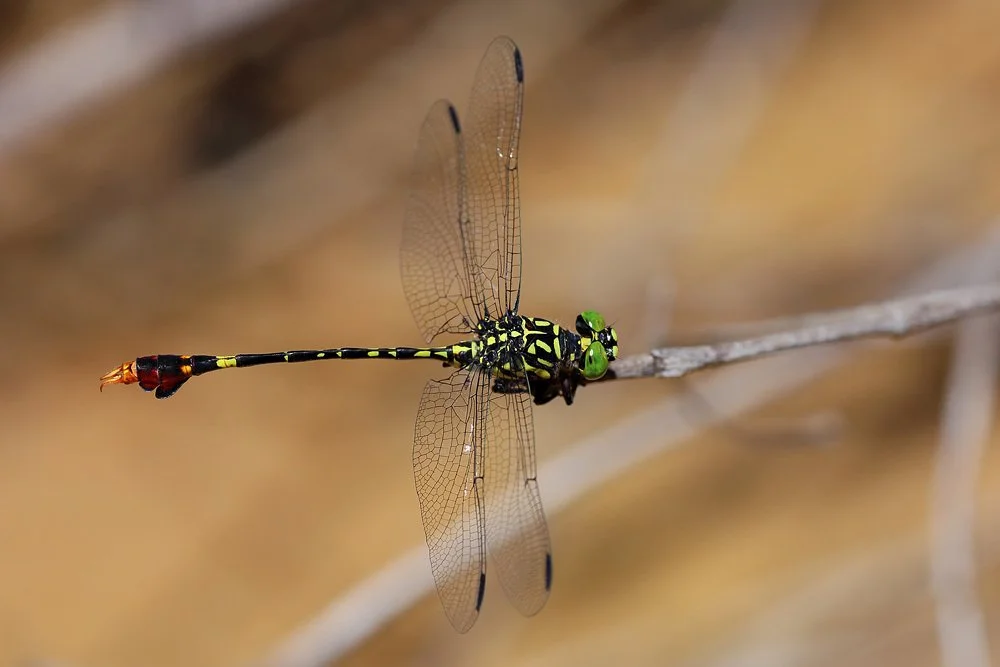
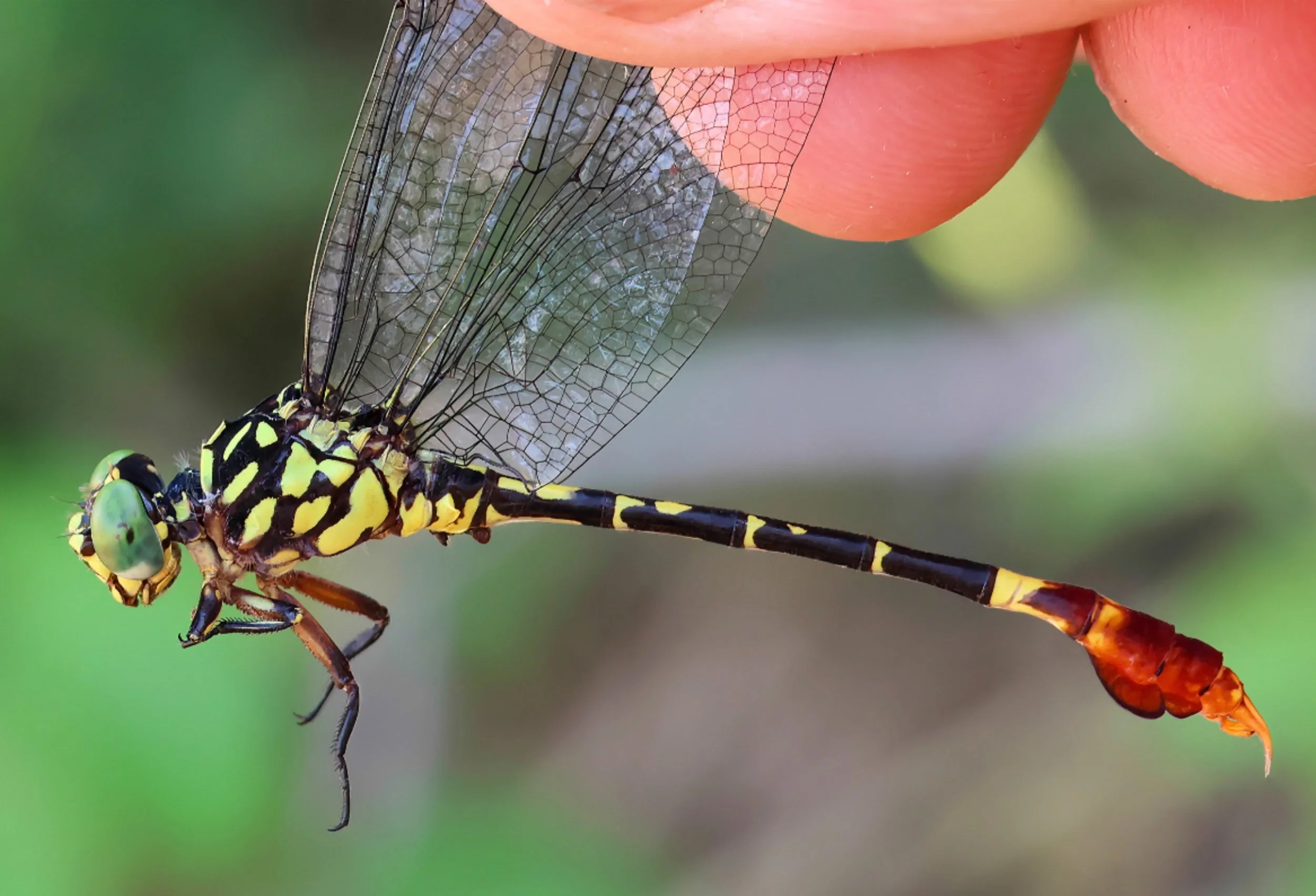
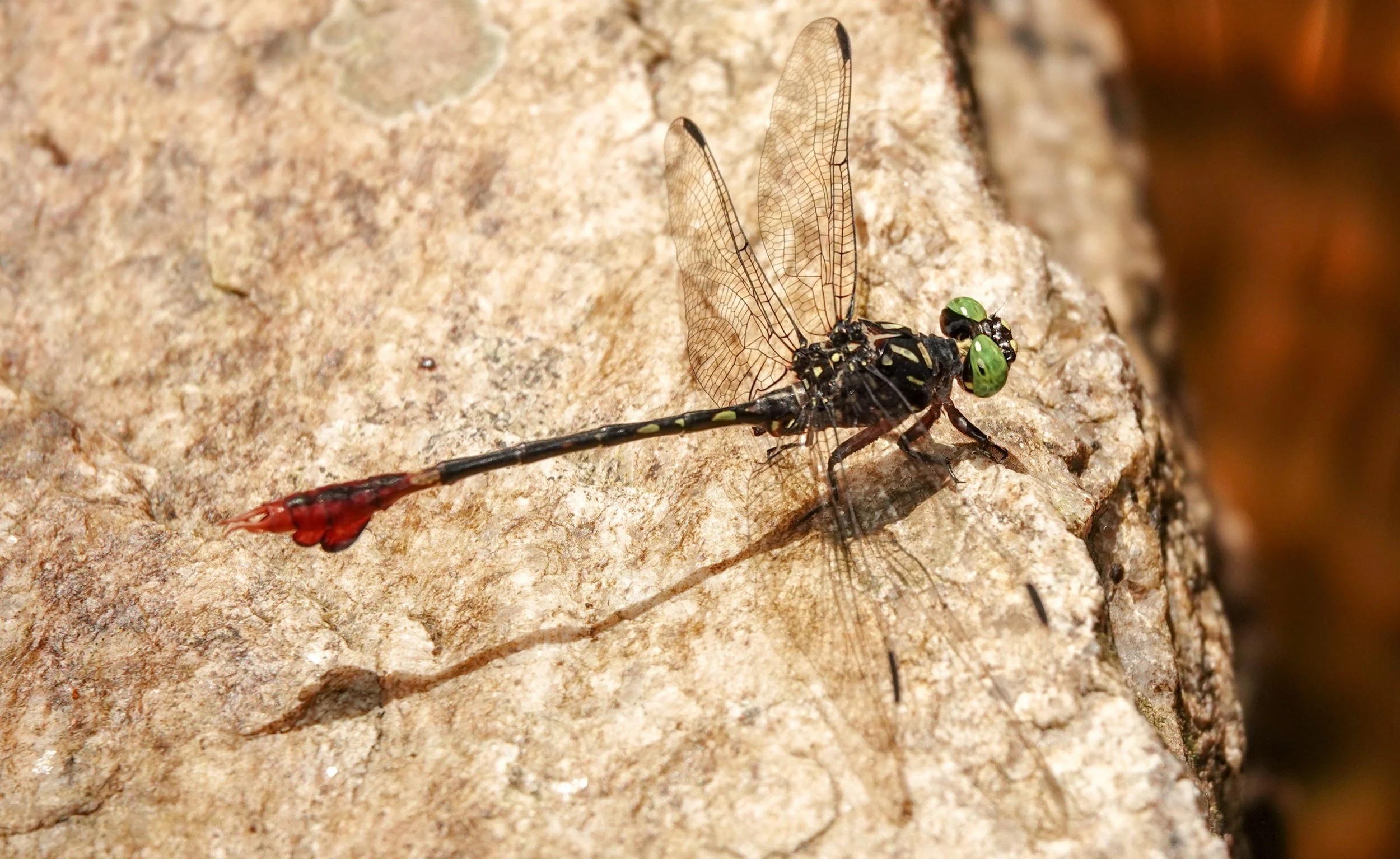
But the three specimens are not equally “dark-coloured.” The original holotype is dark, the Paris specimen noticeably lighter, and the Stockholm specimen the darkest of all three. This, the authors suggest, could be the result of “incipient speciation.” Collected from three distant localities across their vast range, P. matroka could be in the beginning stages of becoming three separate species.
The first signal of such speciation, the authors hypothesize, is the “less conservative” trait of body colouration, which might “evolve more rapidly under slightly different selective pressures,” such as varying habitat conditions. The genital structure of the three specimens, on the other hand, is clearly that of one species — characterised by the distal hook of the secondary genitalia being strongly bent inward and downward.⁴ This is a “more conservative” trait. If genital structure were to change, the populations would no longer be able to reproduce, and speciation would be complete.
All of this — the new discovery, the taxonomic confusion surrounding the Paragomphus genus in Madagascar, and the possibility of incipient speciation in P. matroka — strongly suggests that the true diversity of endemic Madagascan dragonflies is “substantially underestimated.”
That undiscovered diversity is simultaneously heartening and tragic.
The Tsitongambarika Natural Resource Reserve, where P. matroka was collected in 2024, makes up one of the largest remaining blocks of lowland moist evergreen forest on the island. The original discovery site — up that unnamed tributary of the Ampasy River — was one of “pristine beauty,” of primary forest and sun-dappled, crystal clear waters. And yet, just a short distance away near the borders of this protected area, the rich canopy gives way to secondary forest, fields of felled trees, and charred patches of soil.
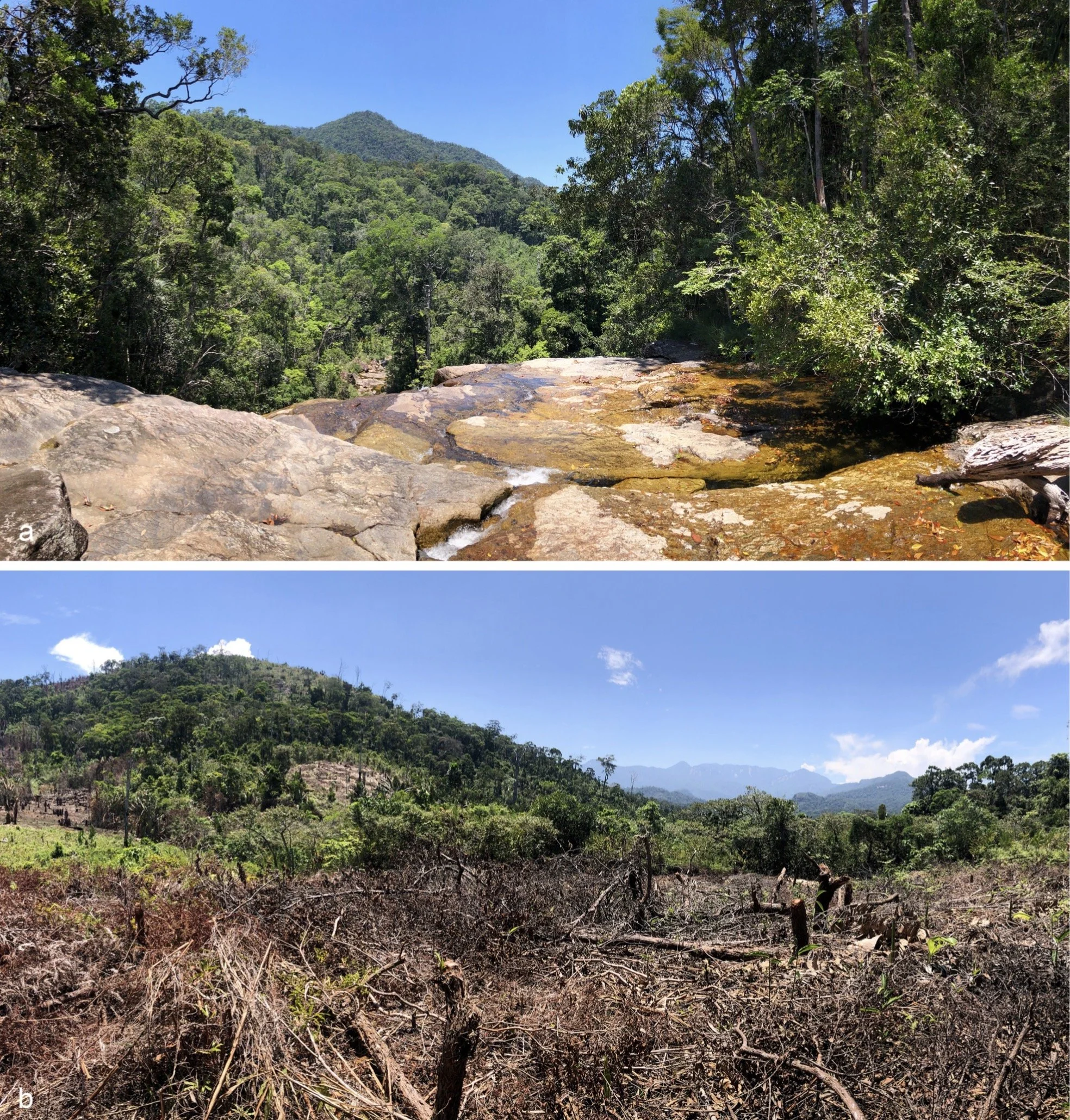
“A stark contrast between (a) pristine beauty of the Réserve de Ressources Naturelles de la Forêt Naturelle de
Tsitongambarika in southeastern Madagascar—scenic view from above the waterfall in the upper reach of the Ampasy River;
and (b) the results of anthropogenic pressures at the border of the protected area—the main threats to the reserve are advancing slash
-and-burn agriculture and illicit logging of forest trees. Photographs by Matjaž Bedjanič.”
Slash-and-burn agriculture, illegal logging, and expansion of human settlements, are wiping out named species alongside those still undiscovered. The authors note that, with the exception of the widespread P. madegassus, we know virtually nothing about the population statuses of endemic Paragomphus hooktails in Madagascar. Despite its substantial inferred range, all we have so far of P. matroka are the three male specimens — we don’t even know what the female looks like.
But knowing that a species exists, even if all you have is one specimen and a name, is far better than nothing. It’s the necessary starting point that enables further research and conservation.
The dark hooktail was found, and not just once.
A trained set of eyes recognised a new dragonfly in the field. A photo was posted online by a citizen scientist. An archived specimen was preserved in a museum for over 25 years. Three initially-disconnected strands of discovery were woven together across three countries to describe one species of dragonfly.
¹ The expedition was led by Matjaž Kuntner. Alongside Kuntner, the team included Matjaž Bedjanič (who collected the holotype specimen), Kuang-Ping Yu, and Matjaž Gregorič. The fieldwork took place between November 18 and December 14, 2024.
² iNaturalist is probably the world's most popular citizen science platform — alongside the likes of eBird and Pl@ntNet — its goal being to map global biodiversity. You can learn more about it here!
³ Paragomphus sofiae was first described by Bernard and Daraż in a February 2026 paper, which was where they also re-described a lectotype (a new type specimen) of P. fritillarius, which ultimately allowed for the description of P. matroka.
⁴ Male dragonflies possess two sets of genitalia: primary genitalia near the tip of the abdomen, where sperm is produced, and secondary genitalia on the underside of the second abdominal segment, where sperm is stored and transferred. Before mating, the male transfers sperm from his primary to his secondary genitalia. The female then connects her primary genitalia to the male’s secondary genitalia to receive the sperm; forming the distinctive ‘wheel’ or ‘heart’ shape of mating dragonflies.
It is the secondary genitalia — the hamules, the penial structure — that varies most distinctively between species, and that the authors examine in describing P. matroka.
-
Bedjanič, M., Bernard, R., Daraż, B. & Yu, K.-P. (2026) Paragomphus matroka sp. nov.—a new Hooktail species from the rainforests of eastern Madagascar (Odonata: Gomphidae). Zootaxa, 5821 (2), 219–235. https://doi.org/10.11646/zootaxa.5821.2.4
Bernard, R. & Daraż, B. (2026) Paragomphus sofiae sp. nov.—a new spotted species of Hooktail from Madagascar (Odonata: Anisoptera: Gomphidae). Zootaxa, 5757 (4), 357–368. https://doi.org/10.11646/zootaxa..5757.4.4
iNaturalist — total observations
iNaturalist — arvid_dejong observation
iNaturalist — angelomg observation
iNaturalist — ethankistler observation
Cordero-Rivera, Adolfo & And, Rivera & Córdoba-Aguilar, Alex. (2010). Selective Forces Propelling Genitalic Evolution in Odonata. The evolution of primary sexual characters in animals.