The Jumping Snail
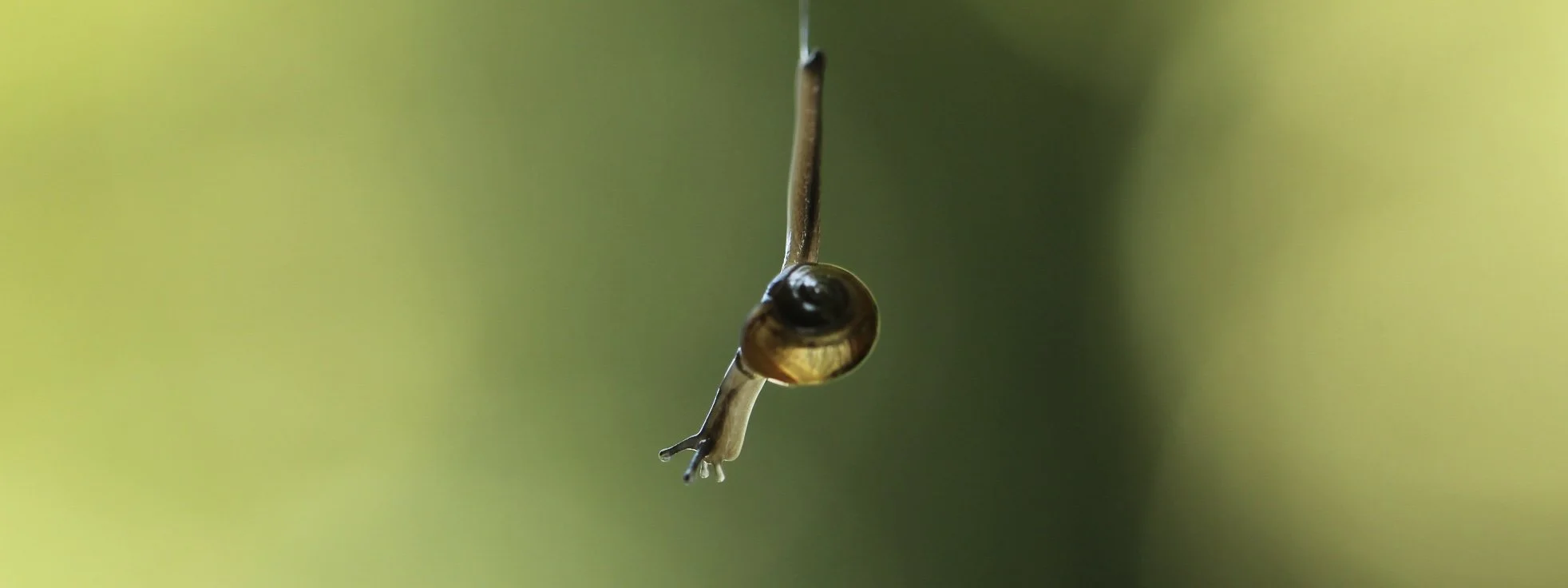
A jumping snail, Ovachlamys fulgens. (© Fellipe Silva / iNaturalist)
We think we know what to expect of snails. These are grounded animals, bound to surfaces — leaves, rocks, garden walls — by the perpetual, sticky grip of their mucus. It seems hardly any action they could take would surprise us. We would see it coming a minute away.
Which makes it all the more jarring when you see a snail coil its foot, flex the fleshy horn protruding from its tail like a scorpion stinger, and catapult itself through the air.
This jumping snail — known properly as Ovachlamys fulgens — leaps between continents as surely as it does vegetation: from East Asia to the greenhouses of Europe and the botanical gardens of the United States. And now it’s actively creeping across South America, into forests that it should not be able to invade.
———
Before the jumping snail became a globe-trotter, it was an odd little species endemic to the Ryukyu Islands of southern Japan.
It evolved to thrive in the archipelagos’ moist forests, where temperatures average just above 22°C and rains fall throughout the year. On Okinawa, the largest of the Ryukyus, it grew abundant in decaying leaf litter — not that you’d notice it if you weren’t looking: a tiny snail with a dark-greyish body and an apple-pip-sized shell, semi-translucent and thin.
A snail’s shell is its primary form of defence, but it is also expensive to build and to carry. A thinner, lighter shell reduces both costs. The flip side: the jumping snail’s shell won’t be protecting it from any predators that manage to catch it.
So the snail has to make sure they don’t.
Capable of crawling two to nine times faster than related species, the jumping snail deprioritised armour in favour of mobility. Still, we’re talking about snails, so fast is relative. If the jumping snail cannot speed away from a threat, then, well, it’s in the name.
The snail retracts its head into its shell and starts turning its horned foot in a repeated circular motion, generating enough force to launch itself several centimetres through the air in a series of leaps.
The jumping snail sped and hopped through the forests of the Ryukyus. And, at some point, it invaded our flower gardens.
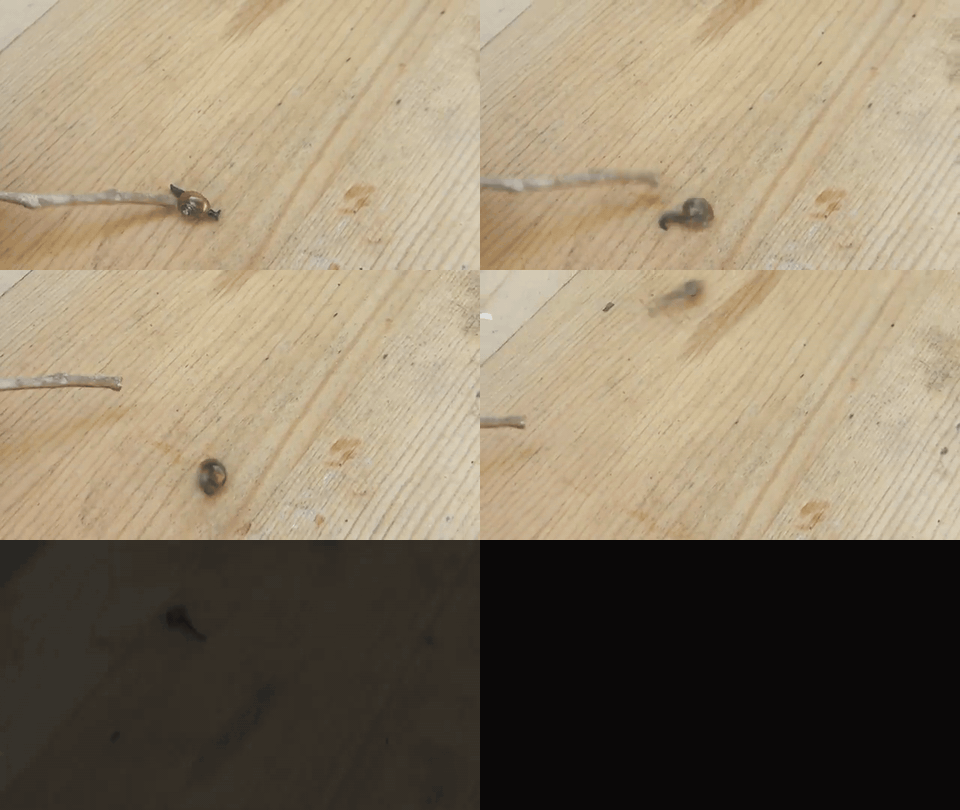
The jumping mechanism in action. Note: please refrain from poking gastropods with sticks.
(© Chin Frank / YouTube)
———
The same warm, humid climate that allowed the jumping snail to flourish on Okinawa — where it was first officially discovered — also made the island an ideal place for the cultivation of orchids.
Beginning in the 1970s and 1980s, Okinawa's rapidly expanding flower industry went international, and dedicated flower cooperatives began regularly transporting ornamental plants overseas.
Beneath the glossy leaves of an Okinawa orchid, in its damp potting soil, between tightly wrapped roots, nestled a single jumping snail. Perhaps the orchid was unpacked in someone’s garden. As it was lifted from its pot, a tiny jumping snail, disturbed by all the movement, catapulted itself into the surrounding vegetation. It probably wasn’t even noticed.
The jumping snail could have been completely alone; the only individual of its species in a new land. It might have never reproduced. It might’ve never even met another member of its species in its life. And yet, it soon began to lay eggs.
Most land snails are hermaphrodites, meaning they have both male and female sex organs, and reciprocal insemination — two snails exchanging sperm — is the norm. The jumping snail, if it isn’t clear by now, is not normal.
Laboratory studies have confirmed that individual jumping snails, completely isolated from the moment of their birth, are still fully capable of producing viable eggs.
All it takes to start an invasion is a single snail.
Once an exotic snail finds an environment where it can lay its eggs (in some damp soil, vegetation, or a compost pile), the invasion force can multiply by more than a hundredfold. The giant African snail, for instance, lays between 100 and 500 eggs in a single clutch. Then it does so again two or three months later, and again, pretty much up until it dies.
The jumping snail is a bit unusual, for a successful cosmopolitan invader, in this regard. Rather than hundreds, it lays just three eggs at a time. However, it can do so day after day, taking only a day or two off between laying streaks. And it will keep going as long as the environment remains humid.
The more nutrients an egg contains, typically, the better off a baby will be when it hatches. But a tiny snail can only pack so much stuff into its eggs before they get too big. One solution is to pack its eggs with a high concentration of nutrients and outsource most of their moisture requirements to the environment.
When first deposited, jumping snail eggs look like tiny, white, shrivelled raisins. The shells are highly permeable and hygroscopic — meaning they attract water. As soon as they hit any kind of moisture, whether damp soil or wet leaf litter, the eggs begin to “drink,” fully hydrating in just two to three minutes, rapidly and dramatically swelling to nearly double their initial size.
Two weeks later, the young hatch, hardy and healthy. And just 45 days after that, they begin laying their own batches of thirsty, little eggs.
———
Self-fertilisation and rapid reproduction helped the jumping snail establish new populations.
Its unique anatomy allowed it to avoid unfamiliar predators — who probably weren’t used to their snail prey leaping away. But no matter how unusual and adaptable the jumping snail may be, it could hardly hop entire oceans on its own.
“Successful introductions often have a lot to do with what we call introduction pressure,” explains Dr. Rodrigo Salvador, a malacologist and a specialist in invasion biology from Brazil. “In other words, there have probably been numerous attempts to introduce the species, with multiple people or cargo shipments independently bringing them into the area. Eventually, one of these introduction attempts will ‘work.’”
If it wasn’t for us, the jumping snail would have probably remained just another odd little endemic from a Japanese archipelago full of odd little endemics. The Ryukyu jumping snail: a speedy snail, an acrobatic gastropod!
Instead, it jumped between continents, riding the shipping routes of the ornamental plant trade.
By the 1980s, the jumping snail had made it to Costa Rica, establishing its first foothold in the Americas. Its presence was discovered in an orchard within the capital, San José — where these exotic snails reached densities of 43 individuals per square metre.
It was here scientists discovered that over 90% of the population enters aestivation during dry periods. This in itself is pretty typical of snails — several species form a hard door (known as an epiphragm) to lock themselves into their shells, and become inactive. But, instead, the jumping snail uses adherent mucus to “glue” itself to the underside of leaves. If the plants they’re attached to are moved, well, the snails move with them.
The jumping snail soon became a familiar horticultural hitchhiker. It appeared in the Pacific: in American Samoa in 1998 and Hawaii in 1999. The first record in the continental United States is from 2001 in Florida, and in Europe in 2004, appearing in a Tropical Rainforest house of a Swedish university.
Then, in 2013, the first record of a jumping snail appeared in South America.
Its earlier invasions were largely associated with human environments — the jumping snail was what’s known as a synanthropic (a “with-human”) pest. But now, finding itself in southern Brazil, it had arrived at the doorstep of one of the world’s great remaining tropical forests.
And, for seemingly the first time, it crossed that threshold and kept on crawling.
———
Despite the remarkable global expansion of the jumping snail, researchers are careful applying specific labels.
“We do not yet know whether the jumping snail is a truly invasive species, because no systematic studies have been conducted to establish that,” explains Dr. Salvador, regarding its presence in Brazil.
It is an introduced/exotic species. To be officially classified as invasive, however, it must be demonstrated to cause measurable harm to the environment, the economy, or public health.
“We do not yet have solid evidence that the jumping snail has any impacts,” says Salvador, “although we can expect this to become the case in the future.”
In other countries, the snail is known to attack orchid nurseries and feed on a broad range of crops, including bananas, citrus, avocados, and mangoes. The jumping snail also loves human environments like sidewalks and garden walls. At the same time, it is a potential vector of rat lungworm — a disease that affects the central nervous system of humans.
But perhaps the most worrying development, because it is a relatively atypical development among invasive snails, is that this new expansion hasn’t been limited to human environments.
“It is rare for these species to reach pristine areas on their own,” Salvador says, “largely because of the strong biotic resistance of tropical ecosystems.”
Biotic resistance is like an ecosystem's immune system, in that, the stronger it is, the better an ecosystem is at repelling invaders. This resistance comes from the natural functioning of an ecosystem: predators keep prey in check, competitors vie for the same food and shelter, parasites and diseases limit populations, and few resources are left unused, few niches unfilled. Together, the countless interactions of native species make it difficult for an outsider to gain a foothold. A foreign species could arrive, but it might not be able to survive long enough to reproduce and establish itself.
Biotic resistance — or rather, a lack of it — is why many exotic species find it easier to become established in more human-altered environments. It is why many introduced snails remain confined to cities and farmland.
By that logic, undisturbed tropical forests ought to be among the hardest places on Earth for exotic species to colonise. Yet the jumping snail seems to be doing just that. It has already been recorded in protected areas such as Iguazú National Park in Argentina and Brazil’s Serra do Mar State Park — the latter being one of the largest remaining expanses of Atlantic Forest.
“We are not entirely sure how the jumping snail managed to reach areas such as the Serra do Mar,” says Salvador, “but the most obvious explanation is human activity.”
———
This year saw the publication of the first comprehensive national inventory of non-native molluscs in Brazil. Its results showed a more than 200% increase in introduced species — an addition of 56 species — over the previous 15 years. That means, on average, 3.7 new species have been introduced to the country per year.
Whether the jumping snail will have significant ecological impacts in Brazil remains to be seen. But by the time those impacts become obvious, it may already be too late. So how do you stop a snail invasion?
Completely barring exotic species from entry remains the most effective defense.
Biosecurity measures can reduce the number of stowaways arriving via ports and airports — meaning strict screenings of incoming plants by personnel trained to find and recognise non-native hitchhikers. The jumping snail, for instance, has been intercepted coming into the United States several times and on plants of all sorts: roses, heliconias, spindle bushes, dragon trees, etc.
Dr. Arruda points to another promising approach that’s already used in grain storage. It involves placing imported plant products or seedlings into a hermetically sealed environment filled with carbon dioxide. Because land snails and slugs require oxygen, the gas treatment kills any hidden mollusks while the plants remain unharmed.
But while these methods can be very effective, they’re also far from the most feasible.
Ironically, in fighting slow and small invasives, the biggest challenges are speed and scale. Some snail species can survive for days in low-oxygen environments by sealing themselves inside their shells — or to a leaf, as does the jumping snail — requiring treatments to be maintained for extended periods to ensure every potential hitchhiker is eliminated. Inspecting or gassing every shipment container arriving at every port of entry is virtually impossible, or at least unrealistic in a country as large as Brazil.
Detection and prevention are more of a sieve, at the moment, that stop some exotic species getting through, while others slip through the mesh. And the holes can be so large as to necessitate mathematical intervention.
———
On that San José orchard, where jumping snails first appeared in Costa Rica, researchers laid out 4,000 dinner-plate-sized plots. They then randomly selected hundreds for visual searches, getting down on their hands and knees among the leaves and grasses, counting every snail they could find.
Some of those tallied plots were then collected — all their vegetation and top centimetre of soil were scooped up and taken back to the laboratory, where they were systematically sorted and examined under 10× magnification.
It turned out that, for every one living snail a researcher found in the field, there were more than three actually present. As a result of this study a correction factor was issued: the tally of any visual field search had to be multiplied by 3.36 to estimate the actual likely population.
Even when researchers were specifically looking for them, the majority of snails managed to slip past detection.
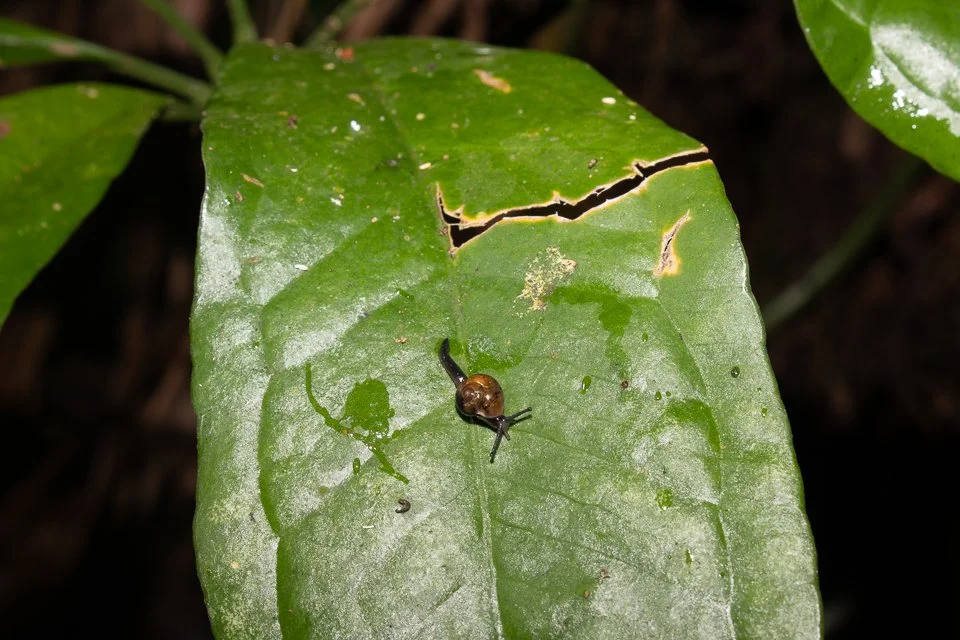
A jumping snail…
According to the 2026 inventory, there are already 70 species of non-native molluscs recorded in the wilds of Brazil. With the exception of the giant African land snail, most of them remain extremely understudied. Many are classified as Data Deficient, and for many others, like the jumping snail, evidence of their ecological impacts remains anecdotal rather than experimentally demonstrated.
It's not that researchers are doing a poor job, or moving too slowly. Far from it.
But in the end, the malacologists are few and the snails are many.
———
Surveying a country the size of Brazil is a monumental task. Yet the country’s greatest challenge may also be one of its greatest strengths.
More than 200 million people travel its roads, work its farms and tend its gardens every day. The same human network that inadvertently moves hitchhiking snails around Brazil could also become the network that detects them.
In an ironic turn, the very traits which appear to have enabled the jumping snail to successfully spread across the globe are now making it easier to identify and track.
When ordinary citizens spot a strange snail with a horned tail on a garden wall or sidewalk, they’re more likely to be curious about it than a regular-looking species.
“It was out in the open during the day, and that was what first caught my attention,” said a user of the citizen science platform iNaturalist, who posted an observation of a jumping snail they saw near São Paulo, “then I noticed it was a little different than the native snails I previously had encountered.”
Experts frequently receive photos of the jumping snail from the public, usually accompanied by an inquiry: “Is it dangerous?” One 2022 study found it to be the ninth most photographed snail or slug species in all of Brazil on iNaturalist.
“I believe that any species with a distinctive characteristic (size, color, or some other unusual feature) is more likely to be observed and photographed,” notes Dr. Ana Carolina Díaz. “If researchers or regulatory agencies were to raise greater awareness, it would help volunteers be more alert or actively look for that particular species.”
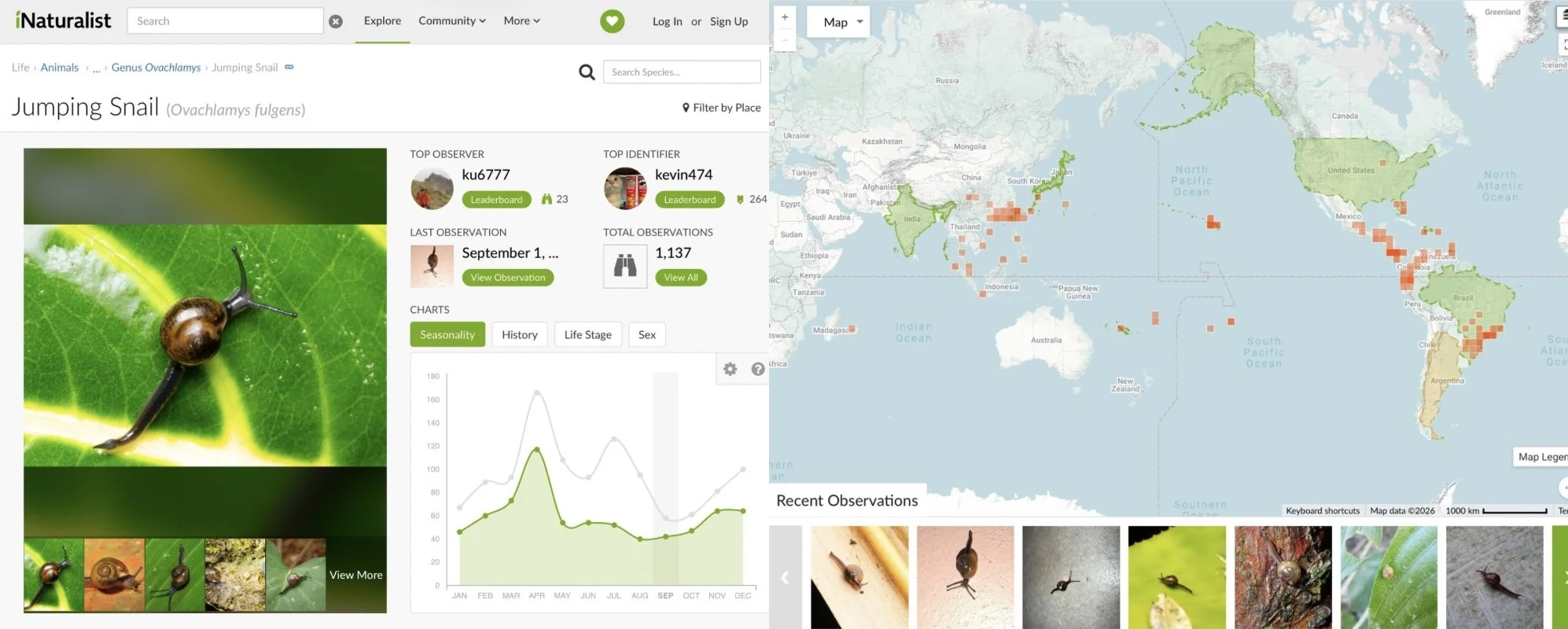
iNaturalist page for the jumping snail. (© iNaturalist)
Citizen science platforms like iNaturalist transform chance encounters into scientific data. Each observation records both the location and date of a sighting, allowing researchers to reconstruct the snail’s spread from coastal trade hubs into interior forests. In late 2021, for example, a single upload extended the jumping snail's known Brazilian distribution northward into Espírito Santo before the expansion had appeared in the scientific literature.
Knowing where the snail has already become established can help us understand why it succeeds in some places and not others. That might then allow us to predict where it’s likely to show up next.
“It would be interesting to learn more about the environmental conditions favorable to its spread,” Díaz adds, “and to conduct studies that would help identify areas susceptible to invasion so that we can carry out campaigns directly in those areas.”
What does it look like, to carry out campaigns against an army of tiny snails?
Campaigns might involve stricter hygiene measures in plant nurseries, increased surveillance in high-risk regions, restrictions on moving soil and plants, or targeted eradication efforts while newly established populations remain small.
“If introduced species are detected early enough, eradication programs can be successful,” explains Dr. Salvador. “Beyond a certain point, however, once they become too numerous or widely distributed, management efforts shift toward damage control, or the situation may even become a losing battle.”
Everywhere around the world, humans find themselves in losing battles with slow-moving foes.
The golden apple snail is one of our most notorious enemies. Native to Argentina, Uruguay, and parts of southern Brazil, it was repeatedly introduced to Japan as a source of food, establishing itself in 1981. Soon after, it showed up on the island of Okinawa.
It feasted on rice and taro crops, it outcompeted native snails, it carried and transmitted rat lungworm. Once it was established, efforts to eradicate it invariably failed. Thanks to the island’s subtropical climate, the golden apple snail laid eggs nearly every month of the year, matured faster, and spread and spread.
Okinawa has managed to successfully eradicate other introduced pests, like the melon fly and oriental fruit fly. But not the golden apple snail. Its bubble-gum pink egg clusters still plaster canal walls and plant stems just above the waterline across Okinawa — and much of Southeast Asia.
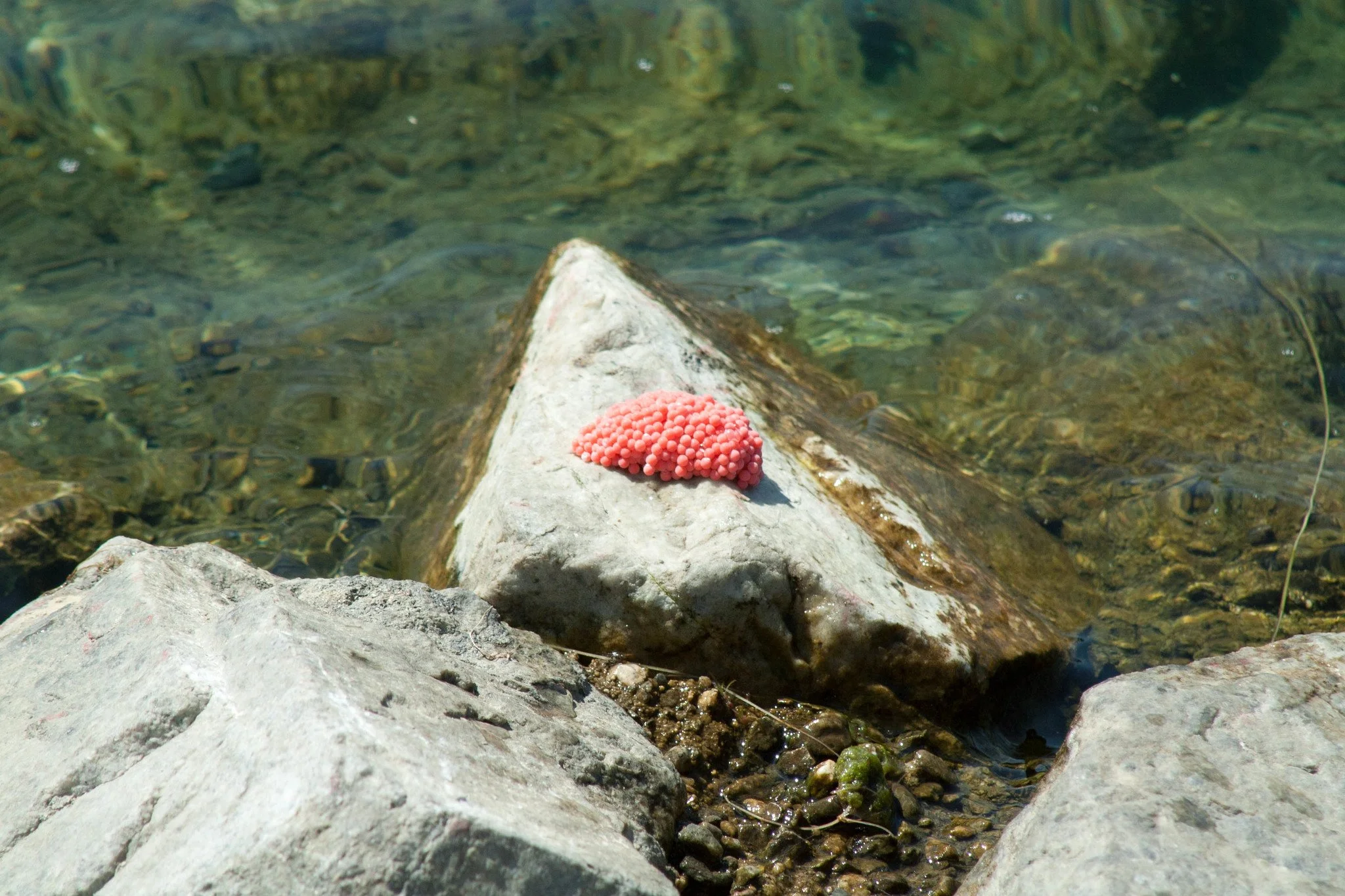
The egg cluster of a golden apple snail, Pomacea canaliculata.
———
Dr. Salvador suggests that finding a long-term solution means looking beyond the snail itself.
“I may differ from many of my colleagues, who advocate tackling invasive species directly,” says Dr. Salvador. “I believe that the most effective way to reduce the damage caused by invasive species is to build and maintain healthy ecosystems, which will boost biotic resistance.”
That means, of course, protecting and preserving untouched wilderness. But there’s no reason to stop at pristine, “natural” environments. Small patches of native vegetation between farmland can provide refuges for native species. Replacing monocultures with more diverse crops leaves fewer opportunities for adaptable invaders to establish themselves.
For many introduced species, the first foothold isn’t a rainforest but a city.
“Creating greener cities that promote native plants rather than imported ornamental species could go a long way,” says Dr. Salvador. “This would, in turn, support native insects, native birds, and, of course, native snails, giving the exotic species less space to thrive.”
Urban and agricultural landscapes serve as the hubs from which exotic species can spread out to the rest of the country. By strengthening the biotic resistance of these human-dominated landscapes, we may be able to prevent those initial populations from taking hold in the first place. We could halt the invasion at its local source.
———
The jumping snail, with its ability to self fertilise and catapult away from dangers, seems uniquely well adapted to spread and establish itself. But its biology is only part of what makes a successful invader.
Whether the next jumping snail invasion succeeds may depend less on the snail itself than on the chances we give it to leap — deeper into South America or to other continents — and what it finds when it lands.