It Only Takes One Cave
The mystery of cave-dwelling opossum shrimp found half a world apart
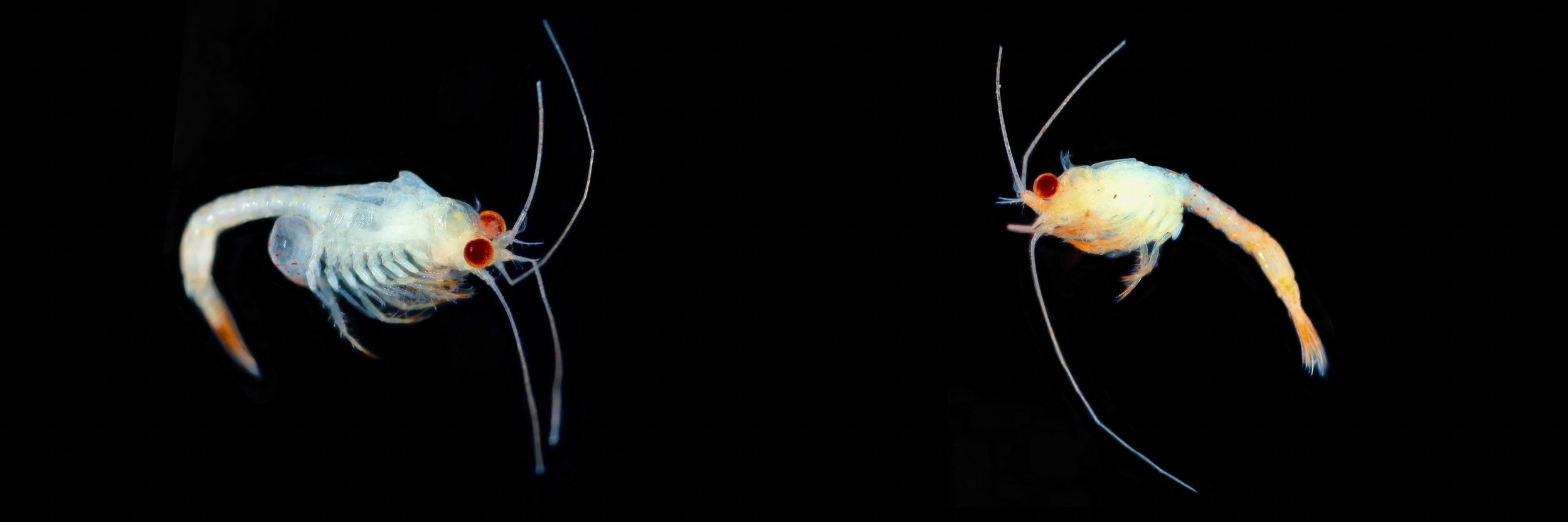
Palaumysis jetama sp. nov. (© Azman et al. 2026)
Deep beneath Malaysia’s Sipadan Island stretches an aquatic labyrinth known as Turtle Tomb. Littering the floor of this submerged cave are the skeletal remains of hawksbill sea turtles that lost their way and perished in the dark.
Dr. Abdul-Rahim Azman leads a research team into this sunken graveyard. As he pans his dive torch past the piles of sand-dusted turtle bones, the light falls upon great swarms of life.
“They drift with the gentle current yet move as a cohesive swarm,” Azman describes, “creating a shimmering, almost misty cloud that seems to pulse in response to the diver's presence.”
These clouds are congregations of tiny crustaceans, each just a few millimetres long, and they are what Azman and his team are after. But they don’t just drift passively. These creatures dart away from the collecting tubes at the slightest disturbance. Any sudden movement risks scattering the swarms. With care and patience, over multiple dives, the researchers collect the specimens they need.
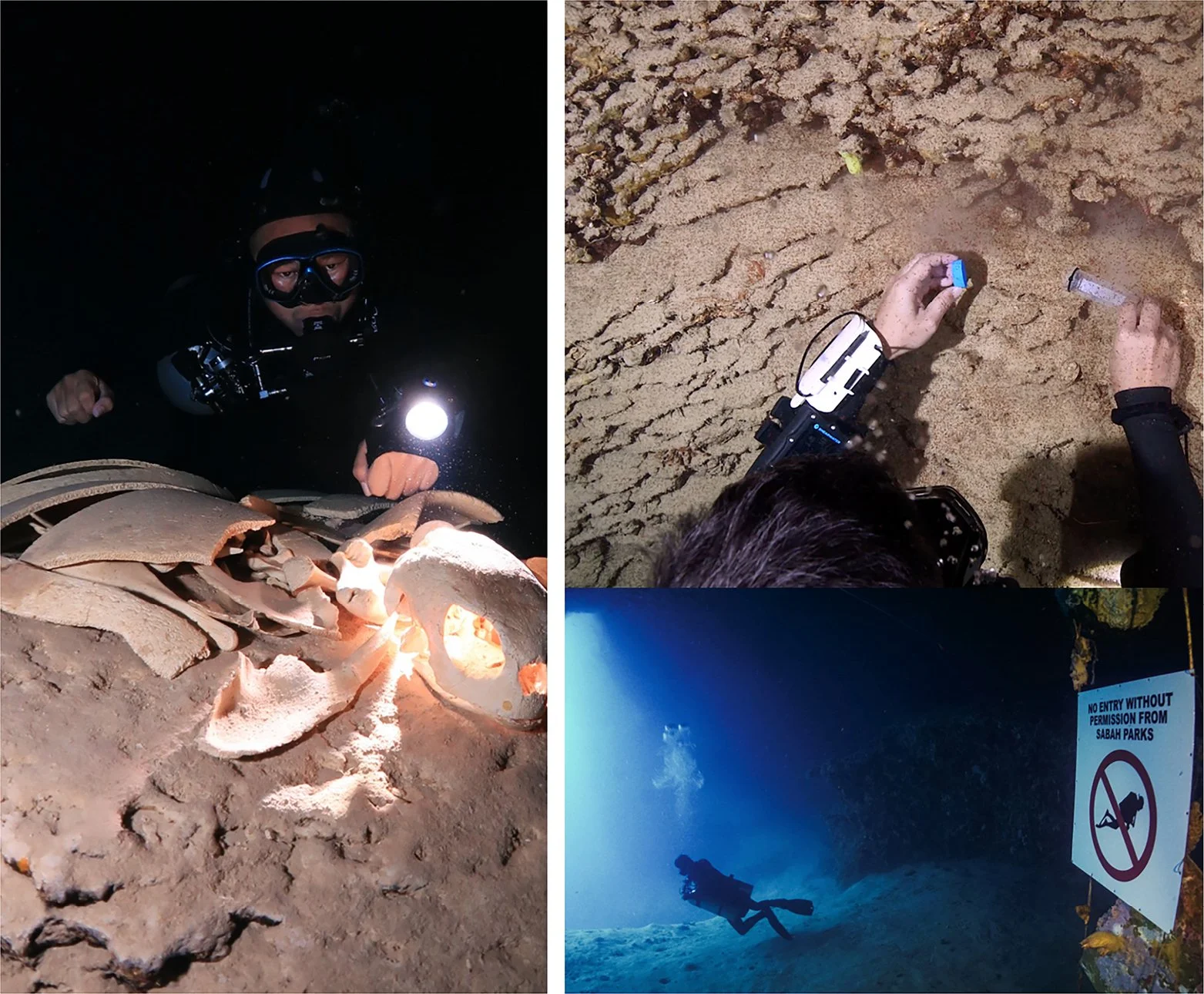
Ahmad Zaki and the skeletal remains of a turtle (left). Dr. Azman collecting mysid specimens (top right). View from the entrance of Turtle Tomb (bottom right).
Back at the lab, those specimens are examined more closely. Each crustacean is translucent and ghostly white, with bright orange eyes glowing like tiny lanterns.
What they’d found was a species of mysid — also known as an opossum shrimp, because females have unique brood pouches inside which they rear their larvae. It is a species completely new to science: Palaumysis jetama sp. nov.
———
“It only takes one cave to rewrite books,” says pioneering speleobiologist Dr. Tom Iliffe, who co-described the very first Palaumysis species.
Four decades ago, and some 2,000 kilometres northeast of Turtle Tomb, Iliffe dove down into Palau’s Chandelier Cave. Flooded chambers opened one after another, their ceilings hung with massive limestone stalactites that had formed long before the cave drowned beneath the sea. There, he and his team discovered Palaumysis simonae — the first species of a new genus.
Over the following forty years, members of the genus emerged from an unlikely collection of hidden worlds. A second species was found in the lightless depths of Mapating, or “Shark” Cave in the Philippines. Later that same year Palaumysis turned up in the Atlantis Blue Hole in the Bahamas — on the opposite side of the planet. Next, the genus surfaced in the flooded limestone caves of Okinawa, Japan. In June of 2026, another species emerged from cathedral-like caverns beneath the Caribbean, described just a month before the latest addition from Turtle Tomb in Malaysia.
“It’s a rather interesting, puzzling distribution,” says Iliffe.
Islands, isolated from the mainland and one another by oceans, are famous for harbouring unique species. Marine caves are much the same. Each is an ecological island where life evolves, isolated and strange, within its cave’s peculiar conditions.
Palaumysis is a perplexing example of this insular phenomenon. It would be like discovering Darwin’s finches not only on neighbouring Galápagos islands, but scattered across distant islands in the Caribbean, Southeast Asia, and the western Pacific.
Such a disjunct distribution begs the question: how did a lineage of tiny, cave-dwelling crustaceans colonise caves half a world away from one another?
———
Using the current geographic distribution of living species to reconstruct their history is a bit like reading the last few sentences of a biography, and trying to guess what events led to that ending. The trouble is, many different paths can lead to the same destination.
One theory posits that the different Palaumysis species never really moved at all. Rather, the world moved around them.
Perhaps their ancestors all lived on the same ancient supercontinent of Pangea, when the oceans separating Malaysia from the Caribbean and Japan from the Bahamas had yet to fully open. And as Pangea began to fracture some 180 to 200 million years ago, the Palaumysis simply drifted apart with it.
“So this is kind of a continental drift type of theory,” summarises Iliffe, “that animals are associated and stay in the one area where they were found.”
If true, the species drifting through Turtle Tomb today may belong to a cave-dwelling lineage older than the oceans that now separate them.
Most of the world's 1,200-plus mysid species inhabit open ocean. It’s not difficult to imagine that the ancestors of Palaumysis once swarmed there too.
So when did the lineage leave the open seas and become obligate residents of aquatic caves?
The Earth’s surface is always shifting: continents drift, oceans open and close, climates change, and, as a result, many species vanish. But there are a few remarkably stable places — refuges where life can persist through the most extreme of upheavals, allowing some lineages to carry on unbroken across hundreds of millions of years.
Marine caves can be such refuges. The scattered cave-dwelling mysids we see today might not be isolated pioneers, but the last survivors of what was once a far more widespread lineage, now confined to their subterranean shelters.
“Think of these caves as evolutionary time capsules,” explains Azman. “When you find a lineage in Malaysia that is also found in the Bahamas, the Philippines, or Okinawa, you are witnessing a ‘disjunct distribution,’ a fragmented remnant of a much older, more widespread population. These caves provide stable, protected refugia that allow ‘relictual’ or ancient lineages to persist long after their ancestors may have vanished from the open ocean.”
So how do you resolve these competing histories? Did Palaumysis ancestors drift with the continents, or die out in the oceans?
———
Scientists use different kinds of clues to reconstruct a lineage’s history. By working out how closely related the known species are — say, by comparing their morphology — they can infer where their common ancestor lived and how its descendants spread across the globe.
Based on their morphology, the Malaysian, Philippine, and Okinawan species appear to be close relatives, the Bahamian and Caribbean species form their own pair, and Palau’s P. simonae stands as the odd one out — exactly the family tree their geographic distribution would predict.
But appearances can be deceiving.
Biologists have repeatedly found that similar environments can produce remarkably similar crustaceans from different evolutionary lineages. Cave species in particular often converge on the same suite of adaptations known as ‘troglomorphies’: reduced or absent eyes, pale skin and translucent exoskeletons, elongated appendages, etc.
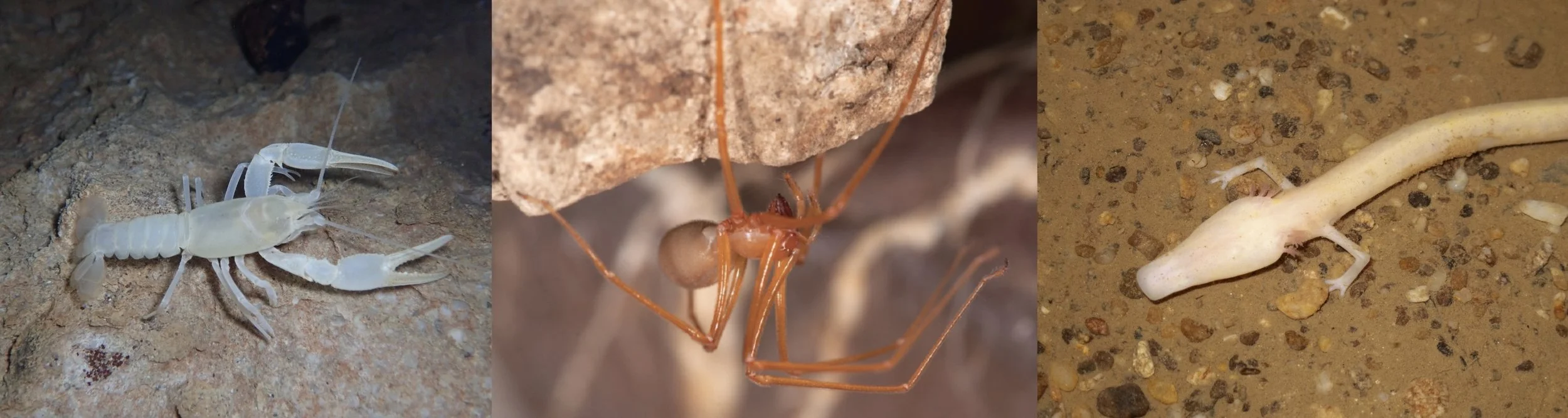
Examples of troglomorphic species. (Pedro Ardapple-Kindberg / USFW), (© Griswold et al. 2012), (© Wouter Beukema / iNaturalist)
Some of the most striking examples of convergence come from anchialine caves. These submerged caves have an upper layer of lighter fresh or brackish water and a lower layer of heavier salt water, between which is a border called the halocline.
Because anchialine caves are very specialised habitats, neither fully freshwater nor fully marine, they repeatedly push unrelated animals toward remarkably similar solutions for survival.
“The halocline, in some instances, can be exceptionally thin and sharp; as sharp as the thickness of a sheet of paper.” Iliffe explains. “So, all of a sudden, you're going from this fresh or brackish water, and you hit this layer, and as you drop through it, down into the saltwater, everything distorts and becomes blurry. But then when you get down into the deeper water, everything comes back into sharp focus again.”
This strange environment — where several of the Palaumysis species are found — might constrain evolution in predictable ways, making unrelated species look deceptively alike.
“You’re walking down the street and all of a sudden you see somebody that looks like your next door neighbor,” Iliffe explains. “It doesn’t mean they’re your next door neighbor. It could be that they’re just somebody who happens to look like them.”
Perhaps the Asian and Pacific species aren’t actually that closely related to those in the Caribbean. Maybe the founding Palaumysis species from Palau only looks related to the other cave-dwelling mysids, when really it belongs to a completely different branch of the mysid family tree — a stranger that only resembles your neighbour.
“They appear to be related now,” says Iliffe, “That doesn't mean future work isn’t going to come up with additional details, that could split them into two groups or three groups or whatever.”
“One thing that would be interesting,” Iliffe continues, “would be to sequence the DNA of specimens and compare the genes to see if they are actually closely related to one another or they just, by chance, happen to look alike.”
———
Assuming, as we do now, that these six known species are actually related, there is a final theory — perhaps the most realistic, and certainly the most humbling one. It is less about the opossum shrimp themselves, and more about us, and our limitations.
The theory posits that the Palaumysis genus is not disjunct, but rather, that our data on the genus is.
The known species occupy remarkably different parts of their caves: swarming in shallows and depths, clinging to cave walls, or hiding among coral rubble. That diversity hints we might still be sampling only a fraction of the habitats Palaumysis occupies.
From the labyrinth-like passages of Turtle Tomb to the cold waters of the Atlantis Blue Hole, where powerful tidal currents determine when the cave can be explored, the dangers to divers are many. And the deeper they go, the more dangerous it gets, and the less time divers can safely spend collecting specimens before decompression limits force them back to the surface.
“We can only get a peek at a very small portion of the deeper water habitats,” says Iliffe.
For all we know, there could be many more Palaumysis species inhabiting the marine caves of the Indonesian Archipelago, the islands of the Pacific, and the tropical coastlines of Central America and the Caribbean.
“I'm sure that there are many, many other locations, caves or crevices or marine caves, where this same genus of mysids are found,” says Iliffe. “We just haven't uncovered them yet.”
So how do we uncover them?
———
Curiosity draws a scientist’s eye away from giant turtle skeletons and toward the tiny crustaceans drifting through the darkness. It reveals a graveyard as a thriving ecosystem.
“When you shift your attention from the open reef into the darkness of the cave,” says Azman, “you quickly realize how much life has remained hidden in plain sight.”
Each discovery is both a clue and another question. Scientists develop competing hypotheses: continental drift, evolutionary refuges, convergent evolution, or sampling bias. Every discovery brings scientists a little closer to understanding — understanding Palaumysis, for instance — while prompting new questions that beg to be uncovered. The only way to find out is to keep looking.
“All you need to do is find one cave,” says Iliffe. “You find a species that could be related to one from a completely different cave. Then you keep doing that, and eventually you may connect the dots, if that is how they’re distributed. There’s still a lot to learn, is the bottom line here. There’s a lot we don’t know.”
Dr. Iliffe remembers reading a paper written by German scientists researching a cave in the Canary Islands, off the western African coast. He wrote to them, suggesting that diving the cave might turn up something new.
“They wrote back and said, ‘We hate to bust your bubble, but we've been working on this cave for more than 20 plus years…there's nothing new that you're going to find,’” Iliffe recalls. “On the very first dive, we found a new species…”
Individual Palaumysis may be minuscule, but their mystery spans a whole lineage, several continents, and tens of millions of years. No matter how curious or persistent someone may be, no one person can shed light on such a grand story alone.
“What I try and do,” says Iliffe, “is find the best people in the world and work with them. Now it could be the best cave divers in the world. It could be the best experts on mysid shrimp… I'm a second or third author on the paper, and that's fine with me because we've got the best people doing the work.”
Even describing a single new species is usually a collaborative effort. The paper describing Palaumysis jetama was written by Dr. Azman and two co-authors (Shozo Sawamoto and Ag Ahmad Zaki Bin Abu Bakar), but it also acknowledges eight others who contributed to the description of this new species — among them Dr. Iliffe.
And it wasn’t just other scientists. The discovery was also made possible by experienced citizen divers who had spent countless hours exploring Turtle Tomb and were able to guide the researchers’ sampling efforts.
Diving Turtle Tomb requires considerable experience, since getting lost in its silty labyrinths could leave you entombed with the turtles. The number of divers allowed inside at any one time is rightfully limited — both for the safety of the divers themselves, and the protection of the cave.
Despite appearing harsh and sterile, caves can be surprisingly fragile environments.
In anchialine caves, organic matter tends to accumulate at the halocline, and this boundary buffet serves as an important source of food for the cave’s ecosystem. One concern is that bubbles released by scuba equipment could disturb these normally stable layers. Although this hypothesis has yet to be fully tested, if true, even short visits may subtly alter a cave’s conditions.
The very act of exploration could be destructive, so every expedition must balance discovery against disturbance.

Caves of the Walsingham Tract, Bermuda. (© Iliffe et Calderón-Gutiérrez, 2021)
As every cave explored brings us closer to an answer, every cave destroyed makes one harder to find. Losing a cave means losing its species and any clues they might have divulged. Only then does the mystery finally end. But it ends unsolved.
“So save caves,” says Iliffe. “And if you're studying the ocean, you might want to save the ocean. If you're interested in birds, save birds. Whatever you're interested in, whatever you're curious about, work to protect and preserve it.”
———
During his first dives into Turtle Tomb, Dr. Azman recalls that the mysids appeared as little more than red specks drifting through the darkness. Each sweep of his dive torch revealed only a sliver of the cave and its inhabitants.
Palaumysis began as a single point of data from Palau’s Chandelier Cave. Forty years later, there are now six species, found in seventeen scattered caves from Malaysia to the Caribbean. With each discovery, the mystery has only deepened.
“Yet with time,” continues Azman, “patterns began to emerge.”
After many repeated dives, the specks in Turtle Tomb resolved into dense swarms that reacted to the beams of their dive light. The team figured out where those swarms gathered. They began to understand them, learned how to catch them, and, together, eventually described them.
As long as there are still curious people willing to collaborate, and caves for them to explore, there’s a good chance that, with time, the dots will connect, patterns will emerge, and books will be rewritten once again.
-
Azman A-R, Sawamoto S, Ahmad-Zaki A-B (2026) Hidden in the dark: A new record and species of cave-dwelling Palaumysis (Crustacea, Mysidacea) from Sipadan Turtle Tomb, Malaysia, with identification keys to world species. ZooKeys 1284: 205-215. https://doi.org/10.3897/zookeys.1284.192633
Wittmann KJ, Chevaldonné P (2026) Biodiversity, complete inventory, taxonomy and keys to the species of Mysidae (Crustacea, Mysida) from marine caves of the Caribbean with revision of three genera and description of three new species. ZooKeys 1283: 93-204. https://doi.org/10.3897/zookeys.1283.169111
Hanamura, Y., Kase, T. Palaumysis pilifera, a new species of cave-dwelling mysid (Crustacea: Mysidacea) from Okinawa, southwestern Japan, with an additional note on P. simonae Bacescu & Iliffe, 1986.Hydrobiologia 497, 145–152 (2003). https://doi.org/10.1023/A:1025469807534
Pesce, G. L., & Iliffe, T. M. (2002). New records of cave-dwelling mysids from the Bahamas and Mexico with description of Palaumysis bahamensis n. sp. (Crustacea: Mysidacea). Journal of Natural History, 36(3), 265–278. https://doi.org/10.1080/00222930010005033
Hanamura, Y., & Kase, T. (2002). Marine cave mysids of the genus Palaumysis (Crustacea: Mysidacea), with a description of a new species from the Philippines. Journal of Natural History, 36(3), 253–263. https://doi.org/10.1080/00222930010004241
Bacescu, Mihai & Iliffe, Thomas. (1986). Contributions to the knowledge of Mysidacea from Western Pacific: Aberomysis muranoi n.gen., n.sp. and Palaumysis simonae n.gen., n.sp. from marine caves on Palau, Micronesia. Travaux du Museum d'Histoire Naturelle "Grigore Antipa". 28. 25-35.
Cheminade, Alexandre & BAR, Azman. (2026). Digital Preservation of Submerged Biological Specimens Using Underwater Photogrammetry: Insights from Sipadan Turtle Tomb, Sabah, Malaysia. International Journal of Multidisciplinary Sciences and Technology. 3. 3048-5037. 10.71141/30485037/V3I2P115.
Durán, B., & Álvarez, F. (2025). Trophic ecology in an anchialine cave: A stable isotope study. PloS one, 20(1), e0315821. https://doi.org/10.1371/journal.pone.0315821
Peter R Grant, B Rosemary Grant, From microcosm to macrocosm: adaptive radiation of Darwin’s finches, Evolutionary Journal of the Linnean Society, Volume 3, Issue 1, 2024, kzae006, https://doi.org/10.1093/evolinnean/kzae006
Longo C, Giménez G, Miscioscia F, Corriero G. Sponge Fauna of the Apulian Marine Caves (Southern Italy): Current State of Knowledge. Diversity. 2023; 15(5):641. https://doi.org/10.3390/d15050641
Benítez S, Illife TM, Quiroz-Martínez B, Alvarez F (2019) How is the anchialine fauna distributed within a cave? A study of the Ox Bel Ha System, Yucatan Peninsula, Mexico. Subterranean Biology 31: 15-28. https://doi.org/10.3897/subtbiol.31.34347
Hou, Zhonge & Li, Shuqiang. (2018). Tethyan changes shaped aquatic diversification. Biological Reviews. 93. 874–896. 10.1111/brv.12376.
Perez-Moreno, Jorge & Iliffe, Thomas & Bracken Grissom, Heather. (2016). Life in the Underworld: Anchialine cave biology in the era of speleogenomics. International Journal of Speleology. 45. 149-170. 10.5038/1827-806X.45.2.1954.
Bishop, Renee & Humphreys, William & Kršinić, Frano & Sket, Boris & Iliffe, Thomas & Žic, Vesna & Moore, Willard & Cukrov, Neven & Cukrov, Marijana & Boxshall, Geoff & Pohlman, John. (2015). ‘Anchialine’ redefined as a subterranean estuary in a crevicular or cavernous geological setting. Journal of Crustacean Biology. 35. 511-514. 10.1163/1937240X-00002335.
Protas, M., & Jeffery, W. R. (2012). Evolution and development in cave animals: from fish to crustaceans. Wiley interdisciplinary reviews. Developmental biology, 1(6), 823–845. https://doi.org/10.1002/wdev.61
Iliffe, Thomas & Kornicker, Louis. (2009). Worldwide diving discoveries of living fossil animals from the depths of anchialine and marine caves. Smithsonian Contributions to Marine Science. 38. 269-280.
Wortham-Neal, Jennifer & Price, Wayne. (2002). Marsupial Developmental Stages in Americamysis Bahia (Mysida: Mysidae). Journal of Crustacean Biology. 22. 98-112. 10.1163/20021975-99990213.
Iliffe, Thomas. (2000). Anchialine cave ecology.
-
Thanks to Dr. Azman for sharing his experience discovering the new Palaumysis jetama in Turtle Tomb.
And to Dr. Iliffe for sharing his knowledge on anchialine caves, mysids, and philosophy around science and conservation.