¹ Oldfield Thomas derived the generic name Glironia from the Latin glis (“dormouse”) in reference to its soft, rodent-like tail, pairing it with the specific name venusta, meaning “graceful,” “charming,” or “amiable.”
² A fully-furred tail is extraordinarily unusual among opossums. The bushy-tailed opossum shares this trait with only one other New World marsupial: the black-shouldered opossum (Caluromysiops irrupta).
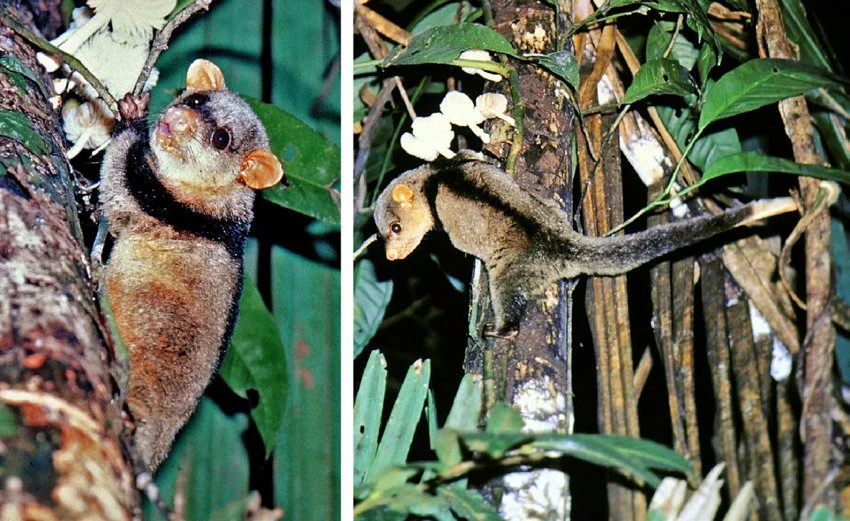
A black-shouldered opossum, Caluromysiops irrupta.
(© Márcio Martins / Wikimedia Commons)
³ First, Dr. Arévalo-Sandi and his team went digging through 350 publications, combing through species inventories and academic theses to eventually unearth 43 verified records.
However, they didn’t want to list where the opossum used to live; they needed to know where it was now. They capped their search timeline at 1985 — the year annual land-cover records from the MapBiomas platform began. They could then look at the exact coordinates where an opossum was found and see the state of the forest in that exact year of observation, and compare it to the current forest cover.
Next they turned to citizen science platforms. Out of fifteen unique sightings logged by the public on iNaturalist, eight had already been cited in past papers, but seven were entirely new to science. And rather than relying on massive, automated biodiversity databases — like the Global Biodiversity Information Facility (GBIF) — the team checked every record individually, removing duplicates and verifying locations.
Finally, they added their own original data. Building on Arévalo-Sandi’s doctoral research, they continued camera-trap studies between 2017 and 2023 across the Cuieiras, Manicoré, and Juruá river basins. Those surveys contributed a further 22 previously unpublished records, filling some of the largest remaining gaps in the species’ known distribution.
⁴ “At this stage, the priority is to reassess the species using the best available evidence rather than to advocate for a specific threat category,” explains Arévalo-Sandi concerning its current IUCN status. “The broader distribution may support the current classification, but localized habitat loss in several parts of the Amazon deserves careful consideration.”
Analysis of MapBiomas land-use data revealed that 48.6% of all verified Glironia records lie outside official Conservation Areas. Because half the known population exists in working or unprotected landscapes, long-term survival requires landscape-scale canopy connectivity rather than relying solely on protected reserves.
“In terms of conservation actions, protecting large areas of intact Amazonian forest remains the most important measure,” says Arévalo-Sandi. “However, the near-even split of occurrence records inside and outside Conservation Areas indicates that persistence depends equally on unprotected landscapes, reinforcing the need to move beyond a protected-area-only paradigm toward landscape-scale conservation that maintains functional connectivity.”
⁵ “We need to improve biodiversity monitoring in forest canopies, which remain one of the least studied components of tropical forests,” says says Arévalo-Sandi. “Adopting this pragmatic framework of targeted monitoring, proactive data sharing, and holistic management can help secure the future not only of this enigmatic species but also of other arboreal mammals across the Amazon.”
⁶ Arévalo-Sandi’s co-authors for the 2026 paper were Wilson Roberto Spironello, Maria Nazareth Ferreira da Silva, Andressa Bárbara Scabin, Fernando Ferreira de Pinho, and Fernando Trujillo. The earlier works of Andrew Whitworth, Corrie E. Rushford, Sean Glynn, Rogério Vieira Rossi, Thiago B. da Silveira, Javier Calzada, Natália Carneiro Ardente, M. Mónica Díaz, and David A. Flores paved the way for this modern synthesis.