Footnotes for The Pilotbird
¹ The pilotbird features as Track 19 on Songs of Disappearance, an Australian bird-call album released in December 2021 by the Bowerbird Collective in collaboration with BirdLife Australia and other conservation partners.
² Today the infraorder Meliphagides (or superfamily Meliphagoidea) ranges from polychromatically painted honeyeaters, boldly blue fairywrens, and delicately dotted pardalotes, to blandly brown-and-grey thornbills, gerygones, and bristlebirds. The unassuming pilotbird clearly fits in with the latter group.
³ This quote originates from Gregory M. Mathews's The Birds of Australia (Volume 10, published 1922–1923).
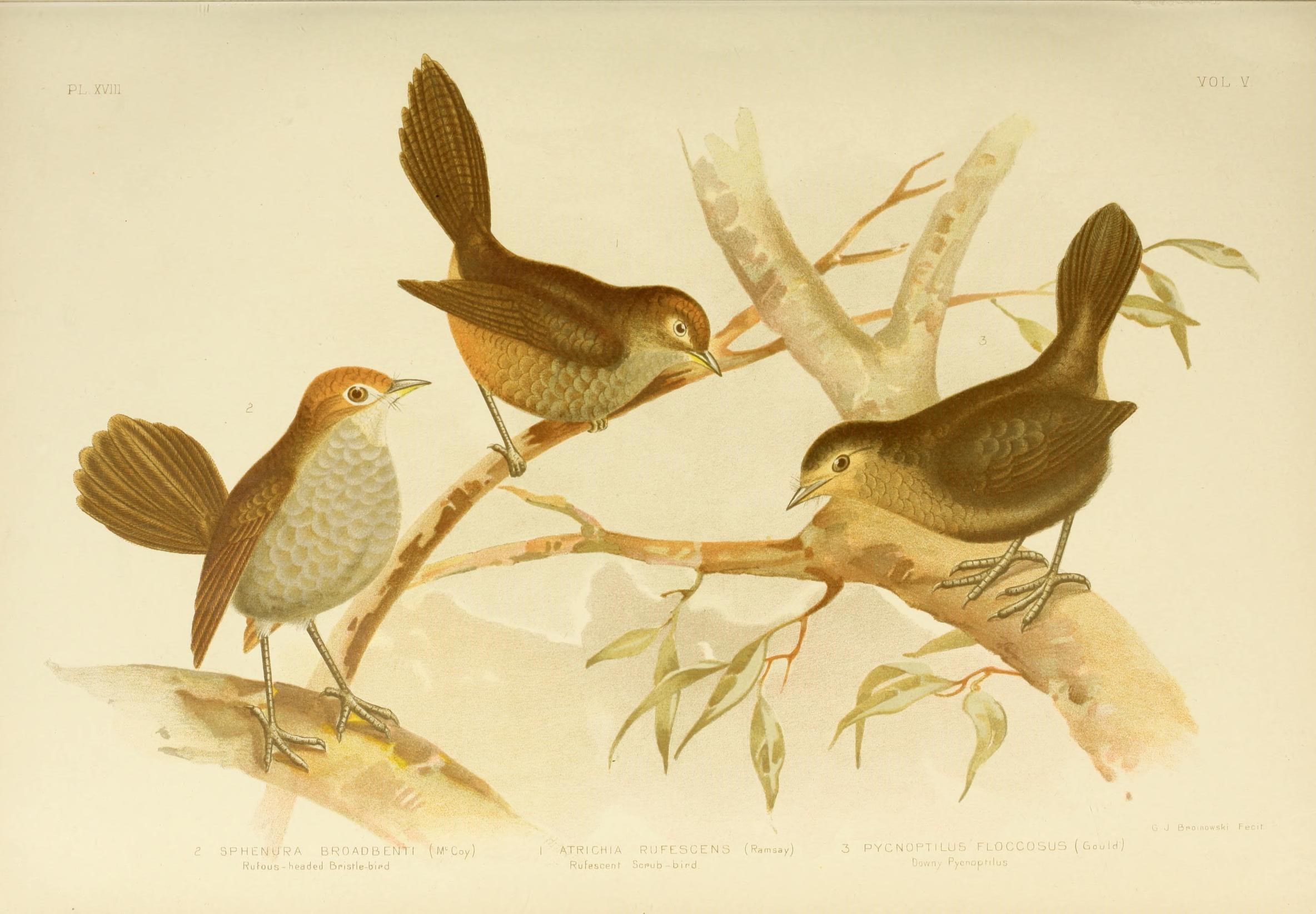
Rufous scrubbird (Atrichornis rufescens), rufous bristlebird (Dasyornis broadbenti), and pilotbird (Pycnoptilus floccosus)
Plate XVII from Volume V of The Birds of Australia (published 1915–1916) by ornithologist Gregory M. Mathews, illustrated by artist Henrik Grönvold.
⁴ The Acanthizidae family comprises some 66 species in 15 genera.
Acanthizids are small to medium-sized songbirds, and primarily insectivorous. Their habitats and habits range from wet-forest bark-gleaners to arid-outback ground-feeders, with closely related groups — like scrubtits and whitefaces — sometimes occupying completely different niches. As a result, the family was a frequent source of taxonomic confusion, with the pilotbird — long considered an evolutionary “missing link” bridging bristlebirds and acanthizids, but actually nested deep within Acanthizidae — being just one example.
Many of these species are found in Australia, including the weebill, the country’s smallest bird. But the family also extends north across New Guinea and Indonesia, as well as east to New Zealand and Pacific islands like New Caledonia, Vanuatu, and the Solomon Islands.
As of writing (Sep. 2026), the majority of acanthizids are considered to be species of Least Concern; a few, like the pilotbird and mountain thornbill, are Vulnerable; one, the fernwren, is Endangered; and one known species is extinct.
The following is from an article by S. J. Paramonov in a 1960 edition of the journal Pacific Science:
“The Lord Howe Island flyeater, Gerygone insularis, is also called the ‘rain-bird’ because it was active after rain, or the ‘pop-goes-the-weasel’ on account of the supposed resemblance of its song to that air. It is the smallest of the birds on the island, and belongs to a group with a wide distribution in Australia, New Guinea, the Pacific islands, and New Zealand. Hindwood (1938) regarded this species as extinct.”
The Lord Howe Island flyeater (or Lord Howe gerygone) likely went extinct after black rats were introduced to the island when the SS Makambo ran aground there in 1918.
⁵ Tree cavities, or hollows, are used by more than 300 species of Australian mammals, birds, reptiles, and amphibians. Over 100 bird species nest in tree hollows, including the many parrots and cockatoos of Australia, as well as owls, treecreepers, and even waterfowl like the wood duck. Mammals such as possums and gliders use them too.
And a tree doesn’t stop being useful when it falls: trunks, logs, and branches provide invaluable food and shelter for animals such as antechinuses, bandicoots, and bush rats.
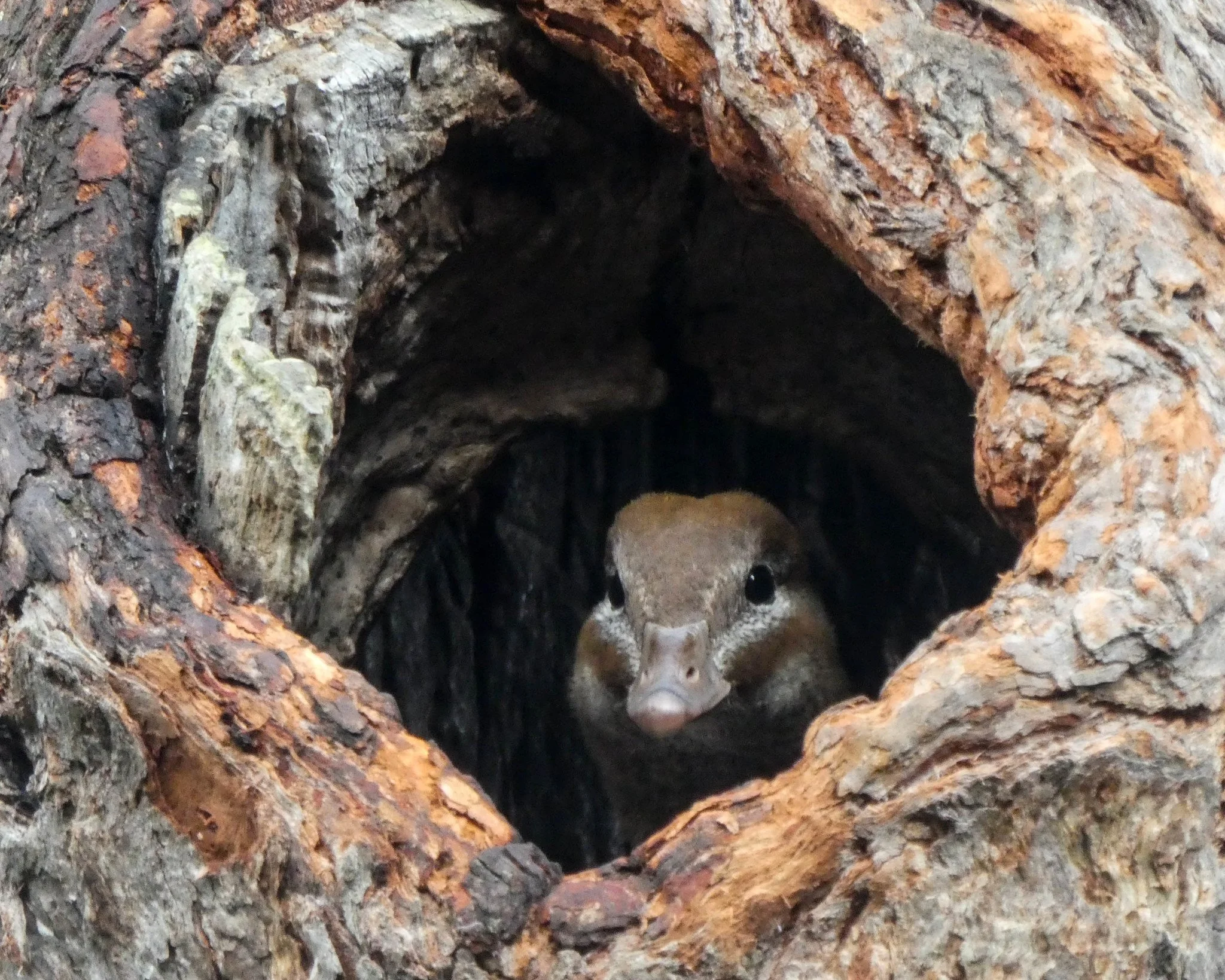
A young Australian wood duck, Chenonetta jubata, in a tree hollow.
⁶ The pilotbird isn't the lyrebird’s only follower.
“When lyrebirds forage,” says Maisey, “you often see yellow robins and scrubwrens that will all follow the lyrebirds around and pick up the scraps that the lyrebirds might miss.”
A 2025 study co-authored by Maisey revealed the extent of the lyrebird’s role as an ecosystem engineer — and thus its impact on the wider ecosystem.
Every year, superb lyrebirds displace an average of 155 tonnes of litter and soil per hectare, creating a mosaic of microhabitats where different kinds of invertebrates thrive. This “farming” by the lyrebird was found to increase the invertebrate biomass by approximately 52% and taxonomic richness by about 14%.
You can imagine how this might benefit a ground-foraging, insect-eating bird.
⁷ “They did try to introduce Lyrebirds back in the early 1900s and it failed,” says Maisey. “So there aren't Lyrebirds there at the moment, as far as we know. But there is a possibility that they are going to get back there.”
The Promontory’s isthmus, historically an open grassland, has become increasingly covered by native coast tea-trees, potentially providing a route for lyrebirds from the southernmost mainland population to reach the Prom.
“Now, I can almost imagine a Lyrebird getting across the isthmus under the canopies of these coast tea trees,” says Maisey. “But every time we shift animals around, there's a big, big risk involved.”
The introduction of lyrebirds to Tasmania in the 1930s has come to be seen as a mistake, as the lyrebirds alter the island’s unique ecosystems.
“Now, we've got many, many lyrebirds that are ripping up these ancient moss beds that have never been disturbed,” says Maisey, “and I think they'd probably be having big impacts on the invertebrate communities.”
⁸ These quotations are from Libby Robin’s book The Flight of the Emu: A Hundred Years of Australian Ornithology 1901–2001.
⁹ “One of what I would call a keystone structure in wet forests and rainforests in the Central Highlands,” says Maisey, “is tree ferns.”
In rainforests specifically, recovery after a fire is facilitated primarily by those tree ferns with big and soft, leaning trunks.
“So those structures are still there after a fire goes through an area,” says Maisey. “The leaning trunks especially are key germination sites for rainforest species to recolonise. And so if you salvage log, you're going to be knocking down almost all the tree ferns as well as taking out those logs, which are, you know, critical habitat in and of themselves.”
¹⁰ The pilotbird’s 2022 IUCN assessment reads: “Although the cause of this decline is understood and to at least some extent reversible, it is unknown whether the threat has ceased, with climate modelling consistently predicting that such extreme fire events will become more frequent in the future.”
¹¹ It has become difficult to research single species, explains Maisey.
“Increasingly, it's got to be big community or even global studies. If you want to get a paper in a high-ranking journal you really want it to be broad. And I think it's a real shame because you lose all of these species-specific studies. So to do a PhD on a single species, like I did, is just becoming more and more unusual. There'll be fewer of those in the future.”