¹ Ballard et al., 2021, conducted heart rate measurements on the common garden snail (Cornu aspersum) to test whether physical contact with conspecific slime triggers an internal physiological response.
Individual adult snails were secured and backlit using a high-intensity light, allowing researchers to visually count heartbeats through the translucent shell. Researchers then allowed each snail’s lower tentacles to touch a control slide (with clean glass or pure water) versus a slide coated in conspecific (same-species) slime.
The results: contact with conspecific trail mucus caused a statistically significant increase in heart rate, rising from a baseline average of 47 beats per minute to 51 beats per minute.
The authors suggested that this physiological change might represent either excitement from detecting a nearby conspecific, or a stress/arousal response that increases oxygen and nutrient delivery to prepare the body for locomotion.
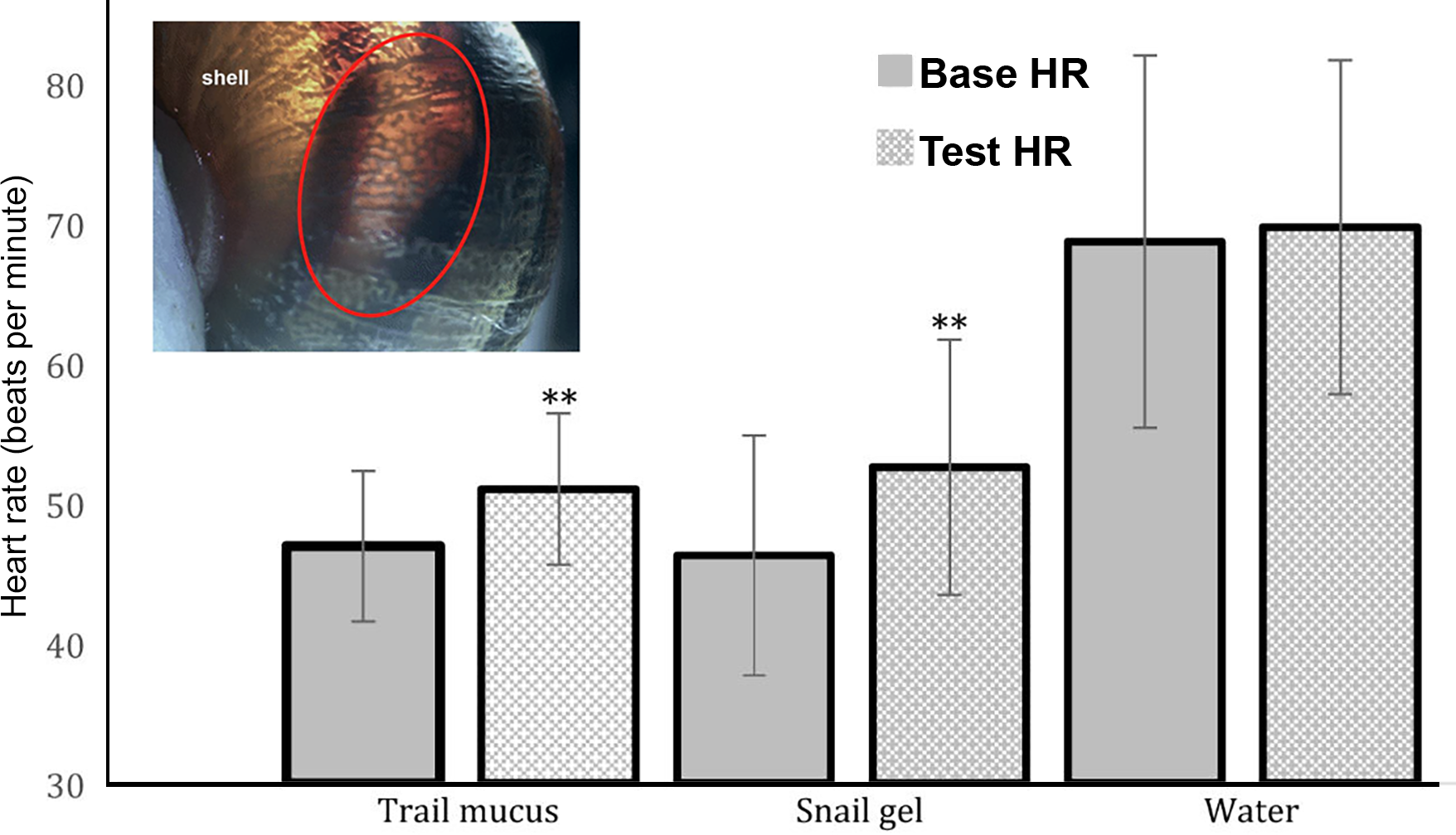
Mean heart rate before and after exposure to different substances. Mucus and snail gel caused significant change, while water did not. Photo shows snail’s heart seen through shell.
² The exact ratio of water to “other stuff” in snail slime varies across different species, habitats, physiological states, and even the parts of an individual snail’s body where the slime is secreted from.
³ Holland et al., 2018, conducted a study to test whether endemic Hawaiian tree snails use mucous trails as chemical communication networks for mate-finding and social orientation.
To simulate the snails’ natural canopy environment, the researchers constructed a Y-junction maze using branches from native ʻōhiʻa lehu trees, stripped of leaves and clamped horizontally. This was then used to see if the tracking snail would follow the leading snail up the same split in the branch.
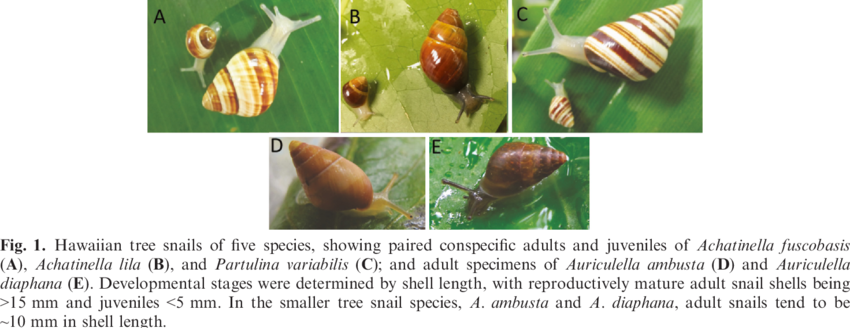
The team tested five endemic Hawaiian tree snail species. All species displayed statistically significant trail-following, although to varying extents ranging from 66.7% to 94.1%.
The study led to several other observations. Adults did not follow juvenile trails, and juveniles did not follow adult or juvenile trails. Adult tree snails showed no interest in trails laid by different snail species (~53% following rate, which is equivalent to random chance). And slime trails left for 24 hours lost their attractiveness and were no longer followed, suggesting that the chemical signals in the trails degrade over time (as the trail dries out).
⁴ While both adults and juveniles produce slime to glide across surfaces, their chemical compositions are fundamentally different, with adult slime being considerably more complex.
⁵ Predators have evolved to exploit reproductive signals in several ways. Parasitoid flies, for instance, locate calling male field crickets by sound.
Predators will even replicate the sexual signals of their prey to lure them, such as bolas spiders, who mimic female moth sex pheromones to attract male moths before snaring them with a sticky glob of silk at the end of a swinging line.
This has even led to some species going “mute,” ceasing to use their sexual signal (or quietening it) as the risk of predation is too great. Crickets lose the structures needed to produce their normal calling song, fireflies lose their courtship flashes, and frogs whisper instead of bellow.
⁶ Note that the lab experiments alone do not necessarily establish that this asymmetrical interaction between the two species occurs in the wild. However, the findings do offer one possible explanation for the apparent imbalance between the two species in the wild.
“We cannot yet say with certainty that Tanychlamys indica is being displaced by Lissachatina fulica in areas of India where both species coexist,” cautions Vinitha. “Such conclusions require continuous, long-term monitoring over several years to establish consistent trends. At present, our team is actively monitoring these populations in the field, and while we do observe lower numbers of T. indica compared to L. fulica, it would be premature to interpret this as definitive displacement without extended observation and data collection.”
⁷ “One of the reasons for the introduction of African snails is a researcher’s error in Kerala,” explains Vinitha.
According to historical accounts, a researcher named P. N. Radhakrishnan brought giant African snails to central Kerala in 1955.
“He carried the snails from another place to his place for study and he placed, into his garden, fewer than 10 snails,” Vinitha continues. “Those snails are the reason for spreading this infestation to the entire state.”
⁸ Synthetic slime would not necessarily eradicate invasive snails, but it could help control their movements and limit the damage they cause. Its greatest potential may lie in combining it with existing eradication methods.
For instance, synthetic slime could draw invasive snails towards bait stations containing a molluscicide or other lethal treatment.
It might also make manual collection more effective. Hand-picking is extremely labour-intensive, particularly because giant African snails spend much of the day hidden away. In heavily infested areas, synthetic lures might draw these snails into open, accessible spaces where they can be collected by hand.
Eradication would still require repeated efforts, however. A single treatment (whether it’s hand collecting or luring to toxic traps) is unlikely to reach every individual. Synthetic snail slime might then be useful in drawing out any residual survivors.