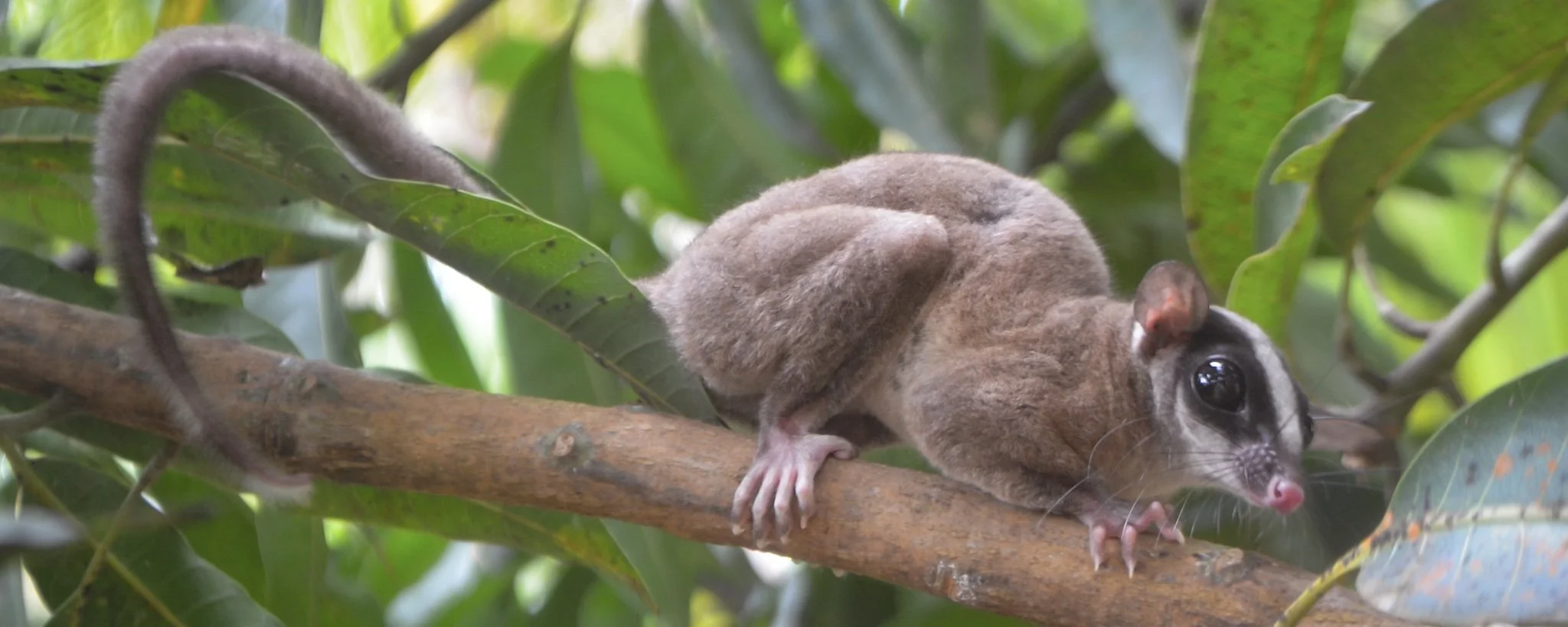
A bushy-tailed opossum, Glironia venusta. (© Mónica Páez Vásquez / iNaturalist)
The Matsés people of Amazonian Peru are renowned for their extensive knowledge of local mammals; from spider monkeys to pygmy squirrels, peccaries, armadillos, and short-eared dogs. Yet when shown illustrations and photos of the bushy-tailed opossum (Glironia venusta), Matsés hunters simply said they had never seen one.
For over a century since its discovery, this unusual marsupial was known from fewer than 25 sporadic specimens — it appeared to be one of the rarest mammals in all of South America. But a comprehensive new assessment published in the journal Mammal Review reveals that the bushy-tailed opossum is not so much rare, as very elusive.
It turns out we’ve just been looking for it in the wrong ways, in the wrong layer of the forest.
———
The bushy-tailed opossum, Glironia venusta, was first documented by zoologist Oldfield Thomas back in 1912 based on a single specimen from central Peru. He described it as the “most beautiful little opossum.”¹
Weighing a mere 140 grams — about as much as a baseball — this little marsupial sports a bold black stripe running from its nose and across its eyes like a mask. Its most distinctive feature, however, is its tail. Unlike the scaly tails of most New World marsupials, the bushy-tailed opossum has a tail that’s furred from base to tip, more squirrel-like than anything else.
In the century following its discovery, field researchers littered the floor of the Amazon rainforest with pitfalls and live traps, catching heaps of spiny rats and armadillos. They aimed their binoculars and shotguns into the branches at sloths and spider monkeys. But it wasn’t until the 1980s that truly practical and replicable methods began to be developed for surveying the rainforest canopy.
That same decade, entomologist Terry Erwin made his famous estimate: the world may contain as many as 30 million species of insects, he announced. He obtained this figure by fogging whole trees with insecticide and catching the fallout in sheets. Not long after he would describe the rainforest canopies as Earth’s “last biotic frontier.”
Early efforts to explore this frontier ranged from inventive to impractical: felling entire trees, shooting down branches, hiring skilled local tree climbers, and launching ropes into trees for ascent. Traps baited with fruit and nuts would be hoisted up into the canopies to procure mouse opossums. Nocturnal species were spotted by way of spotlights shone into the trees, revealing pairs of glowing eyes. And in one case, a scientist in Borneo even trained a monkey to retrieve epiphytes from the treetops.
And yet, by the time 2012 rolled around — a hundred years since the description of the bushy-tailed opossum — the species was known from fewer than 25 published records.
Several of those records were due to happenstance. One individual, recorded in 1983, was found tangled in a mist net meant for bats. Another was spotted during a 2004 nocturnal survey in Adolpho Ducke Forest Reserve near Manaus, Brazil. One of the most studied rainforest sites in the Amazon, the reserve had never yielded a record of the species before.
The researchers managed to follow it for a whole twenty minutes as it moved with a quick, nervous energy across the highways of branches and vines some twenty feet above the forest floor, often pausing to look back down at them. It seemed to be playing “hide and seek” with their spotlights — moving to the opposite side of the tree trunk to avoid the light, reappearing after a few seconds, before vanishing again.

———
In 2016, a research team climbed into the canopy of the Manu Biosphere Reserve in Peru. Their goal was to take “a proven method to new heights,” quite literally.
Camera traps, in one form or another, have been used to record animals at ground level for over 100 years. The research team, led by Andrew Whitworth, took these cameras and hauled them over 80 feet up into the vertical frontier. Looking back at what they’d captured, the team found the first-ever camera trap footage of the bushy-tailed opossum.
These recordings signaled the end of the species' status as an Amazonian “phantom.”
The following year, researchers Sean Glynn and Corrie E. Rushford took to the canopies around the Las Piedras Amazon Center in southeastern Peru. They climbed into the tallest emergent trees, and set up their cameras in areas of dense foliage and abundant vines, reasoning that these aerial corridors served as the opossum’s natural highways.
Up here, the branches splay and split unpredictably, tied together by tangles of vines. Standard camera traps, which are usually strapped around a trunk, were ill-suited to this messy, uneven terrain. So Glynn and Rushford had to innovate: they crafted custom L-shaped posts from wood, securing them to branches with heavy-duty elastic straps. The posts provided stable, level platforms onto which the cameras could be strapped, while flat wooden plates mounted above the cameras shielded them from the pelting rain.

The arboreal camera trap set up.
(© Ali Karlen / Rushford & Glynn, 2023)
These canopy cameras ended up recording 79 videos of bushy-tailed opossums — more encounters in seven months than had been recorded in the entire preceding century.
All recordings occurred at night, suggesting the species is strictly nocturnal, with its activity peaking at 8 PM and 3 AM. Every single 30-second clip showed the opossums traveling one way or the other, using these specific branches as canopy highways. Among the recordings were clips of opossums with their full, bushy-tails and one distinct individual with a truncated tail, meaning that multiple animals were traveling these same canopy routes.
One of the cameras recorded 71 of the 79 videos. It was placed 22 meters above the forest floor on the edge of the research facility, just 4 kilometres away from a rapidly growing logging and agricultural community. Two other cameras in the same study area recorded nothing at all.
———
As canopy field research advanced over the past decade, records of the bushy-tailed opossum began popping up across much of the Amazon. Those records then quickly became buried in various scientific journals and digital databases.
One of those records belonged to Alexander Roldán Arévalo-Sandi.
In 2018, at the peak of the rainy season in northwestern Brazil, Arévalo-Sandi was deep in the rainforest conducting his doctoral research. He and his team had deployed nine camera-trap stations with the goal of comparing mammal diversity between the forest floor and the canopy. Each station consisted of two cameras: the floor cameras were installed just 20 to 30 centimeters above the ground, placed near footprints or tracks, while the canopy cameras were hauled 15 to 20 meters into the trees, positioned on branches that looked out over potential footbridges.
The canopy camera traps revealed a bustling canopy community of rodents, primates and marsupials. Black-tailed hairy dwarf porcupines scrambled slowly past the camera, while brown-tufted capuchins and golden-handed tamarins swept through the upper canopy. The bare-tailed woolly opossum, recognisable by its starkly naked tail, was logged 13 times. The most abundant canopy species, however, was a rodent known as the plain brush-tailed rat, logged 26 times.
Both ground and canopy cameras logged 30 mammal species across 530 total encounters. The bushy-tailed opossum accounted for four of them, always in the canopy.
Naturally, Arévalo-Sandi wondered how his records of this rare animal fit into the broader picture of the species across the Amazon. But when he went searching for an answer, he found records of the bushy-tailed opossum fragmented across various papers and reports. The bushy-tailed opossum was a phantom of both the forest and the literature, showing up patchily here and there, seemingly at random.
“The project began after recent records obtained during my doctoral research in the Alto Cuieiras Reserve near Manaus,” says Arévalo-Sandi, “which led me to wonder how much information about the species remained scattered across the Amazon.”
Was the bushy-tailed opossum genuinely one of South America’s rarest mammals, found in small, isolated pockets of a vast green ocean? Or was its rarity an illusion created by our limited data?
Arévalo-Sandi — now Dr. Arévalo-Sandi — and his team went to work. They combed through more than 350 publications. They verified citizen-science observations one by one. Finally, they contributed their own original data: a further twenty-two previously unpublished records. Piece by piece, they constructed a picture of the animal’s actual distribution, revealing the truth behind its supposed rarity.
“We expected some expansion of the known distribution because many records had accumulated during the last decade,” says Arévalo-Sandi. “However, we were surprised by the magnitude of the increase.”
The completed map revealed a distribution approximately 77% larger than the most recent IUCN range, and more than doubled the number of verified localities represented in global biodiversity databases like GBIF.
This “rare” species, we now know, can be found across 60% of the entire sprawling Amazon biome.
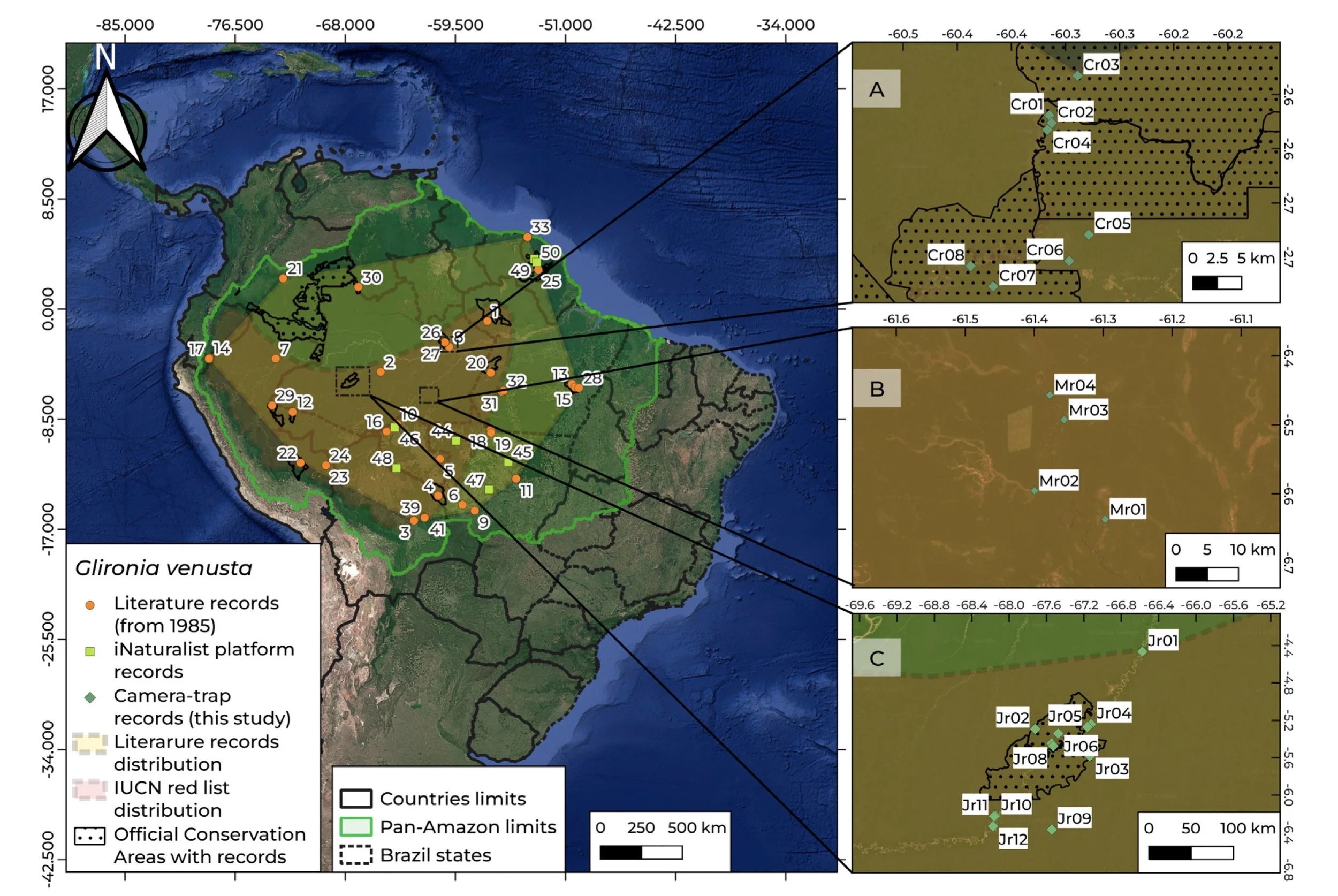
(© Arévalo-Sandi et al., 2026)
———
Back in 2011, when the bushy-tailed opossum was still considered a rainforest phantom, a hydroelectric dam project was underway in northern Brazil. Workers were in the process of felling an enormous Brazil nut tree; its canopy, extending nearly 100-feet skywards, came crashing down to the forest floor.
Within its mangled branches, they found a female bushy-tailed opossum and her three young. The mother, overwhelmed by the trauma of the ordeal, died of stress the following day. Her cubs didn’t make it two weeks without her.
The 2016 IUCN assessment of the bushy-tailed opossum reads as follows: “This species is listed as Least Concern, although it is poorly known. The species’ range is not under enough threat to qualify for a higher category, it has a widespread distribution, a large presumed global population, and is found in several protected areas.”
Surely, there’s even less need to worry about the species now. Right?
“Although the species appears to be more widespread than previously recognised,” says Dr. Arévalo-Sandi, “several of the newly documented localities occur in the southern Brazilian Amazon, within the so-called “Arc of Deforestation,” one of the regions most affected by deforestation and agricultural expansion in the Amazon Basin.”
One site within this arc, where the bushy-tailed opossum was recorded in 2004, saw forest cover plummet from 38% down to a minuscule 0.1% by 2023 — that’s 99.7% of its local habitat gone.
“The broader distribution provides some reason for optimism,” Arévalo-Sandi says, “but it should not be interpreted as evidence that the species is free from conservation threats. Like many Amazonian forest specialists, Glironia venusta ultimately depends on the persistence of intact forests.”
To arboreal species, the forest is less a collection of individual trees — as we tend to experience it from the ground — and more a kind of green ocean; a three-dimensional space consisting of branches and vines rather than water.
In 2012, a research team in western Brazil cornered a female bushy-tailed opossum in a small understory tree barely ten feet tall. With no vines running to adjacent trees, she was stranded. After fifteen minutes of deliberation — during which she sat perfectly still, watching the researcher below — she suddenly leapt down to the forest floor, sprinted to a taller tree, and vanished up into the greater canopy sea.
For a canopy specialist species, the ground is almost like dry land to a fish. As more forest is felled, the search for food or mates becomes a perilous dash across the forest floor where there are many less benign obstacles than field scientists.
“Protecting the canopy is important not only for Glironia,” explains Dr. Arévalo-Sandi, “but also for countless other species that depend on this habitat, including primates, rodents, marsupials, birds, reptiles, insects, and many plant species.”
The species most threatened by the felling and fragmentation of forests are those most specialised to arboreal lifestyles — those we’ve just recently begun to learn more about.
———
Call a species rare, and it may truly become rare. It is a kind of self-fulfilling prophecy. No one looks for it beyond the handful of places it's been seen. No one protects the places where it exists, but has never been recorded.
“Glironia venusta illustrates a simple but powerful message,” says Dr. Arévalo-Sandi. “We cannot effectively conserve what we do not know.”
When hundreds of Amazon River dolphins died during recent extreme droughts and heatwaves, the disaster made international headlines because they are such prominent, iconic animals.
“But if such visible species can be affected so dramatically by environmental change,” asks Dr. Arévalo-Sandi, “what might be happening to small, elusive mammals living high in the forest canopy that are rarely seen and seldom monitored?”
The Amazon river dolphin is a flagship species for its habitat. The African savannah has a flagship species in the bush elephant, China’s temperate broadleaf and bamboo forests in the giant panda, and the Arctic sea ice in the polar bear.
The Amazonian canopy, this frontier habitat, needs a flagship species of its own.
“Glironia venusta is particularly well suited for this role because it is both charismatic and mysterious,” says Dr. Arévalo-Sandi. As a symbol and ambassador, this opossum could represent the long-hidden history of its habitat, and of all the other obligate arborealists that live there: the petite primates, common canopy rodents, and fellow cryptic marsupials.
By piecing together a century of fragmented literature, citizen science observations, and camera-trap records, the work of Dr. Arévalo-Sandi — of Whitworth, Rushford, Glynn and others — has unmasked this canopy phantom.
Now we know where the opossum lives; we’re learning more about how it lives. But will we act to save it, and all of its canopy companions, from truly becoming rare?