A green-pigeon (genus Treron) is as much a part of a rainforest canopy as the leaves on the branches or the dangling figs.
Large flocks clamber through tree branches across tropical Africa and Asia, like so many dumpy, feathered squirrels. They hang upside down, plucking figs and tender leaf buds. They are golden and orange and, of course, brilliantly green.
Far from the rainforest, inside a wire-mesh cage, lives a smaller flock of pigeons. They peck at bowls of grain and seed. These are also green-pigeons, though they hardly look deserving of the name, for their feathers are sombre purple and grey.
———
A rainforest canopy is overwhelmingly green. Sure, there are red figs, yellow berries, and deep purple plums, but these hang between countless virescent leaves. The leaves get their green from chlorophyll, a pigment that absorbs much of the blue and red light from the sun — capturing its energy for photosynthesis — and reflects back green as a sort of visual by-product.
Animals, however, do not have chlorophyll. Grasshoppers, frogs, snakes, and all the other green animals, including green-pigeons, must attain their green by other means.
There are two broad routes: through pigments and through structure.
Pigments, like chlorophyll, are picky molecules. They absorb particular wavelengths of light while reflecting others. Very few birds produce green pigments of their own; in fact, only one bird family — the turacos of Africa — do so, making a unique pigment known as ‘turacoverdin.’
Other birds, if they want to be green, must make use of structure. Microscopic structures within a feather or on the surface of skin scatter and reflect light, sending more green back towards an onlooker’s eyes than wavelengths of other colours. Certain jewel beetles and emerald-patched butterflies produce their brilliant metallic green purely through structure alone. But these, again, are the exceptions.
Most green animals are green from a combination of structure and pigment.
———
“On 20 September 1999, a chick was blown out of a nest in strong winds, and died. Its crop was full of fresh Msasa leaves, some few fruits, and bits of fruit from F. burkei and F. sycamorum [fig trees] and fresh leaf buds.”
During his nine years studying African green pigeons in the Trelawney district of north-central Zimbabwe, Ant Fynn had come across several chicks who had been blown from their nests. Some, tragically, had already died. Others, still clinging on to life, he took in and cared for.
These chicks, with their unkempt pale-olivine plumage, had yet to take on verdant adult colours. Fed on a captive diet, they remained pale, until, writes Fynn, “we started adding the fresh red and green Msasa leaves to their diet.”
A green pigeon lays down a dark foundation of melanin within the feather — a pigment produced within its body that can appear as greys, blacks, and browns. Above this foundation, the feather develops an intricate nanostructure made of keratin and air that changes the appearance of the underlying colour; not to green, however, but a greyish purple.
The pigeon then needs a final colour, one its own body cannot produce: yellow.
So it becomes a foraging chemist. It finds figs, berries and other fruits. It extracts their yellow carotenoid pigments and directs some of those molecules into its growing feathers.
“Can we now answer the question ‘why do Green Pigeons lose their colour in captivity?’” asks Fynn in a 2022 paper.
Like sunlight filtered through a forest canopy, some wavelengths of light entering a green-pigeon’s feather are scattered by the microscopic keratin structures while others manage to travel deeper down. The dark melanin beneath absorbs stray light, while the yellow carotenoids absorb much of the shorter wavelengths passing through the feather.
What emerges is neither the blue of the structure nor the yellow of the pigment, but the leafy green of the forest canopy.
———
Naturalists have been remarking upon the crypticity of green-pigeons for centuries.
In an 1898 volume of The Fauna of British India, W. T. Blanford wrote that “They always perch on trees, and resemble the foliage so closely in colour that it is often almost impossible to see them unless they move, and even then difficult to watch them.”
As a general rule, if a bird species is named for its appearance, and the species is sexually dimorphic, it is named after the appearance of the male. However, it is the green-pigeon females that are the reliably verdant sex, their plumage tea-green or olivine, sometimes with a yellowed tint.
The males, on the other hand, are eclectic.
A male Sumatran green-pigeon has a bill that graduates from green to blue. Bruce’s green-pigeon has a bright yellow belly. The little green-pigeon a vivid orange breast. And you can guess what colour feet the yellow-footed green-pigeon has, or what colour the pink-necked green-pigeon wears around its neck.
These colours are not splashed randomly across each bird. They are variously applied to feathers, skin, and keratinous beak. Patchwork combinations of structures and pigments cover a green-pigeon’s body to make one area green, another yellow, and another maroon. And, given that it is only males who wear such ornamented attire, its purpose is pretty clear.
The appearance of a male green-pigeon, therefore, must serve two counterintuitive purposes: to blend in and stand out, to hide and attract attention.
In April 1971, while doing research in northern Ghana, zoologist J. Frank Walsh noticed a yellow-bellied green-pigeon sitting on a nest about three meters off the ground in a bare, unidentified tree. Walsh circled the tree to get a better look at the bird, but his view didn’t change — the pigeon’s upraised tail was always presented towards him.
The bird had “imperceptibly shuffled round” on its nest, so that all Walsh could see was the underside of its tail feathers, which, he noted, “looked like a piece of bark.” Only after he moved some distance away from the tree was Walsh able to get a view of its flank; of its conspicuous purple shoulder patches and bright yellow underparts.
As sloths were defined by slowness and peacocks by their extravagant beauty, crypticity defined the green-pigeons. All the way back in 1845, English zoologist Edward Blyth wrote that entire flocks often “eluded observation from the similarity of their colouring to that of the foliage.”
But that was only half of the green-pigeons image. They were cryptic birds, hidden as leaves in the canopy, but they were also tasty birds — and so they were hunted birds.
What appeared to be empty canopies produced, as if by magic, several plump pigeons with every blast of a shotgun. Blyth continued, describing how, when a hunter shot at one visible bird, “two or three will commonly fall” that had been previously hidden.
———
It was September 6th, 1969. Baldev Singh Lamba had spent over an hour unsuccessfully stalking a pair of black-winged kites near the city of Pune for the Zoological Survey of India. He could see these monochrome birds — with their greyish-white bodies, black wings, and blood red-eyes beneath dark brows — but they were “very wary,” and would not let him get close.
Frustrated by the kites, he instead turned his attention to a group of around fifteen yellow-footed green-pigeons perched nearby on a tall fig tree. Lamba told his helper to flush out the birds, and on his signal, his helper threw a stone at the tree.
As the flock flew overhead, Lamba fired a “long shot” with a twelve-bore shotgun, injuring one of the fleeing pigeons. As the wounded bird was “sailing through the air losing height,” one of the black-winged kites suddenly swooped in and grabbed the falling pigeon, carrying it away before it could hit the ground.
The black-winged kite is not a big raptor. Its usual prey consists of insects, small reptiles, rodents, and small birds. But a fat green pigeon, weighing nearly as much as the kite itself, was clearly too enticing a meal to pass up.
Green-pigeons have long been hunted for their rich, often fatty meat — and not just by birds of prey.
18th-century explorer James Bruce reported seeing green pigeons in Abyssinia that were “excessively fat” from gorging on fruit. They can become so heavy, according to Bruce, that when they are killed and fall to the ground, “the fat which covers the rump breaks like the pulp of an orange.” In Thailand, yellow-legged green-pigeons have likewise been said to be “so gorged with figs that they burst open upon striking the ground.”
In addition, Bruce noted that “the flesh is excellent,” joining in a chorus of early naturalists all decrying the delectability of the green-pigeons: that they “all afford excellent eating” and are “good birds for the table.”*
Green-pigeons continue to be hunted across their range: from southern Africa to India to southern Indonesia.
In parts of Africa and Southeast Asia, hunters utilize a sticky latex derived from trees known as birdlime, which is smeared on branches to trap pigeons as they land to feed. In other regions, such as the island of Pemba, green-pigeons are easy targets for adolescent hunters, who use slingshots (known as panda) or traps (called fyuka), while hunters on São Tomé target them with air guns.
In Côte d’Ivoire, they are sometimes served at city bars to entice customers. In Timor, their oily meat (locally called rekus) is considered a delicacy. In 2015, more than 300 green-pigeons were recorded at a single market in the Gayo Highlands of Sumatra.
But not all the fruit that green-pigeons feast on are turned to fat.
Unlike other fruit pigeons, green-pigeons possess thick, muscular gizzards filled with grit that grinds up and digests small seeds. They are seed predators, consuming and destroying the forest’s future trees.
Yet green-pigeons are also very clumsy. Their boisterous feeding can cause them to drop up to 24% of the fruits they pick. And from these fruit-falls more fruiting trees sprout anew.
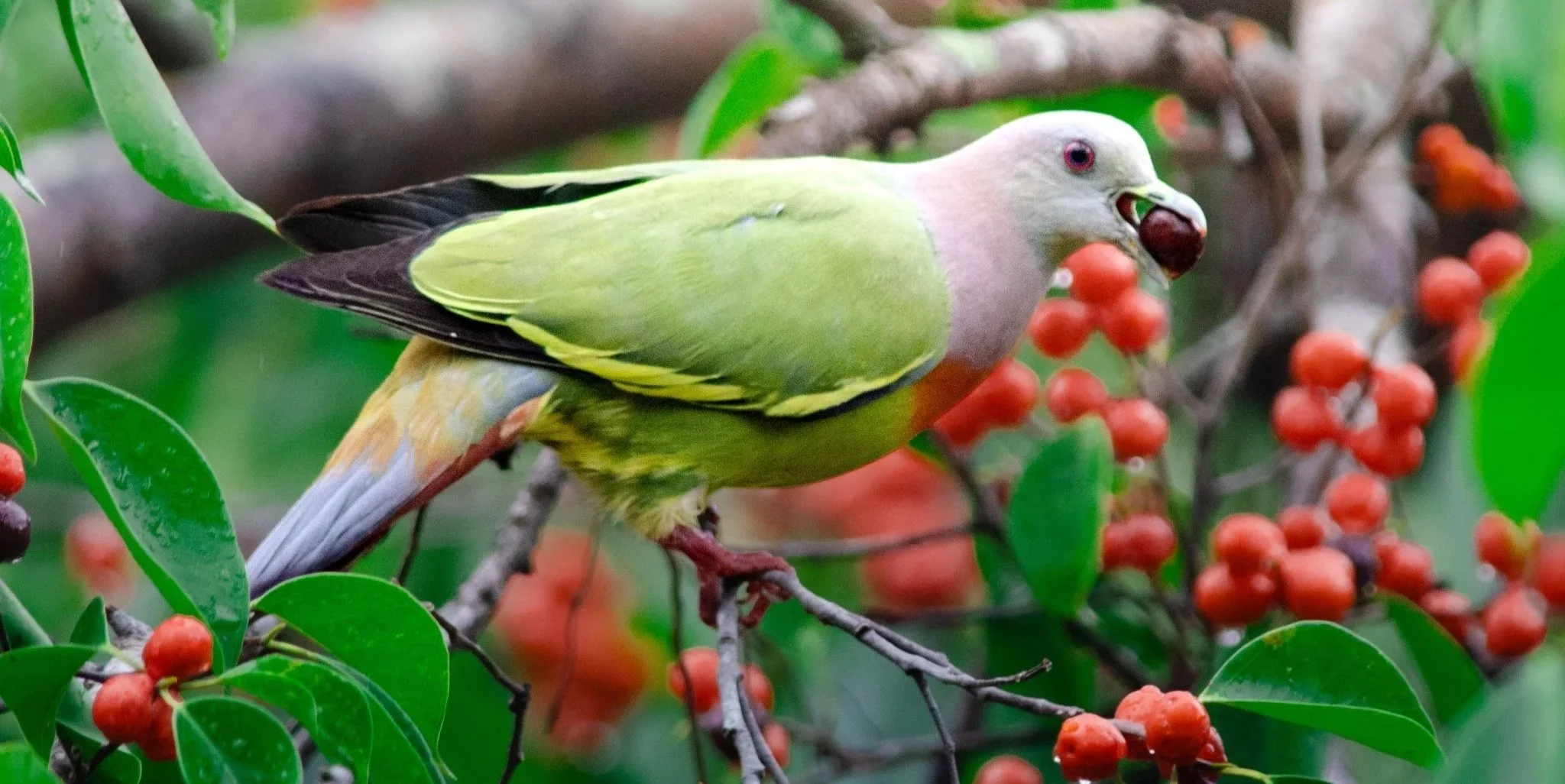
A pink-necked green-pigeon, Treron vernans, eating fruit.
(© Matt Vincent Leonoras / iNaturalist)
———
In the Indian city of Vadodara, on an Oil and Natural Gas Corporation campus, stood a dry, leafless cassia tree. But, on this cold winter morning, it did not look barren.
All along its branches perched tens and tens of green-pigeons: their bodies moss-green and yellow, with bluish-gray crowns and striking purple eyes. They all faced the sun, their feathers fluffed-up and yellow legs covered, absorbing its heat.
The campus had plenty of lush banyans, neems, and peepal trees, but every morning, day after day, the pigeons gathered on the cassia. Eighty-nine pigeons in all were counted on this single tree, bringing its barren branches back to life like so many leaves.
While some species, such as the yellow-footed green-pigeon, can find refuge in cities like Vadodara, many other green-pigeons are restricted to more pristine habitat.
Some time in the prehistoric past — during a pluvial period, when humidity was high and the rains would fall and fall — a continuous belt of rainforest stretched from Southeast Asia across India, reaching as far west as the regions surrounding modern-day Vadodara. During these wetter times green-pigeons are believed to have ventured out from Asia, crossing the then-green Arabian Peninsula, and travelling down into the tropical forests of Africa.
But these corridors were eventually severed.
As the global climate dried, the vast tropical forests retreated up the slopes where they could still catch moisture from the passing clouds. The ancient mega-forest was fragmented by drying lowlands. Populations of green-pigeons became isolated — as they had on the many islands of Indonesia and the Philippines — and over time, these isolated populations became separate subspecies and eventually species.
Today, there are some thirty in all.
Some still live across vast ranges. The yellow-footed green-pigeon, for instance, is found across the entire Indian subcontinent and even parts of Southeast Asia. It is the species most capable of adapting to degraded forests and urban habitats. As of writing (Aug 2026), it is also the only species with an increasing population.
The population trend of every single other green-pigeon species evaluated by the IUCN is decreasing.
The pin-tailed green-pigeon is “is tentatively assessed as being in decline due to habitat.”
The Madagascar green-pigeon is “suspected to be declining slowly in response to ongoing forest cover loss.”
The large green-pigeon “has seen large portions of its range converted from low-lying forest (on which it depends) to agriculture…”
The Pemba green-pigeon is “inferred to be rapidly declining as a result of habitat loss and degradation.”
For the Sumatra green-pigeon, “the forest immediately surrounding the current range of the species has been heavily damaged.”
———
There is a fable from the Riau Malay people of Indonesia regarding the origin of the Sumatran green-pigeon. In the story, a father sends his two lazy daughters to clear some land by burning the grass, but instead they fall asleep in the field. When the father arrives and sees the still-grassy field, he lights the fire himself, not realising his sleeping daughters are still in the field. As the girls perish, surrounded by flames, they transform into green pigeons. Their mournful cooing is said to be a warning: laziness leads to ruin and to death.
Far to the southeast of Sumatra, at the opposite end of the vast Indonesian archipelago, lies the island of Timor. Over the past two centuries, its rainforests have been burned and felled, until lowland forests covered less than 10% of what they once did.
The Timor green-pigeons crowded into shrinking fragments. Fewer and fewer fruiting trees remained. Those few that did drew larger and larger flocks. And the fruiting of a tree is a predictable event.
A hunter stands beneath a large gathering of green-pigeons in a fruiting tree. He fires his gun and a green-pigeon topples from its perch. But the rest of the flock doesn’t scatter. They scarcely move at all.
In eastern Timor-Leste, the green-pigeon is known as tule, meaning “deaf,” because they appear “deaf” to the danger they’re in.
But the Timor green-pigeons are not deaf, nor are they lazy. Much larger raptors than black-winged kites patrol the skies, searching the canopies for movement. If the pigeons all scattered at the sight of danger, they could be easily picked off in flight. But as long as they remain still in the canopies, all a raptor sees is an ocean of green leaves. And leaves don’t flee from danger.
The hunter reloads, and shoots again.
———
The name of the green pigeon genus, Treron, comes from the Greek trērōn, which simply means “dove.” The Greek word itself, however, derives from the root treō — meaning “to flee from danger.”
The Timor green-pigeon, surrounded by the fires of humanity, has nowhere to flee as it is gunned down, even if it chose to.
But the Timor green-pigeon is only one Treron species.
The green-pigeons have spent hundreds of thousands, even millions of years in some cases, diverging from one another on their islands and in their montane rainforest fragments. The species have come to speak in different voices: some sing a melodic whistling song while others sound like the “weird, prolonged cry” of a child in pain. The males have painted themselves in strikingly different colours and patterns: pink-necks, yellow-bellies, orange-breasts.
Each species carries its own evolutionary history, and each faces a different future.
The yellow-footed green-pigeon may continue to thrive in cities, finding food and shelter among the fruiting trees that grow there. Other species may not be so fortunate.
A wild green-pigeon is as much a part of a rainforest canopy as the leaves on the branches or the dangling figs. A green-pigeon’s plumage is the forest canopy; digested, metabolised, and visibly expressed, used for camouflage and for courtship.
Destroy the canopy, and you destroy the biochemical potential for beauty and complexity, leaving a palette of greys, blacks and browns. Even if the pigeons survive, adapted to the degraded forest and urban environments, we may find a much less colourful avifauna.