From courtship to warfare, the surprising importance of a snail’s slime trail
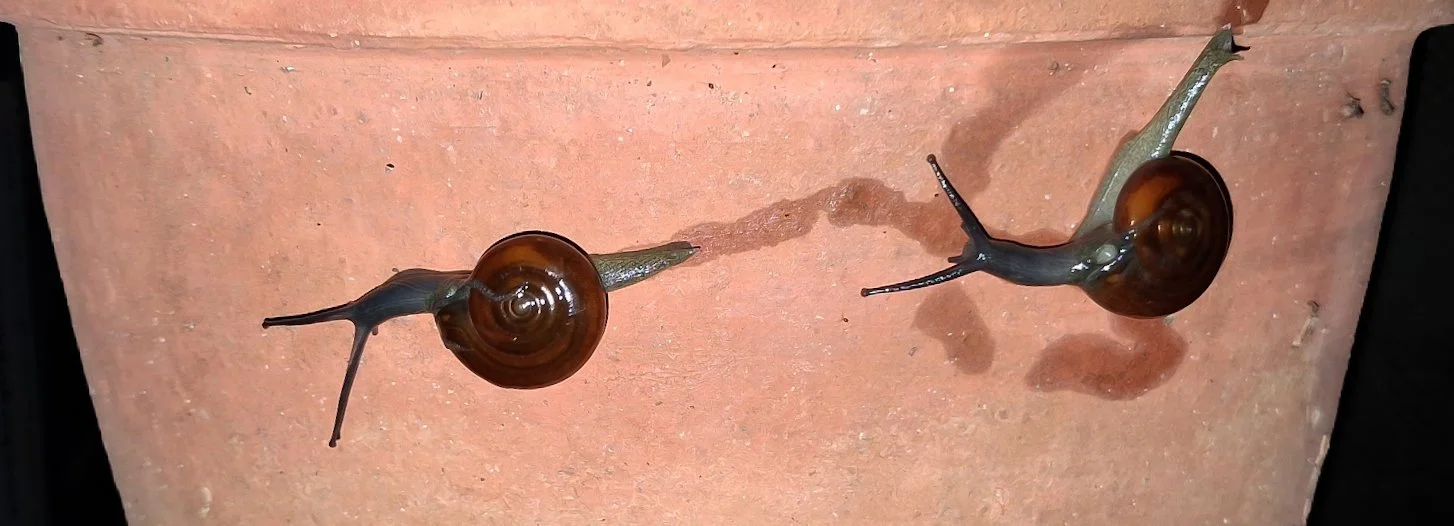
Two Indian horntail snails, Tanychlamys indica. (© Sayak Dolai / iNaturalist)
In a darkened laboratory, scientists stare at the pulse of a snail’s two-chambered heart.
Its shell is backlit with a high-intensity lamp, revealing its inner workings. On a slate of clean glass, its pulse is a steady 46.9 beats per minute.
Then one of its lower tentacles brushes against a streak of fresh slime, left behind by another snail. Subtly, but suddenly, its pulse rises to 51 beats per minute.
Is this a surge of excitement, perhaps, or the onset of fear? Whatever may be happening in its little snail brain, the slime certainly elicits a reaction — something has sent its heart beating a little faster.¹
———
A snail trail looks like nothing more than an iridescent streak on a garden path or wall.
That streak, the snail’s slime, is composed primarily of water — around 95%. The other 5%, however, is a mixture of peptides, sugars, proteins, lipids, volatiles, and metabolites. If it sounds complicated, that’s because it is.²
That 5% is a snail’s pharmacy; compounds in the slime help repair the tiny cuts a snail might sustain while gliding over rough terrain and protect it against pathogens.
Left in the snail’s wake, on pavement or plant, the slime goes from medicine to message.
Encountering a trail laid by another member of its species, a tree snail locks on. It taps the ground with its short lower tentacles, reading the chemistry of its fellow snail’s mucus. Even when the leading snail spirals erratically around a tree branch, the chasing snail keeps resolutely to its course.³
However, only the adults follow one another — juveniles do not tail their fellow snails. These trails, then, are dating hotlines too, used by adult snails to track down potential mates.⁴
But it is not only snails that follow these slime trails. A signal intended for reproduction can become hijacked for purposes of predation.⁵
The New Guinea flatworm (Platydemus manokwari) — a slimy, ribbon-like creature some five centimetres (2 in) long — hunts almost entirely by scent. As it glides through the damp leaf litter, it continuously sways its flat head from side to side, lightly tapping the ground to sample the substrate for chemical evidence of a snail’s slime trail. When it finds one, the flatworm must make a choice: which way to go, for one direction will bring it towards its prey, while the other will take it further away.
If it chooses wrong — if it senses the trail’s intensity fading — it doesn’t just give up; it turns around and begins to backtrack, travelling the entire length of the trail in the opposite direction until it catches up with the slow-going snail. Once its trail has been found by a flatworm, a snail is essentially marked for death, as its stalker creeps towards it to devour it alive.
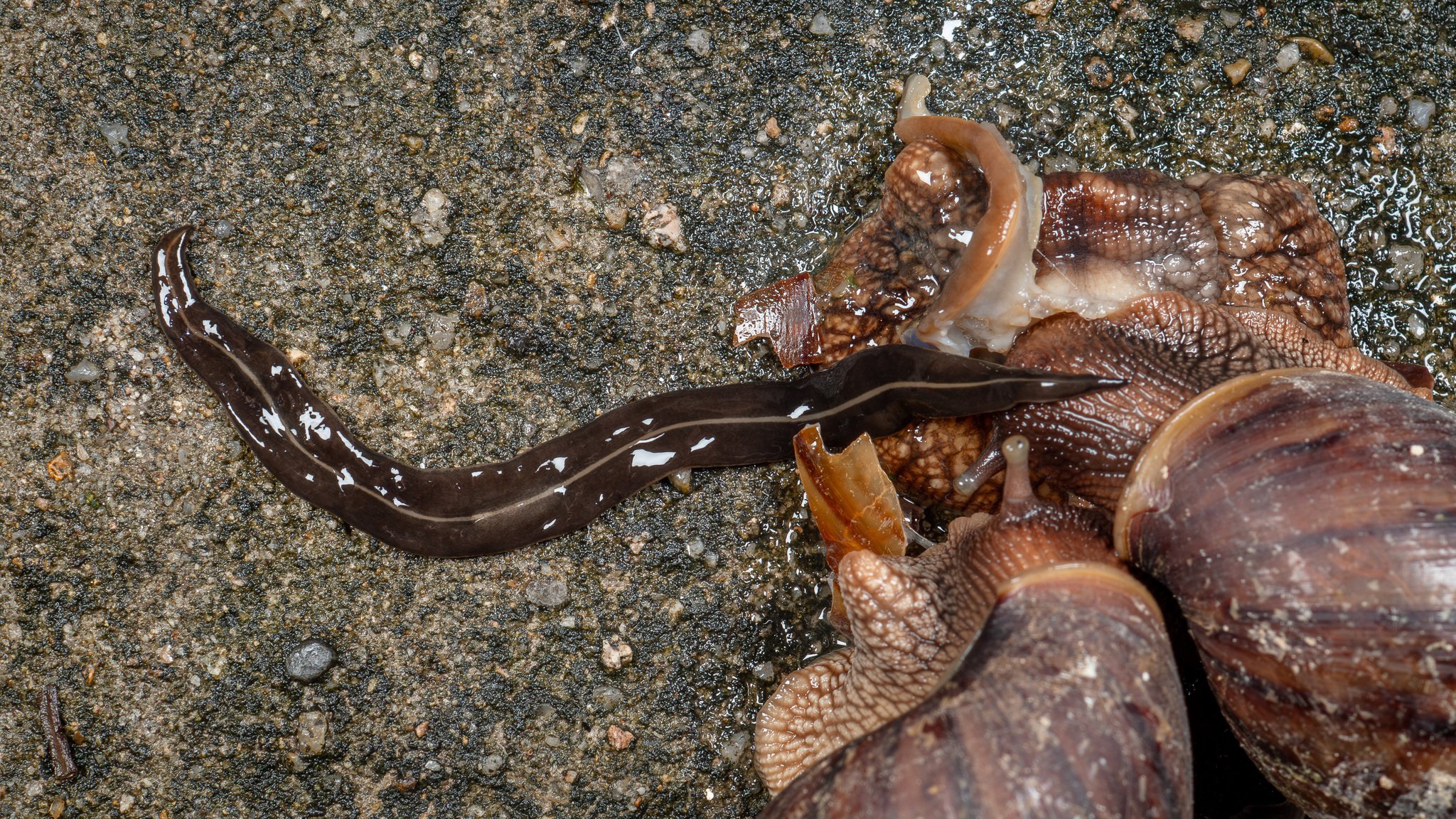
A New Guinea flatworm, Platydemus manokwari, homing in on two snails.
(© 渔喵 / iNaturalist)
So relentless a snail-predator is the flatworm that it was recruited by humans as a biological control agent.
In the mid-to-late 20th century, agriculture officials intentionally introduced the New Guinea flatworm across several Pacific islands in the hopes that it would eradicate a major invasive pest: the giant African snail (Lissachatina fulica).
The giant African snail itself had been unintentionally introduced to the Japanese island of Chichi-jima in 1937 and subsequently exploded in numbers, reaching densities of up to one million snails per hectare by the 1980s.
Meanwhile, the flatworm had escape containment. Hidden in imported plants and soil, it began appearing unexpectedly on islands like Chichi-jima.
“On Chichi-jima Island, P. manokwari has caused population declines even in the giant African land snail, suggesting that it may have some potential as a biological control agent,” says Dr. Shinji Sugiura, who led the field studies tracking the flatworm’s impact across the Ogasawara Islands.
But an adult giant African snail is a massive, heavily armoured target that is difficult for a flatworm to overpower. The island’s native snails, however, are small and all but defenceless. “Consequently, smaller native species may decline or become extinct before P. manokwari populations become sufficiently dense to suppress L. fulica,” says Dr. Sugiura.
On Chichi-jima and on many other islands, the flatworms swarmed the trails of defenceless native snails.
“Before the invasion, many native snails could be found along forest paths and on vegetation,” recalls Dr. Sugiura. “However, as P. manokwari became established, large numbers of empty shells began to accumulate on the forest floor. Eventually, as more time passed, these forests became places where hardly any living snails could be found. The transformation was striking, as forests that had once been home to abundant land snails became almost devoid of them.”
The giant African snail, meanwhile, continues to be among the world's most destructive snail species.
———
In a small crop field, beneath the hot midday sun of Kerala, southwestern India, a team of researchers collect snails into a 15-litre bucket.
“The snails felt sticky to the touch, leaving slime residues on the hands,” recalls lead researcher Meluveettil Vinitha. “Within about half an hour the bucket was filled.”
The giant African snails crawl slowly up the sides of the bucket, clustering around the lid.
“Although the bucket was not excessively heavy, the sheer number of individuals gathered in such a short time highlighted the scale of infestation.”
The giant African snail is an invader across much of the world’s tropics and subtropics — including India. It has an indiscriminate appetite for more than 500 different plant species. It gnaws on concrete house foundations to extract calcium for its thick, 20-centimetre-long shell. During the monsoon season, it invades homes, swarms kitchens, blocks drainage pipes, and can even force families to evacuate their homes.
As the researchers comb the field, they find the small, amber shells of native Indian horntail snails (Tanychlamys indica) scattered in the soil around them — empty, picked clean by birds. They find not a single empty shell of a giant African land snail.
———
As the sun goes down, Vinitha and her colleagues don’t leave the laboratory; they don’t go home for the night. Their test subjects are just beginning to stir.
The 300 snails they’d collected in the sunny Kerala fields are waking in their glass terraria: 150 invasive giant African snails, with their flame-striped conical shells, and 150 native Indian horntails, with tiny upturned spikes at the tips of their tails.
Two arenas have been set up: a 50-centimetre-square arena for the coin-sized native horntail and a one-metre-square arena for the giant invader.
Vinitha gives each snail a gentle five-minute soak in a shallow Petri dish of water — a brief bath to hydrate its foot and rinse away any soil — before placing them, one by one, in the centre of their respective arenas.
“I feel that some of the snails are like my companions or my friends,” says Vinitha. “I know their movements. I know their feel. I tell my snails: do your best, do your best!”
In each trial, the floor is swabbed with one of three solutions: homospecific slime (from the same species), heterospecific slime (from the other species), or a control (distilled water). Across a fifteen-minute window, overhead cameras track every movement, every twitch, every pause — to see what happens when these snails, native and invasive, encounter one another’s slime.

The results were strikingly asymmetrical.
Both juvenile and adult horntails became less active in the presence of giant African snail mucus. They moved more slowly, covered less ground, and spent more time withdrawn into their shells. Conversely, in an arena coated in native horntail slime, the invasive African snails didn’t freeze up. In fact, they did the opposite: the adults moved faster and covered greater distances.
The invader’s slime seemed to suppress the exploratory behaviour of the native horntail, while the horntail slime acted as a stimulant, encouraging the giant invader to explore more.
———
What could explain these opposing reactions? And what would be the consequences if this asymmetrical behaviour, observed in the lab, also plays out in the fields?⁶
“Adult L. fulica respond to the slime cues of the native T. indica with heightened exploratory behaviours because they interpret these trails as positive environmental indicators,” explains Vinitha. “Slime deposits signal favorable microhabitat conditions — adequate moisture, shelter, and shared resource availability. Rather than perceiving them as deterrents, L. fulica exploit these cues to expand their foraging range.”
But boldness and exploration are not inherently superior traits. Boundless curiosity often leads to becoming prey. An animal’s willingness to move, forage, and explore is never arbitrary, but calibrated to the dangers it evolved alongside.
Every species lives in its own “landscape of fear.” This is a kind of psychological geography. For a nocturnal mouse, it might mean the relative safety of dense brambles, beyond which lies the danger of an open clearing.
For a land snail, that usually-invisible landscape can be quite literally drawn out in mucus, like a topographical map of risk: here, a ridge of safety free of slime, there, a steep valley of danger coated in menacing mucus.
However, it is possible for a species to escape its landscape of fear.
Every invasive species is native somewhere. In its native East African ecosystem, a giant African snail moving with careless curiosity would quickly pay with its life — it would be snatched up by a banded mongoose, attacked by snail-feeding carabid beetles, or feasted on by predatory snails like the green wolf.
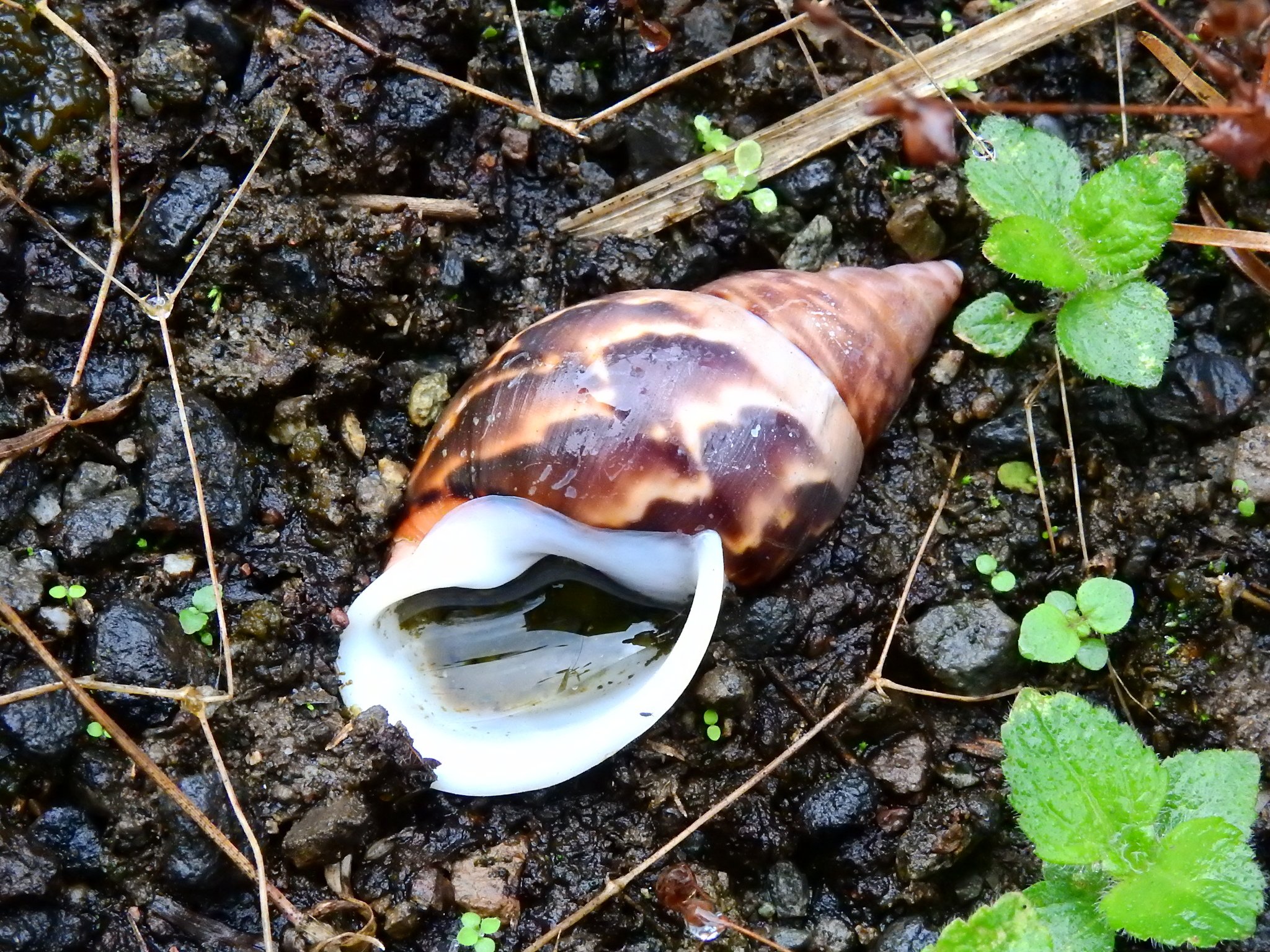
The empty shell of a giant African snail, Lissachatina fulica.
(© Esteban Poveda / iNaturalist)
But what punishes the African invader’s brazen exploration in the fields of Kerala?
“In invasive ranges, L. fulica face no specialized predators, removing natural checks on their bold behavior,” explains Vinitha. “This absence of predation pressure allows them to treat slime as an opportunity rather than a risk.”
The more expeditiously an invasive species explores a new habitat, the quicker it establishes a foothold, expands its range, and explodes in numbers. “Slime trails,” says Vinitha, “are used to maximize resource acquisition and establish territorial control.”
And the native horntail?
It gets no respite from predation — common mynas, house crows, and greater coucals readily hunt it across its native range. The horntail tucks its head into its shell and remains hidden in moist garden patches, beneath layers of leaf litter. And rather than risk an uneven confrontation with a snail ten times bigger than itself, it waits for the invader to pass by.
But what if it never does? What if the invader gains a foothold, multiplies, and never leaves?
The giant African snail has been present in Kerala for over half a century, and it’s showing no signs of going anywhere.⁷ Its slime saturates the soil, coating leaves, mulch, and stones. If every patch of ground smells of an invading giant, the horntail’s entire landscape may elicit “fear.”
If the horntail responds to the invader’s mucus in the wild as it did in the lab, night after night, the cumulative toll of its caution would mount: missed foraging opportunities, stunted growth, and shorter reproductive windows.
The invader is “boosted” into active exploration while the native snail is simultaneously “bullied” into hiding. Sidelined by its own survival instincts, the resident snail could risk being squeezed out of its own habitat, maybe even driven to local extinction.
“L. fulica is highly adaptable and has begun to penetrate some of these last refuges,” notes Vinitha, “particularly in home gardens and shaded crop margins.”
The giant African snail already dominates the agricultural fields, pervading territory created and cultivated by another species: us.
In the early mornings and evenings, farmers in Kerala comb through crop rows on foot, hand-picking snails and egg clutches to drown in concentrated salt pits or bury in salt trenches. In their fight against the African invader, farmers might seem natural allies of the horntail. Yet efforts to control an invader can compound the harm to native species.
“Chemical methods are increasingly used,” says Vinitha. “Metaldehyde baits are widely employed, and spraying copper sulphate or applying salt directly to infested areas is common. While these chemical approaches are effective against L. fulica, they are nonselective and can negatively impact non-target native gastropods like T. indica, as well as other soil invertebrates.”
———
The native horntail is harmed by indiscriminate human management, hunted by its local predators, and potentially suppressed by the presence of the giant invader.
But the Indian horntail snail is not some poor, defenceless species.
Just as every invasive species has its native home, every native species has the potential to be invasive elsewhere. Invasiveness, in other words, is not a species trait, but an ecological state — a relationship between an organism and an ecosystem.
The Indian horntail is itself an invader in places as diverse as Egypt, Florida, Brazil, and Japan. Released from the pressure of its native predators, it appears to harbour its own predatory predilections.
In laboratory experiments at Tohoku University, researchers placed invasive horntails in containers with Japanese land snails. The horntails actively hunted their local counterparts: chasing them down, inserting their heads into their shell openings, and devouring their soft tissues while they were still alive.
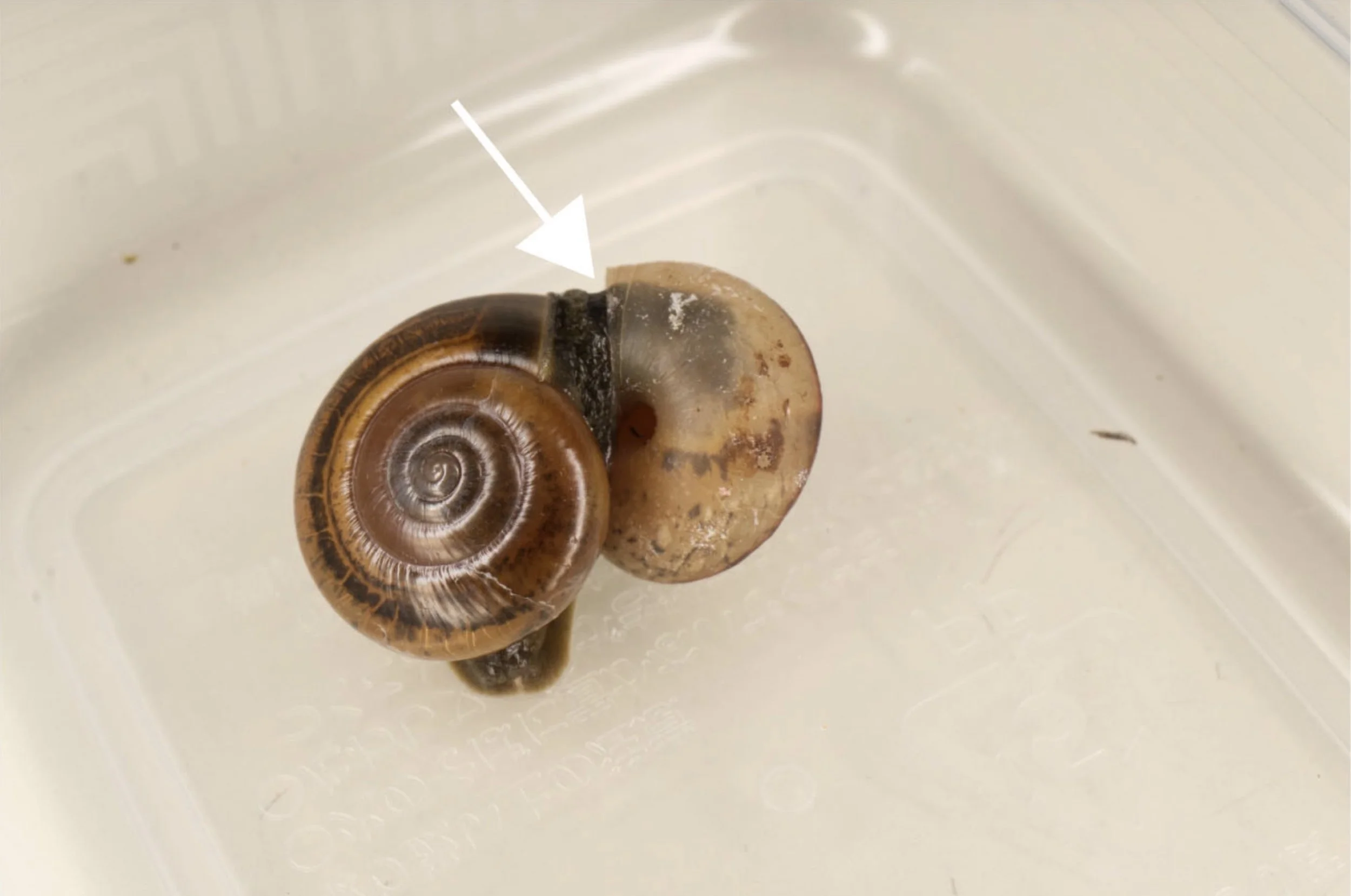
An Indian horntail snail, T. indica, preys on Bradybaena circulus, a Japanese endemic. The white arrow points to T. indica’s head.
On Japan’s Hahajima Island, a swarm of horntails was even documented attacking, overwhelming, and consuming a young giant African snail.
Taken from its original homeland and introduced into a novel landscape, a shy detritivore can become an aggressive carnivore. A predator thought to hunt one thing, when dropped onto an island of vulnerable endemics, might end up hunting another.
Introducing an exotic species to an ecosystem will always be, to some extent, an unpredictable risk.
———
Across all three hundred trials Vinitha conducted, each snail crawled through an empty arena. There was no physical competition, no predation, no direct interactions between the two species at all. The animal and the signal were decoupled. A snail could alter another’s behaviour without ever coming into contact with it.
This raises an alluring possibility. Maybe you wouldn’t need to introduce a predator to hunt down an invasive snail, or coat entire fields in pesticides to poison it, if you could isolate and synthesise the chemical cues that compel it to move.
“Synthetic slime represents a very different, more modern direction in invasion biology compared to the historical biocontrol attempts with predators like Platydemus manokwari [the New Guinea flatworm],” says Vinitha. “The underlying idea is not species-specific predators, but rather species-specific sensory manipulation.”
“Every snail species relies on chemical cues in mucus trails for orientation, mate finding, and habitat exploration,” she continues. “If researchers can identify and replicate the unique chemical signatures that trigger behaviour in a given invasive species, then synthetic decoys could be tailored to lure or divert them.”
Unlike natural snail mucus, synthetic snail slime could be made sterile and standardised; it could be mass produced and engineered to last.
That is all easier said than done, however.
“Synthetic slime-mimicking lures are still at a very initial stage of development, and we are far from seeing them widely deployed in the field,” Vinitha cautions. The decoy slime would need to withstand the effects of weather, attract enough snails to make a difference, and direct them away from crops or into a trap.
“Snail slime is chemically complex,” says Vinitha, “and reproducing the exact compounds that trigger Lissachatina fulica’s exploratory response is difficult.” Which compounds, exactly, trigger the exploratory response: proteins, metabolites, volatile organic compounds, or some combination of these?
The chemical complexity of snail mucus is perhaps the biggest challenge in synthesising slime. At the same time, that complexity is also what makes the concept of synthetic slime possible.
A major drawback to pesticides and many introduced predators is their indiscriminate nature, often harming natives just as readily as the invaders. The complex mixture of chemicals in snail slime, however, may allow for the creation of a more selective tool.
Snail trails are not inherently private, it’s true — as the New Guinea flatworm demonstrates, other unintended species might exploit them too. But they could be made more private, more targeted.
“Our priority is to ensure species-specificity,” emphasizes Vinitha, “by isolating and validating compounds that selectively attract L. fulica without affecting T. indica.”
The synthetic slime could be a siren song that leads the invasive giant straight into a trap, while the native horntail crawls past, deaf to the chemical call.
“It leverages the invasive’s own exploratory response to slime cues,” explains Vinitha, “turning their competitive advantage into a management tool.”
If decoy snail slime is successfully synthesised, the implications could extend far beyond the crop fields of Kerala. The same principles of species-specific sensory manipulation might offer a new method for confronting invasive gastropods across the globe.⁸
Could, for instance, synthetic giant African snail slime be used to suppress horntails on Japan’s islands? Could synthetic slime lure invasive New Guinea flatworms away from vulnerable native species?
In the grand scheme of things, invasive snails might not seem like the most urgent of threats facing our world today. But how we decide to manage them could lead to very different futures.
In one future, fields lie littered with the empty shells of native species. This is a world of vanished island endemics, poisoned soils, and the same invasive snails spreading disease and blight, saturating the globe with their slime.
In another future, the giant African snail taps a trail of synthetic slime with its lower tentacles, sensing a complex cocktail of chemicals that sends its heart beating a little faster. It follows the scent oh so faithfully, away from the crop fields, away from the microhabitats of the native snails, and straight into a trap.
Across the fields of Kerala, under cover of night, the native horntails uncurl, stretch their feet, and begin to crawl — laying down fresh trails of slime.
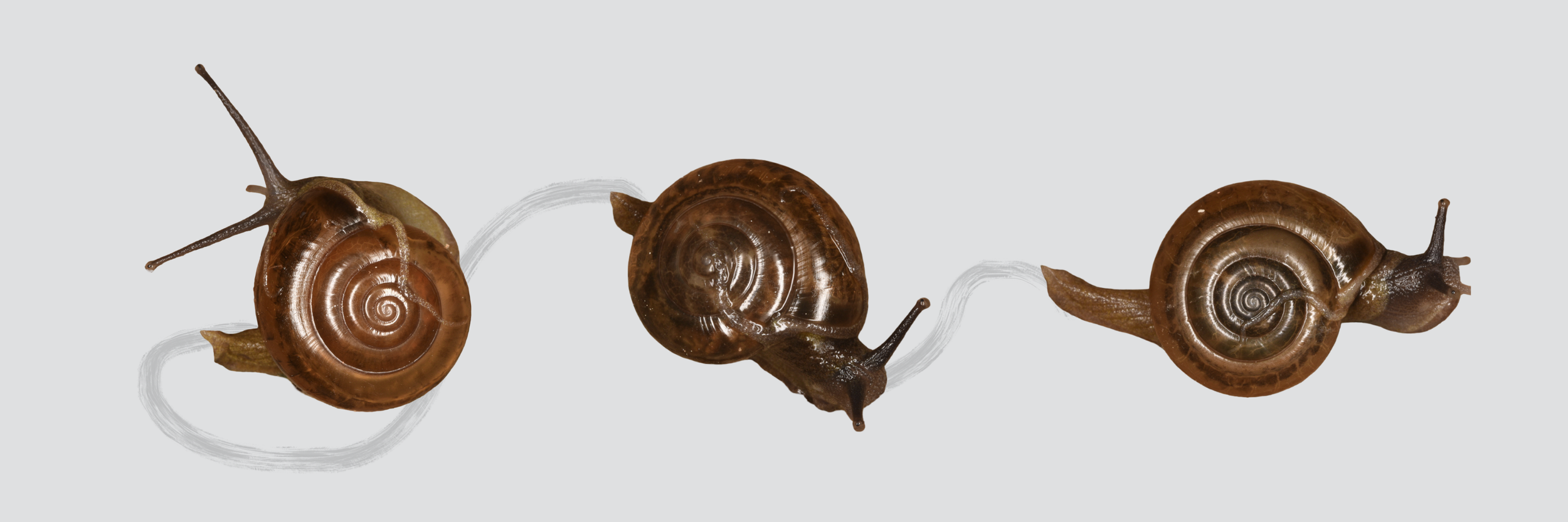
(© CHIK SIU LUN / iNaturalist)
-
Ballard, K. R. (2022). The bioactivity and functionality of the molecular and microbial components of the trail mucus in the invasive land snails Theba pisana and Cernuella virgata (Doctoral dissertation, University of the Sunshine Coast). UniSC Research Bank.
Ballard, K. R., Klein, A. H., Hayes, R. A., Wang, T., & Cummins, S. F. (2021). The protein and volatile components of trail mucus in the Common Garden Snail, Cornu aspersum. PLoS ONE, 16(5), Article e0251565. https://doi.org/10.1371/journal.pone.0251565
Buchinger, T. J., & Li, W. (2023). Chemical communication and its role in sexual selection across Animalia. Communications Biology, 6(1), Article 1178. https://doi.org/10.1038/s42003-023-05572-w
Crane, A. L., Feyten, L. E. A., Preagola, A. A., Ferrari, M. C. O., & Brown, G. E. (2024). Uncertainty about predation risk: A conceptual review. Biological Reviews, 99(1), 238–252. https://doi.org/10.1111/brv.13019
Damas-Moreira, I., Riley, J. L., Harris, D. J., & Whiting, M. J. (2019). Can behaviour explain invasion success? A comparison between sympatric invasive and native lizards. Animal Behaviour, 151, 195–202. https://doi.org/10.1016/j.anbehav.2019.03.008
Davis-Berg, E. C. (2012). The predatory snail Euglandina rosea successfully follows mucous trails of both native and non-native prey snails. Invertebrate Biology, 131(1), 1–10. https://doi.org/10.1111/j.1744-7410.2011.00251.x
Gerlach, J., Barker, G. M., Bick, C. S., Bouchet, P., Brodie, G., Christensen, C. C., Collins, T., Coote, T., Cowie, R. H., Fiedler, G. C., Griffiths, O. L., Florens, F. B. V., Hayes, K. A., Kim, J., Meyer, J.-Y., Meyer, W. M., III, Richling, I., Slapcinsky, J. D., Winsor, L., & Yeung, N. W. (2021). Negative impacts of invasive predators used as biological control agents against the pest snail Lissachatina fulica: The snail Euglandina 'rosea' and the flatworm Platydemus manokwari. Biological Invasions, 23(4), 997–1031. https://doi.org/10.1007/s10530-020-02436-w
Hirano, T., Tatani, M., Ito, S., Kudo, K., & Wada, S. (2023). The introduced land snail Tanychlamys indica preys on live land snails. Journal of Molluscan Studies, 89(2), Article eyad010. https://doi.org/10.1093/mollus/eyad010
Holland, B. S., Chock, T., Lee, A., & Sugiura, S. (2012). Tracking behavior in the snail Euglandina rosea: First evidence of preference for endemic vs. biocontrol target pest species in Hawaii. American Malacological Bulletin, 30(1), 153–157. https://doi.org/10.4003/006.030.0113
Holland, B.S., Gousy-Leblanc, M. and Yew, J.Y. (2018), Strangers in the dark: behavioral and biochemical evidence for trail pheromones in Hawaiian tree snails. Invertebr Biol, 137: 124-132. https://doi.org/10.1111/ivb.12211
Hutchinson, N., Davies, M. S., Ng, J. S. S., & Williams, G. A. (2007). Trail following behaviour in relation to pedal mucus production in the intertidal gastropod Monodonta labio (Linnaeus). Journal of Experimental Marine Biology and Ecology, 349(2), 313–322. https://doi.org/10.1016/j.jembe.2007.05.019
Iwai, N., Sugiura, S., & Chiba, S. (2010). Prey-tracking behavior in the invasive terrestrial planarian Platydemus manokwari (Platyhelminthes, Tricladida). Naturwissenschaften, 97(11), 997–1002. https://doi.org/10.1007/s00114-010-0717-4
Jiang, X., Zheng, P., Soto, I., Haubrock, P. J., Chen, J., & Ji, L. (2022). Global economic costs and knowledge gaps of invasive gastropods. Ecological Indicators, 145, Article 109614. https://doi.org/10.1016/j.ecolind.2022.109614
Meyer, W. M., III, Yeung, N. W., Slapcinsky, J., & Hayes, K. A. (2016). Two for one: Inadvertent introduction of Euglandina species during failed bio-control efforts in Hawaii. Biological Invasions, 19(5), 1399–1405. https://doi.org/10.1007/s10530-016-1354-4?urlappend=%3Futm_source%3Dresearchgate.net%26utm_medium%3Darticle
Nafeesa, M., Aravind, N. A., Murugan, M., & Remya, J. S. (2026). Report of massive infestation of horntail snail [Tanychlamys indica Godwin-Austen, 1883 (Gastropoda, Ariophantidae)] on small cardamom [Elettaria cardamomum (L.) Maton]. Indian Journal of Entomology, 88(3), 599–601.
Ng, T. P. T., Saltin, S. H., Davies, M. S., Johannesson, K., Stafford, R., & Williams, G. A. (2013). Snails and their trails: The multiple functions of trail-following in gastropods. Biological Reviews, 88(3), 683–700. https://doi.org/10.1111/brv.12023
Phrompanya, P., Suriyaruean, N., Nantarat, N., Saenphet, S., Tragoolpua, Y., & Saenphet, K. (2023). Biological properties of mucus from land snails (Lissachatina fulica) and freshwater snails (Pomacea canaliculata) and histochemical study of mucous cells in their foot. PeerJ, 11, Article e15827. https://doi.org/10.7717/peerj.15827
Raw, J. L., Miranda, N. A. F., & Perissinotto, R. (2013). Chemical cues released by an alien invasive aquatic gastropod drive its invasion success. PLoS ONE, 8(5), Article e64071. https://doi.org/10.1371/journal.pone.0064071
Roda, A., Yong Cong, M., Donner, B., Dickens, K., Howe, A., Sharma, S., & Smith, T. (2018). Designing a trapping strategy to aid Giant African Snail (Lissachatina fulica) eradication programs. PLoS ONE, 13(9), Article e0203572. https://doi.org/10.1371/journal.pone.0203572
Sarma, R., Munsi, M., & Ananthram, A. (2015). Effect of climate change on invasion risk of giant African snail (Achatina fulica Férussac, 1821: Achatinidae) in India. PLoS ONE, 10(11), Article e0143724. https://doi.org/10.1371/journal.pone.0143724
Sugiura, S., Holland, B. S., & Cowie, R. H. (2011). Predatory behaviour of newly hatched Euglandina rosea. Journal of Molluscan Studies, 77(1), 101–102. https://doi.org/10.1093/mollus/eyq042
Vinitha, M. S., Sheeba, P., & Sudhikumar, A. V. (2025). Who is caught in the trap? Boldness is not linked to the bucket trap entry by invasive giant African snails, Lissachatina fulica (Bowdich 1822). Ethology Ecology & Evolution, 37(5), 645–666. https://doi.org/10.1080/03949370.2025.2525082
Vinitha, M. S., Sheeba, P., & Sudhikumar, A. V. (2026). Does slime facilitate invasion? Differences in exploratory behaviour to slime cues in native Tanychlamys indica and invasive Lissachatina fulica. Journal of Molluscan Studies, 92(3), Article eyag026. https://doi.org/10.1093/mollus/eyag026
Vong, A., Dahirel, M., & Ansart, A. (2019). Dispersers are more likely to follow mucus trails in the land snail Cornu aspersum. The Science of Nature, 106(9), Article 43. https://doi.org/10.1007/s00114-019-1642-9
-
Thanks to Meluveettil S. Vinitha for sharing her extensive research on snail slime behavioral ecology and detailing her field observations in Kerala.
And thanks to Dr. Shinji Sugiura for his expertise on invasive flatworm predation and the ecological history of biological control across the Ogasawara Islands.