Japanese Squirrel
Sciurus lis
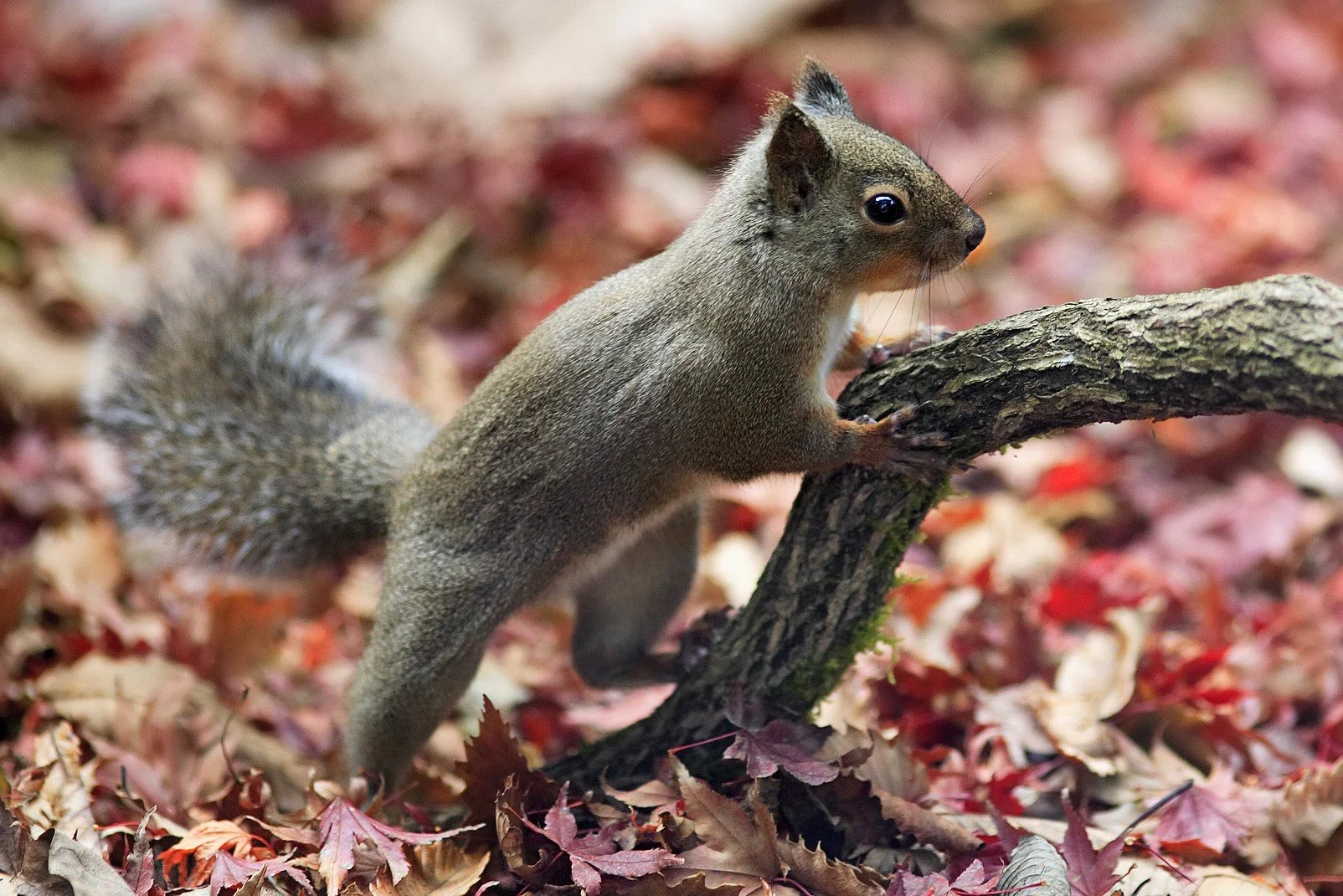
In some areas, 35% of the Japanese squirrel's diet is made up of walnuts. The squirrel is more likely to hoard larger seeds/nuts and is more willing to carry them farther in order to cache them — this may have resulted in walnuts evolving larger sizes in areas where this squirrel lives.
-
The Japanese squirrel has a particular fondness for the Japanese walnut — a plant native to Japan and the Russian island of Sakhalin. The tree and its fruit look much like any other walnut species, with the oval-shaped nuts sheltered in green husks. But beneath the husk, and the hard wrinkly brown shell, the "meat" is vaguely heart-shaped — rather than vaguely brain-shaped — and, as such, this walnut is also known as a heartnut.
In certain parts of the Japanese squirrel's range, such as Nagano Prefecture, these heartnuts comprise up to 35% of the squirrel’s annual diet. One study, which provided Japanese squirrels with 720 walnuts, found that the squirrels were habitual hoarders; over half (50.6%) of the walnuts were stashed away for later. And they didn’t just stockpile them in one larder, the nuts were hidden in many different caches throughout their territories — a strategy known as ‘scatter-hoarding’. The idea is essentially that of "don't put all your eggs in one basket." If you only have a single hoard, and that hoard is discovered by a competitor, all of the winter reserves you worked so hard to collect are lost in one instance of bad luck. With several scattered hoards, you have insurance.
-
The Japanese squirrel is particular about its hoarding preferences. For example, it likes to save most of its larger seeds for later — 90% of the large seeds given to it were cached, versus only 60% of the small seeds which it often just ate on the spot (likely not worth expending the energy to carry the small seeds). The size of a seed or nut also determined how far a squirrel was willing to travel in order to cache it. A squirrel was more willing to travel farther to find the perfect hiding spot for a hefty prize, while small seeds only warranted a trip to its nearest cache.
From the perspective of a nut, a squirrel's scatter-hoarding strategy is a pretty ideal deal. The squirrel spreads a tree's nuts far and wide — some hidden in tree nooks or hollows, some between roots, and others buried beneath the soil. While a squirrel's memory is good, it's not infallible, and some nuts are inevitably forgotten or, if the squirrel over-prepared for winter, they simply go untouched. To these ignored nuts, the squirrel has essentially acted as a helpful gardener.
Ideally, a walnut tree wants its nuts dispersed as far and wide from itself, and from one other, as possible — to decrease competition for space and resources between its own offspring and itself. Since the larger nuts were more likely to be carried further by Japanese squirrels, they had a distinct advantage. As a result, it seems that the walnuts growing within the Japanese squirrel’s range evolved to become larger in accordance with their “gardener’s” preferences.

📍 Large portions of Honshū, Shikoku, and Kyūshū.
⛰️ Lowland and sub-alpine forests.

‘Least Concern’ as of 18 Aug, 2016.
-
This squirrel is diurnal, most active in the early morning and late afternoon.
It can jump up to 10 metres (33 ft) while travelling from tree to tree.
This squirrel is particularly fond of Japanese walnuts. One study, which provided Japanese squirrels with 720 walnuts, found that the squirrels were habitual hoarders. Over half (50.6%) of the walnuts were stashed away for later, and not in one hoard, but in several scattered across its territory.
It also performs “energy calculations” based on the size of the seed/nut and travel time. 90% of the large seeds given to this squirrel were cached, versus only 60% of the small seeds, which it often ate on the spot. It was also more willing to travel farther to find the perfect hiding spot for a hefty prize, while small seeds only warranted a trip to its nearest cache.
When it forgets about its stashes, or simply over-hoards, the abandoned seeds and nuts are left to germinate. In this way, the squirrel acts as an unintentional forest gardener.
The largest squirrels seem to be the most dominant: holding the largest ranges (which change in accordance with food availability) and, for males, the most success with females.
This species breeds from February to March and May to June, with females going through multiple estrous cycles in a single year but only being receptive to breeding for a short window — during this time, they’ll often have a tail of several lusty males on their trail.
The Japanese squirrel is considered a habitat specialist, and seemingly doesn’t adapt well to suburban environments. Several populations have disappeared due to human activity.