Snowy Sheathbill
Chionis albus

The snowy sheathbill is an Antarctic scavenger. It eats anything it can find or pilfer; from faeces to regurgitated penguin chick food and even elephant seal milk straight from the teat. It often stands on one foot to reduce heat loss — a technique that also makes it quite clumsy.
This shore bird's rotund body is outfitted in a plumage of pure white feathers, making it look like a lump of snow with legs and a beak. Its face is a patch of fleshy pink with a beak that juts out of "sheath"; a hard covering of the upper beak. Dark feet carry this pigeon-like bird along the frosty ground. When it stops for a rest, it balances atop one foot to conserve heat — a useful technique for keeping warm, but a hazardous balancing act on such icy terrain, making for a clumsy bird. Uniquely among Antarctic birds, its feet are not webbed and thus it cannot partake in that reliable Antarctic cuisine; seafood.
Antarctic Garbageman
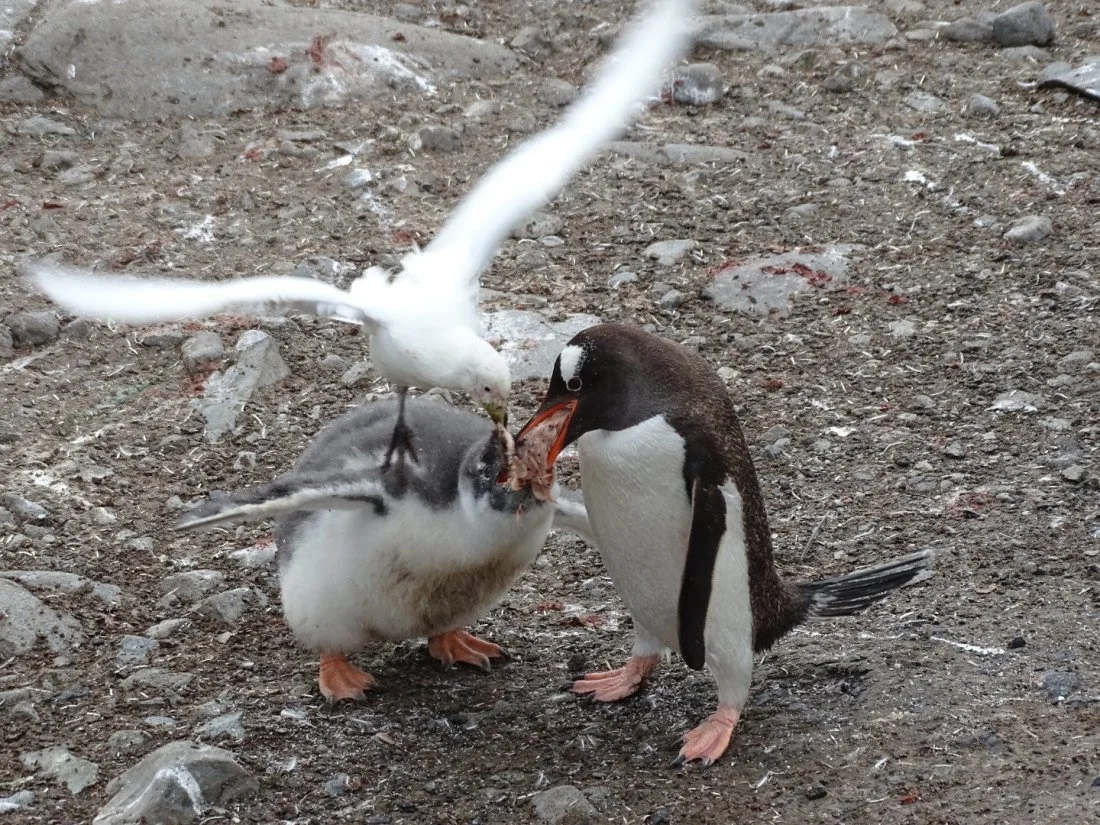
A snowy sheathbill butting in on a penguin chick feeding.
So, a plump little bird — a not-very-imposing 40 cm (16 in) long — with a clumsy habit, and an inability to hunt for fish. How does it survive the frigid and unforgiving Antarctic? The answer seems to be; a bold attitude and a lack of self-respect. It is the scavenger of Antarctica — the waste collector of the white continent. An opportunistic ave that will scoff down anything remotely edible. Algae scavenged along the seashore, carrion, human refuse, and fresh faeces are its typical fare.
This bird's also got a lot of gumption; pillaging and pilfering from penguins and seals — shadowing the edges of colonies to sneak off a snack. The sheathbill isn't above munching down on regurgitated fish and krill — baby food for penguins. Penguins must stay vigilant, as this gluttonous bird will happily eat their eggs and chicks. This kleptoparasite will even eat other parasites, such as tapeworms from the intestines of chinstrap penguins. Given its dining choices and etiquette, it's surprising that its feathers ever remain white. The lengths it will go to to steal a meal are almost commendable. It is known to hop atop injured male elephant seals to pick at their open wounds and slip in among pups to drink from a female seal's teat.
Southern Traveller
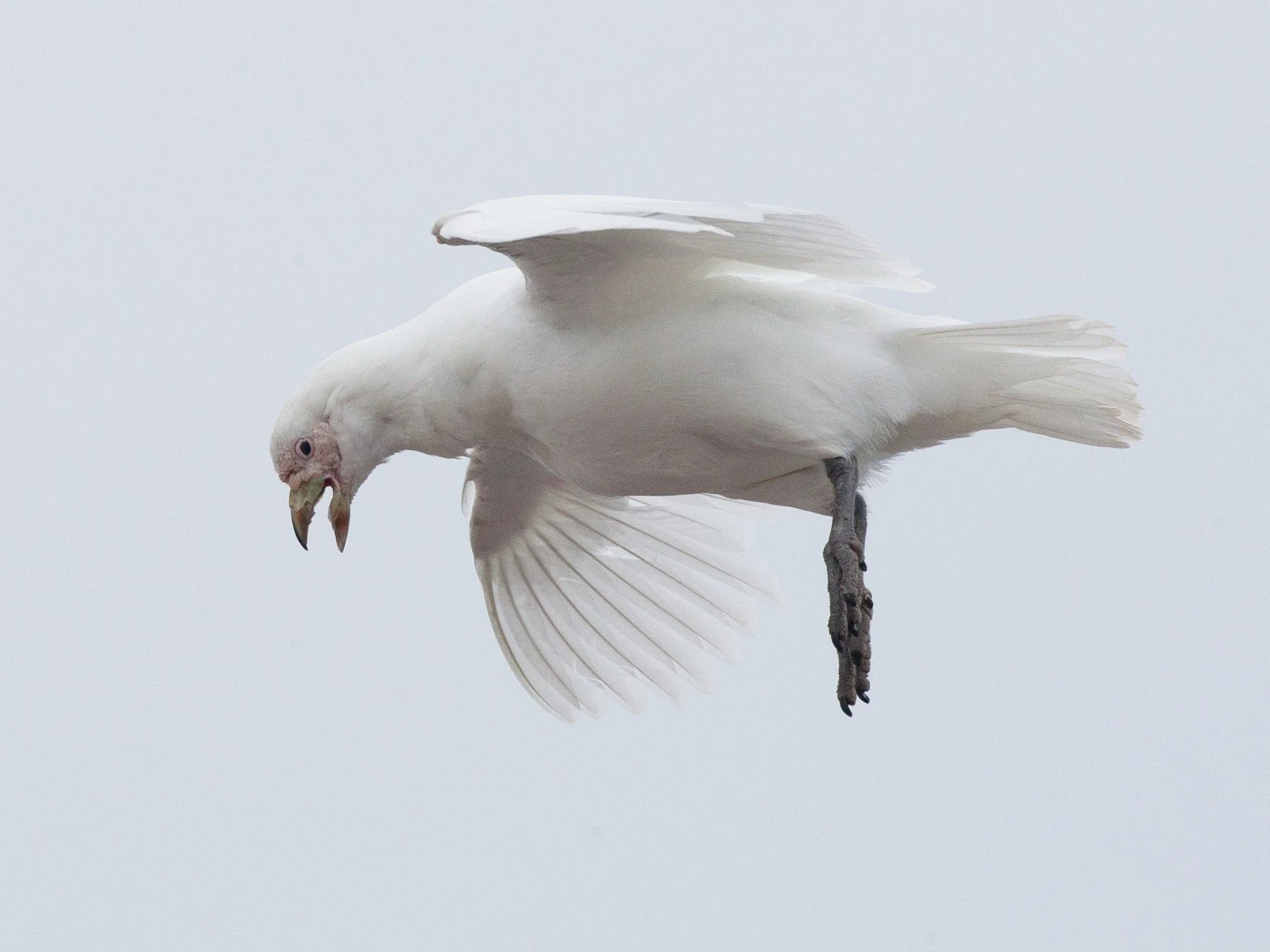
The snowy sheathbill is a strong flier, often migrating great distances.
While it does not swim, it can fly. Strong wingbeats lift it into the air and hold it aloft, allowing it to dive down on its flightless Antarctic cousins. It is also a traveller. It journeys north for the winter; to Patagonia, Tierra del Fuego, and the Falklands — often alighting on icebergs to rest along the way. A passing ship is just as good, and sheathbills have been reported hitching rides all the way to South Africa and even Europe.

Where Does It Live?
⛰️ Coasts; rocky and sandy shorelines.
📍 Antarctica, the Scotia Arc, the South Orkneys, and South Georgia — migrates farther north in winter. ¹

‘Least Concern’ as of 01 October, 2019.
-
Size // Small
Length // 34 - 41 cm (13.5 - 16 in) (w/ tail feathers)
Wingspan // 75 - 80 cm (29.5 - 31.5 in)
Weight // 460 - 780 grams (1 - 1.7 lbs)
-
Activity: Diurnal ☀️
Lifestyle: Social 👥
Lifespan: N/A
Diet: Omnivores
Favorite Food: Pretty much anything it can find
-
Class: Aves
Order: Charadriiformes
Family: Chionidae
Genus: Chionis
Species: C. albus
-
The snowy sheathbill is pretty unique. It is the only land bird native to Antarctica, and one of only two sheathbill species — the other being the black-faced sheathbill (Chionis minor).
This sheathbill is somewhat close to a hen in appearance, but closer to a pigeon or seagull in behaviour.
The snowy sheathbill is an opportunistic and very daring eater. This bird suffers from no excess pride; it will sink to picking at intestinal worms from penguin carcasses and scarfing up faeces and will pull off such stunts as stealing regurgitated penguin chick food mid-feeding session and nipping at female elephant seal teets for a drink of milk.
Although it lives along the shores, it is not a skilled swimmer. It can fly well, however, migrating to warmer places — Patagonia, Tierra del Fuego, and the Falklands — during the southern hemisphere winters.
Sheathbills mate from October to March, lay 2 - 4 eggs between December and January, which hatch in January or February into chicks that fledge in March. Snowy sheathbill breeding grounds are usually found near penguin and cormorant colonies.