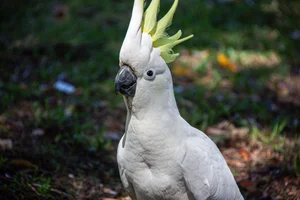
¹ In his 1898 volume of The Fauna of British India, W. T. Blanford wrote: “In birds that have moulted in confinement, the green is replaced by pearl-grey”
Referencing Derek Goodwin’s 1983 monograph, Pigeons and Doves of the World, Bettina Mahler and colleagues wrote in a 2003 paper that captive Treron doves “fail to express their carotenoid-based green and yellow plumage color if the diet was unsuitable, showing gray and purplish colors instead.”
² Technically, there are some animals that get their green colour from chlorophyll — although none can produce it themselves as plants can.
Leaf-sheep graze on green algae, incorporating the algae’s chloroplasts (the cellular structures containing chlorophyll) into their own cells. The bright green, leaf-like structures on a leaf-sheep’s back can even generate energy from sunlight (i.e. they can photosynthesise).
Sloths, meanwhile, can appear green for a much simpler reason: green algae grow directly on their fur.
³ Broadly, animals can attain vibrant colours in two ways: through pigments (like the green-pigeons with their melanins and carotenoids) and through structure.
Microscopic structures within a feather, or on the surface of skin or scales, scatter and reflect light, sending towards an onlooker’s eyes more wavelengths of some colours and less of others. Certain jewel beetles and emerald-patched butterflies produce their brilliant metallic green purely through structure alone. But these are the exceptions.
Often, animals achieve colours like green and blue through a combination of structure and pigment.
Green parrots, for instance, have tiny air pockets in the spongy layer of their feather barbs which scatter blue light, while an overlying layer of yellow pigments (called psittacofulvins) filters that blue light to produce a vibrant green.
How are they green?
⁴ The carotenoids needed to make green beaks, yellow feet, and orange breasts are also necessary for other vital functions like immunocompetence and detoxification. Only when those vital needs are met do the carotenoids go toward aesthetics.
⁵ These fat exploding pigeons were later given the common name ‘Bruce’s green-pigeon,’ after James Bruce himself.
Although Bruce found “his” green-pigeon delicious, the locals would not touch it for religious reasons, at least according to Bruce: “...the Abyssinians do not eat it because they believe it is unclean; and, when it is dead, they dare no more touch it than a dead horse, for fear of defiling themselves.”
The other two quotes come from Edward Blyth (“They all afford excellent eating, but the skin is very tough and thick, and ought to be removed.”) and Eugene W. Oates and W. T. Blanford (“This subfamily inhabits the tropical and subtropical regions of the Old World. Five out of seven genera are Indian. All are purely fruit-eating birds, living on trees, and generally keeping in flocks; and all are good birds for the table.”)
⁶ In a 2017 paper, E. V. Adnagulov describes his observations of a white-bellied green-pigeon on the northern coast of Srednyaya Bay in Russia:
“The bird flew down from the tops of oaks covering the southern slope of a low hill…and sat at the water’s edge. The pigeon was there for 2-3 minutes; judging by its behavior, it bathed and drank. The bird entered the water up to its belly and was clearly drinking seawater.”
While green-pigeons rarely descend to the ground, in both Russia and Japan, the white-bellied green-pigeon has been documented making trips to the coast to drink seawater.
The trouble is, a bird adapted to hiding in the canopy becomes incredibly conspicuous on the coast — an easy target for patrolling falcons, hawks, and kites (not to mention the danger of the crashing surf).
So why descend to the coast at all?
Probably for the same reason that other green-pigeons will eat clay or grit.
Ant Fynn writes: “birds that eat clay tend to be species that eat fruit, which may be low in sodium and it is a mechanism for adjusting their sodium metabolism. It may also protect the birds from toxic secondary compounds by lining the digestive tract or adsorbing these compounds.”
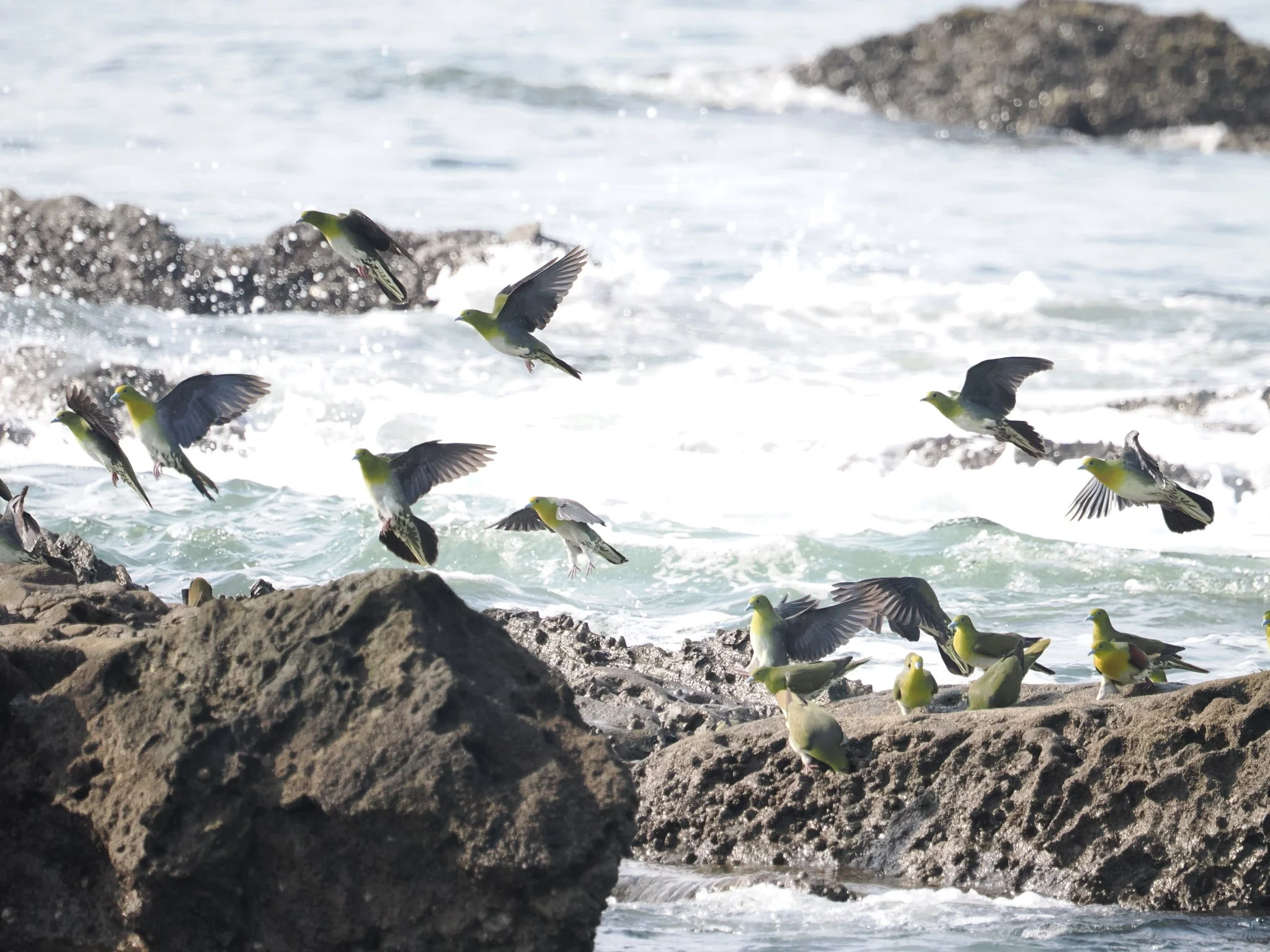
A flock of white-bellied green-pigeons,Treron sieboldii, on the coast.
(© Tellu / iNaturalist)
⁷ This observation comes from the paper “Sun-bathing by Yellow-legged Green-Pigeon Treron phoenicoptera at Vadodara, Gujarat, India” by Anika Tere, published in the journal Indian Birds in 2006.
⁸ Read more about the plight of the Timor green-pigeon in this Mongabay article by Timothy Mihocik from earlier this year (2026).