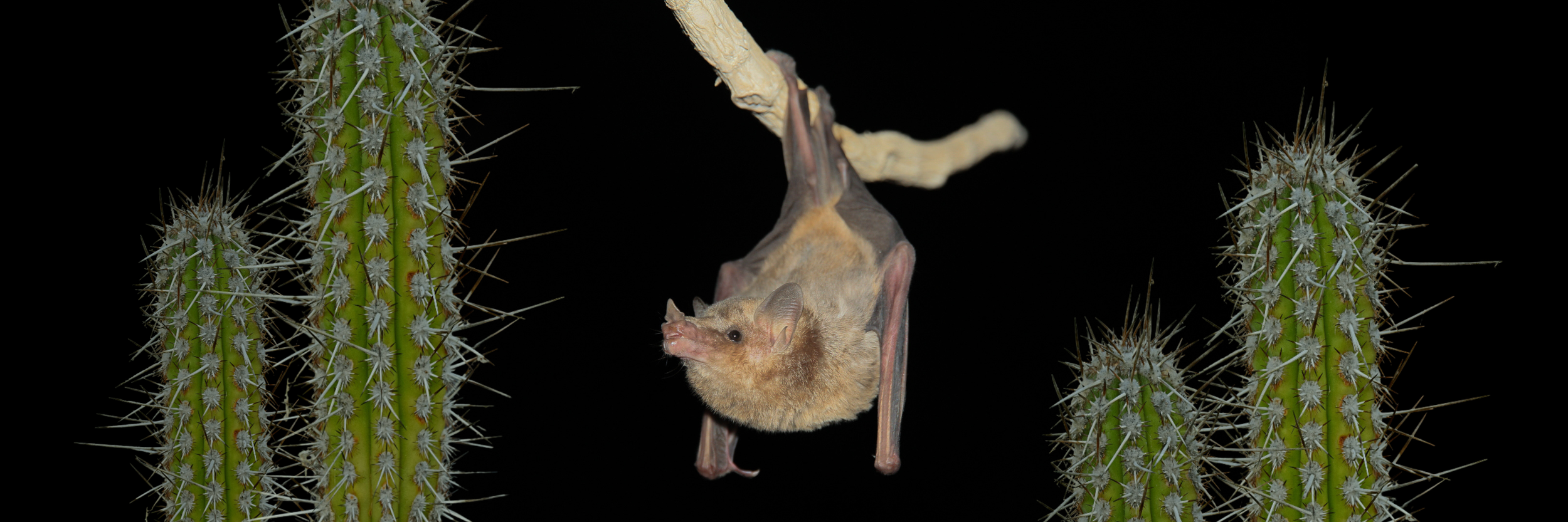
In the cactus-studded deserts of the western Andes, the long-snouted bat (Platalina genovensium) has lent almost every part of its body to the pollen of different desert plants.
Its snout belongs to one cactus. Its head belongs to another. Its back is rented out to a bromeliad. Its reproductive cycle is synced to the bloom cycles of these plants, and when those blooms fail, entire bat colonies vanish or starve.
Researchers documented just such an event in the region of Arequipa, southern Peru, during the 1991-1992 El Niño.
A full 17 months went by without a drop of rain, preventing even the hardy desert plants from flowering; no slender, pale trumpet flowers from the cacti, no towering, floral spikes from the bromeliads.
These are the flowers that shaped the long-snouted bat’s anatomy.
Its elongated tongue is tipped with a brush of horny papillae for lapping deep nectar. Its molars are almost vestigial, as it has little need for chewing. A “hunter” of flowers, its echolocating cries are a whisper, some 50 times quieter than other bats.
Studies of faecal samples around Arequipa found cactus pollen in 99% of samples; the bat is almost completely reliant on the nectar of these desert plants.
In late-1991 and early-1992 — before the full effects of the drought could be felt — researchers surveyed three different roosts, counting a total of 65 individuals. By early 1993, that number had fallen to just two. Survivors had either died or abandoned their colonies. And those that remained could no longer get the energy they needed to reproduce.
———
In June of 2026, the National Oceanic and Atmospheric Administration (NOAA) issued an El Niño Advisory. The World Meteorological Organization (WMO) predicts a near-100% chance that these conditions will hold through early 2027, with forecasters calling an 83% likelihood of a strong-to-very strong event peaking between late-2026 and early-2027.
Desert plants, the cacti and bromeliads, evolved to survive extended droughts; once the rains return, they’ll finally go into bloom again. But for what? For who?
Many nectivorous bats are prolific pollinators, but not necessarily tidy ones. They visit many species of flowers, delivering haphazardly, clogging up the plants’ reproductive organs with “junk mail” from other species and, as a result, reducing the chances that the correct pollen germinates.
The long-snouted bat is a different sort of pollinator. It delivers to a relatively small number of addresses, but it does so in a manner highly tailored to its customer base.
The columnar cactus Haageocereus pseudomelanostele has flowers that dust the bat’s elongated muzzle with pollen. The related H. acranthus, with its longer flowers, forces the bat to reach deeper and brush its crown against the cactus’s reproductive organs. The bromeliad Puya ferruginea, meanwhile, deposits its pollenous payload almost exclusively along the fur of the bat's spine.
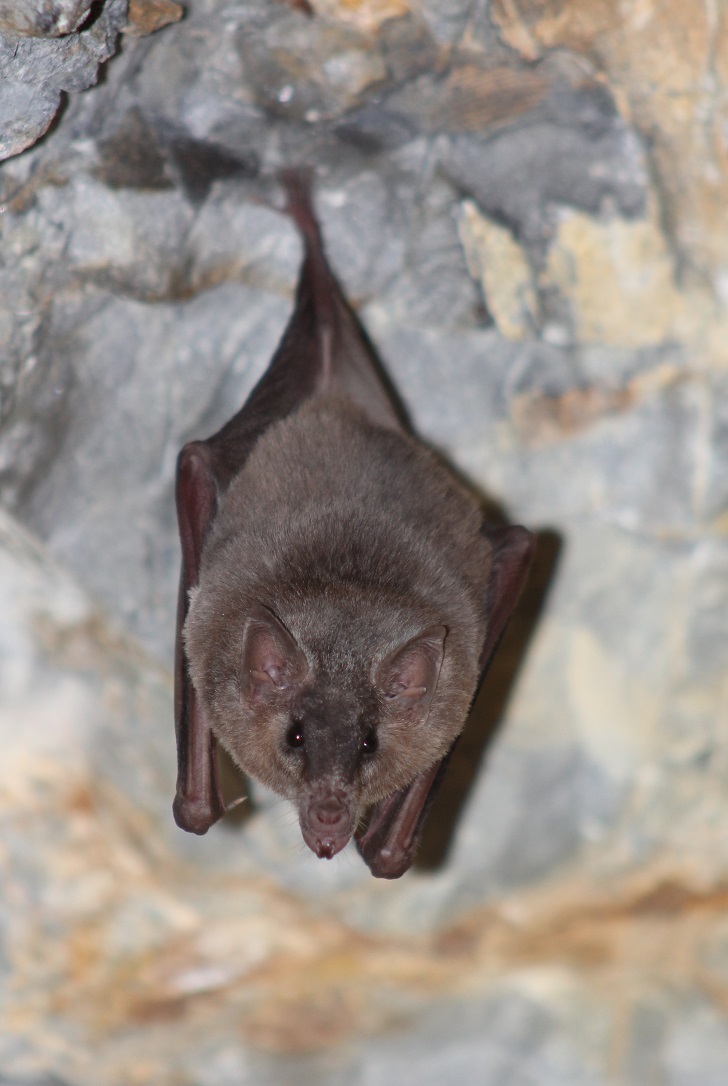
By partitioning the long-snouted bat’s body into distinct zones, these plants ensure their pollen rarely intermixes, even as they share the same singular pollinator.
———
It seems a lot of responsibility for one bat. Thankfully, it doesn't carry the full pollen payload alone.
There are a few other desert pollinators, like the giant and oasis hummingbirds, as well as various bees, flies, and butterflies. In the worst case scenario, cacti can even pollinate themselves.
Following the 1991-1992 El Niño drought, the proportion of flowers that successfully initiated fruit, surprisingly, did not differ significantly between the pre-drought year (when the bats were present) and the post-drought year (when they were not). The hummingbirds especially seemed very capable replacements for the bat’s pollinator duties, in some cases even doing a better job than the bats at fertilizing plants and getting them to fruit.
However, the primary concern is what’s inside those fruits, specifically in their fertilized seeds.
The healthiest seeds are usually produced when pollen arrives from a distant plant, rather than from the same individual or one of its close neighbours. This measure is called the outcrossing rate. The lower the rate, the more often plants are either self-pollinating or only breeding with their closest next-door neighbors — who are usually more closely related to them. The higher the outcrossing rate, the more often plants are reproducing with genetically different, often distant individuals.
For pollinators, then, the question isn’t only how much pollen they carry, or how accurately they deliver it, but how far they travel.
Insects rarely transport pollen more than 300 meters, typically limiting crossbreeding to immediate neighbors. Hummingbirds travel significantly further, carrying pollen across several kilometres, but they can also be incredibly territorial, often remaining in a particular area to defend it from other hummingbirds. The long-snouted bat, on the other hand, follows shifting nectar corridors as they come into bloom along the western slopes and river valleys of the Andes.

Insects
Click to expand stats ↓
Hummingbirds
Click to expand stats ↓
Long-snouted Bat
Click to expand stats ↓Think of it this way: if a bee is a delivery rider on a bike, carrying parcels around the neighbourhood, and the hummingbird is in a car, with its load in the boot, making trips across town, then the bat is a long-haul driver, with a custom built truck, moving freight across the country. In the deserts of Peru, it is the only pollinator that delivers between distant plants, linking cactus populations that would otherwise remain genetically isolated.
The relationship between this bat species and the Peruvian cactus Weberbauerocereus weberbaueri, for instance, is one of the most specialized examples of “cactophily” in the Andes. This columnar cactus produces large, tubular, nocturnal flowers that emit a pungent odor and offer continuous nectar — characteristics specifically evolved to attract bats.
A 1994 study measured the cactus’s outcrossing rate when the long-snouted bat was the primary pollinator, finding it to be exceptionally high at nearly 94 percent.
Hummingbirds, insects, and self-pollination could save a flowering season — or even several — but they likely can’t replace the long-snouted bat’s role in preserving genetic diversity across miles and generations.
———
In November of 2017, a single long-snouted bat appeared on security footage at an office supply depot in Ate, a heavily urbanized district on the eastern edge of Lima.
In their paper reporting the sighting, researchers Dennisse Ruelas and Víctor Pacheco write that “a possible adaptation to urban places is premature…” This desert bat is probably not beginning its move into urban environments, especially given the nature of the observation: a single sighting of a single bat.
So why did this lone bat show up in such an unexpected place? Was it displaced by ongoing urban sprawl? Or by the shifting environmental conditions in surrounding valleys? Did this bat wander into the concrete margins of Lima searching for surviving stands of flowering cacti?
Globally, the long-snouted bat is listed as a Near Threatened species by the IUCN — although the last assessment was more than a decade ago (May 2016). In Peru, the species is considered “En Peligro” or Endangered.
Now, the extreme 2026-27 El Niño is set to climatically split the country in two.
In the South, in regions like Arequipa, extreme drought conditions will halt cactus flowering, likely causing bat colonies to starve or collapse as they did 35 years prior. In the North, however — in places like the Lima valleys — heavy rains and mudslides will erode river basins, knock delicate cactus blossoms off plants, and flood low-lying cave and mine roosts.
As their southern nectar corridors fail due to drought, bats fleeing north might just be battered by torrential storms.
Of course we can’t predict exactly what will happen to the long-snouted bat populations, but based on the past data we do have, a decline seems likely, if not an outright crash.
What happens then to the desert plants that it pollinates?
Well, it’s not as simple as “a pollinator disappears and the plants die out.”
In the seasons following a drought, hummingbirds and diurnal insects will continue to visit the pale trumpet flowers, keeping fruit initiation rates as high as 76 percent. Cacti like W. weberbaueri are long-lived autotetraploids, meaning they can “store” high levels of genetic variation in the short term, allowing them to endure years of environmental stress. The ecosystem will appear to be intact.
If bat populations recover and resume their journeys along Andean nectar corridors, the cacti will likely suffer no lasting harm. The real danger is not the severity of any single El Niño, but what might happen if those conditions occur with more and more frequency.
Climate models show near-universal agreement: global warming is making El Niño far more volatile.
The frequency of extreme El Niño events — such as the one coming this year — is projected to nearly double, from roughly one event every 20 years in the pre-industrial era to one every 10 years this century. Even if global warming eventually stabilises at 1.5°C to 2.0°C, the frequency of these extreme events will continue to increase for up to a century.
While the cacti may persist, and even continue setting seed, their primary means of long-distance gene flow vanishes with the long-snouted bat. Maybe another species will take on that role, but few are as exactly adapted; few pollinators will be able to match the quantity, the accuracy, and the distance of Platalina genovensium.
The effects would only become evident after years and years, perhaps decades. But with no courier to carry their pollen — on its snout, back, and head — the desert’s keystone plants might eventually reproduce themselves into genetic impoverishment.