(© Roberto González / iNaturalist)
On Mexico’s Chihuahuan Plateau, there is a dog town.
Around the perimeter, the grass stands high enough to brush a man’s shins, but as you move inwards, it gradually drops away: from tall bunchgrasses to ragged midgrasses, and finally to a heavily cropped lawn.
The centre of the town is a sun-baked plaza of grassy stubble and exposed earth, dotted with funnel-shaped craters and mounds of dirt. And it is bustling.
Mexican prairie dogs — bulky, cinnamon-brown rodents in the squirrel family — greet each other nose to nose, chirp and bark, popping in and out of burrows that lead to a complex system of tunnels and chambers. Several dogs stand vigil, watching for coyotes beyond the town’s borders and prairie falcons in the skies.
Mountain plovers strut about town, dining on exposed insects crawling through the cropped grasses. Burrowing owls huddle in abandoned prairie dog tenements. Scaled quail, with their crested heads and reptilian plumage, squat among the longer grasses of the suburbs. Here and there, horned lizards bask in the sunlight, while spadefoot toads wallow in the temporary pools that pockmark the town. And giant, bellowing beasts laze in the barren centre.
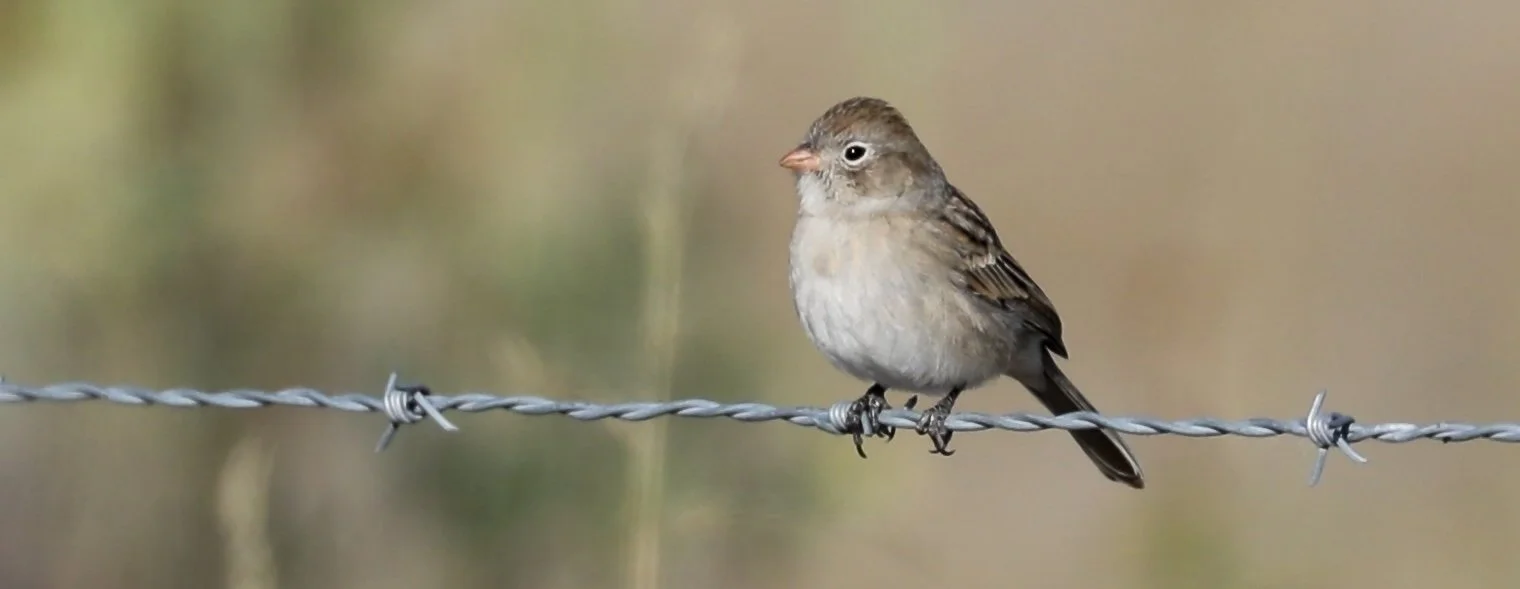
Along the edges of this dog town — where the grasses aren’t too tall nor too short — tucked low inside the heart of a tarbush, is the cup-like nest of a sparrow. It is tightly woven from muhly grasses and insulated with a fine layer of fur. Inside sit three naked chicks. While the female broods on the nest, the male perches on a nearby barbed wire, singing persistently; his dry, rattling trill joining the hubbub of the dog town.
———
It is June 16, 1884, and Charles H. Marsh, a taxidermist living in Silver City, New Mexico, has just shot a bird on a “flat near the town.”
Initially, Marsh thought it was a fairly common field sparrow: small, with greyish-rufous-brown feathers and a pink little bill. But he nonetheless sent the skin to a specimen dealer, Charles K. Worthen, for verification. Worthen then sent it on to Robert Ridgway at the United States National Museum, who soon recognised it as a new species.
In his description, however, Ridgway credited Worthen as the collector — dubbing it Worthen’s sparrow, Spizella wortheni.
Marsh was not pleased at being snubbed, and he let his displeasure be known. He published a paper in the journal Ornithologist and Oologist identifying himself as the collector of the holotype. His response included a “redescription” of the bird, which was largely an abbreviated and plagiarised version of Ridgway’s original 1884 paper, but with all references to Ridgway and Worthen removed. Marsh also wrote the bird’s name as Spizella northeni — maybe by accident, maybe on purpose.
In the end, Ridgway issued a correction acknowledging the true collector, and Marsh apologised for his untoward response. But, regardless, the sparrow remained “Worthen’s.”
———
Once the dust stirred up by its description settled, Spizella wortheni became just another name on the various checklists of North American birds.
For more than a century, no one paid much attention to Worthen’s sparrow. Maybe because it seemed like just another nondescript grassland sparrow. Or maybe because the species vanished as soon as it was discovered.
To date, Marsh’s specimen from Silver City is the only undisputed record of the species in the entirety of the United States.
From scattered records, the species appears to have once lived from the southwestern U.S. down into Mexico, across vast plains of shortgrasses, broken only by low yucca spikes and thorny mesquite. But its range contracted from eight Mexican states to just four, and it was never recorded in the United States again. Today, it is no longer found across 70% of its historic range, confined mostly to localised pockets of northeastern Mexico.
It has been described as “probably the least studied species in its genus” and “one of the least known North American sparrows.” It might also be one of the most threatened: listed as Endangered, with a population estimated under 1,000 adult individuals, and possibly as few as 250.
The reasons for its decline aren’t exactly a mystery.
Worthen’s sparrow is a bird of North America’s scrub and grasslands. The past 500 years have seen a gradual transformation of this biome into crop and grazing land — a transformation that, starting in the late 20th century, has been much less gradual.
———
So why doesn’t Worthen’s sparrow just take to the wing and find areas with more suitable habitat?
Well, it does.
Nicknamed the “rain rover,” Worthen’s sparrow wanders the rangelands of northeastern Mexico searching for unpredictable seasonal rainfall, settling down for the season when it finds the flush of new growth and insect activity it needs in order to breed.
The problem is not finding grassland, but finding the right kind of grassland.
A statistical method known as Ecological Niche Factor Analysis (ENFA) measures how restricted a species’ niche is compared with its total available habitat. When it was applied to Worthen’s sparrow, its degree of specialisation was found to be an order of magnitude greater than its relatives.
For reference, the specialisation coefficient of the field sparrow was 3.453. Worthen’s sparrow came in at 71.657. It is the most specialised of all Spizella species.
Its distribution is limited by altitude and precise seasonal minimum and maximum temperature extremes. In other words, S. wortheni needs a pretty specific combination of conditions, and there are only so many places where those conditions coincide.
But Worthen’s sparrow’s niche is not only shaped by weather. It is also a set of relationships — a neighbourhood, or a town.
———
Across the grasslands, many foraging and grazing species gather to live in groups. After all, with more pairs of eyes watching for danger, there is safety in numbers.
The dangers to prairie dogs are many — their list of predators includes, but is not limited to grey foxes, bobcats, cougars, golden eagles, hawks, falcons, and even species that temporarily borrow their burrows, such as rattlesnakes.
So prairie dogs go a step further: they alter the landscape itself to make it safer. By keeping the vegetation around their burrows clipped, they can maintain a wide and unobstructed view of the surrounding grassland. Any approaching predator can be spotted early by the town watchman, and an alarm bark can be raised.
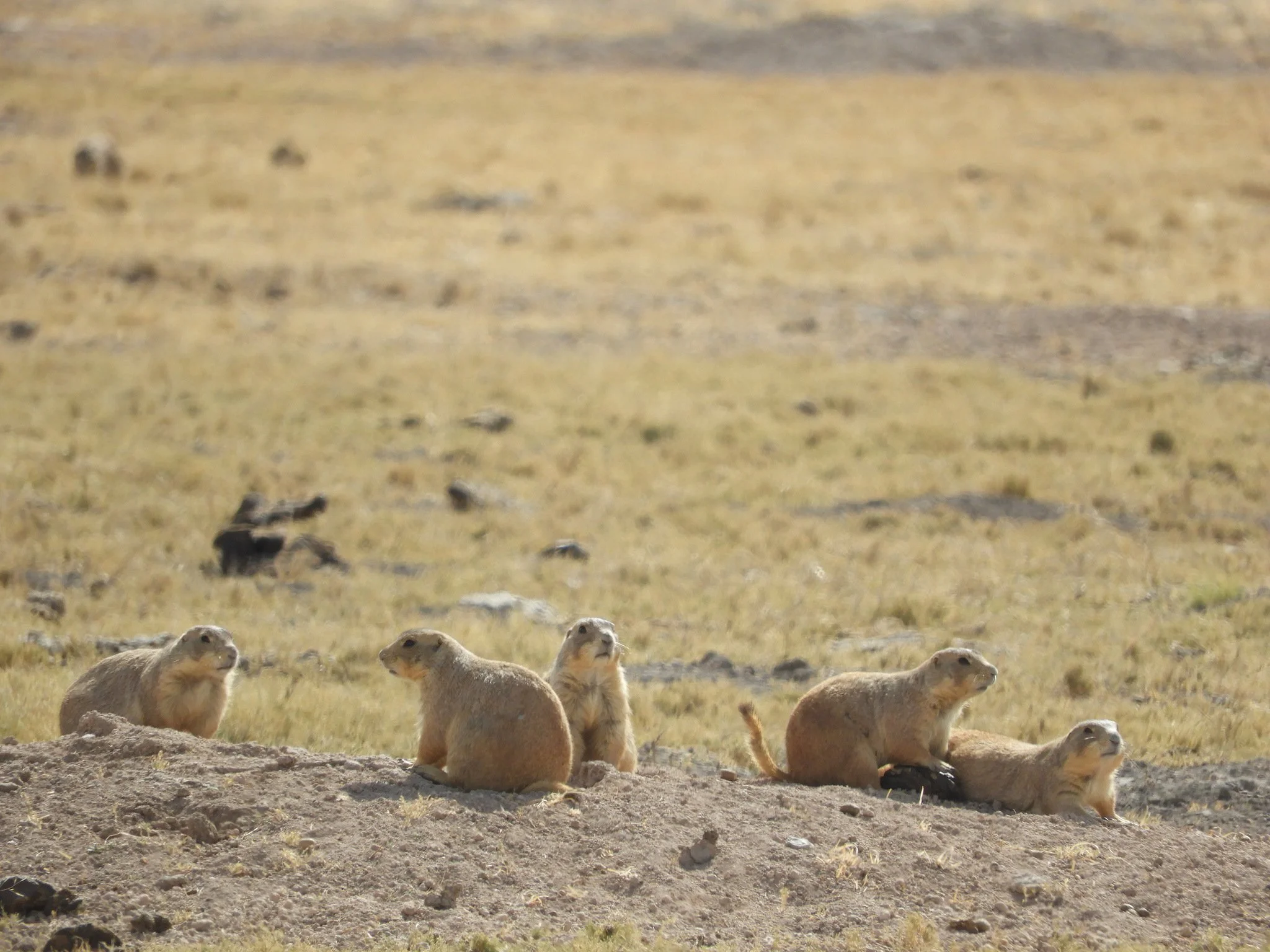
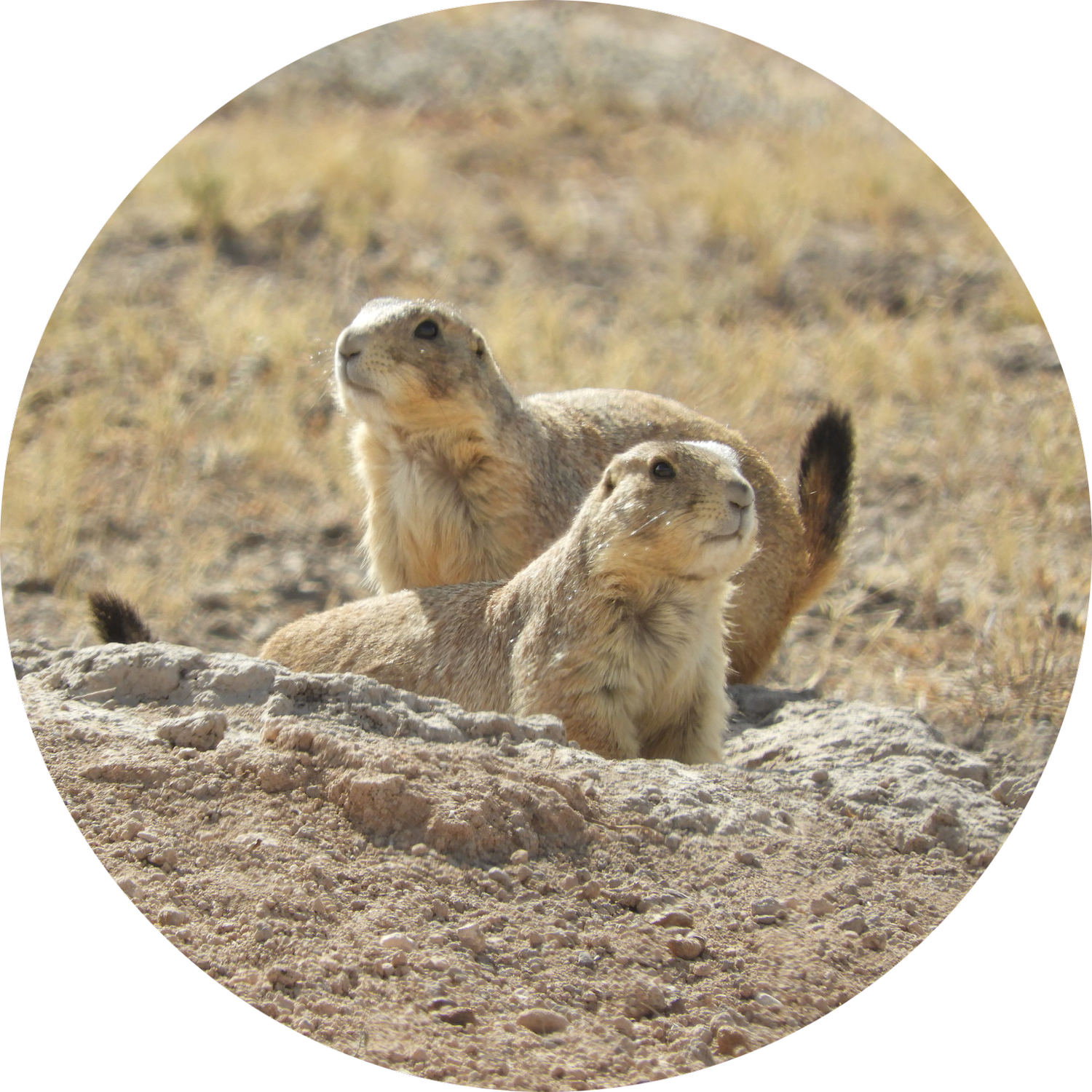
Mexican prairie dogs, Cynomys mexicanus. (© Caralampio de Jesús / iNaturalist)
Worthen’s sparrow seems to be particularly fond of dog towns. Just as it needs the right environmental intersection — where altitude, temperature, and rainfall align — it also relies on a specific junction of its habitat, known as the ‘ecotone.’
This narrow transition zone is located at the outskirts of a dog town, in the “suburbs,” where the open grazing lawn maintained by prairie dogs meets the protective cover of the long grasses and desert scrub.
“I think the patchy distribution of bushes and scrub where the prairie dog colonies are is the main reason S. wortheni is present as well,” says Dr. Julio César Canales-Delgadillo, who has studied the species for over twenty years
“They need plants with low branches for nesting,” says Canales-Delgadillo. “Over the years I worked with this sparrow, I never found a nest on a tree or over 60-80 centimeters above the ground. They always use scrubs or shrubs. Prairie dogs may help maintain this vegetation structure or help select plants with these characteristics.”
The sparrow nests in the protective shrubs along the colony’s edge, but crosses into the dog town to forage for seeds and small insects along the open ground. It feeds and breeds at a meeting point between two kinds of habitat, one of which is manufactured by another species.
But as prairie dogs clip the grasses, they don’t just change their structure — their height and density — they also alter their chemistry. Constant grazing keeps plants in a continual state of regrowth, stimulating nitrogen uptake and increasing the nutritional quality and digestibility of the vegetation.
This flush of nutritious forage is very attractive to other, much larger visitors.
———
Once upon a time bison thundered across the grasslands of North America like rolling waves of muscle and fur. But the possibility that their range once extended south into Mexico only began attracting serious attention in the 1990s.
Around the same time, Dr. Rodrigo Sierra-Corona began studying the vast grasslands that stretch across the US-Mexico border.
“If you look at a map and forget about the geographical boundaries,” says Sierra-Corona, “the Great Plains and the Chihuahuan desert are the same. It’s just a gradient of how dry it gets and where snow ends. There’s grassland ecosystems almost all the way to central Mexico. The species arrangement that would point you towards bison, like prairie dogs and pronghorn, go all the way south.”
So bison may well have ranged into the Chihuahuan grasslands, but exactly when, how far, and for how long remains uncertain. “There’s a lot of nuance, a lot of historical nuance,” says Sierra-Corona.
Further north, across the Great Plains of the U.S., bison and prairie dogs once helped shape one another’s habitat.
Bison grazed at the edges of dog towns, where they found higher quality forage than in untouched grassland and a higher quantity of grass than in the cropped colony centre — where the bison liked to rest and wallow.
Bison could act as enormous mowers, grazing down taller vegetation and opening broader lines of sight and new ground for prairie dogs to colonise. And, unlike a prairie dog, a bison is the furthest thing from a defenceless herbivore. “If a coyote shows up it’s going to kick their ass right,” says Sierra-Corona. “They’re guarding the colony.”
If bison did indeed range deep into the Chihuahuan grasslands, they may have played a similar role in Mexican prairie dog towns. Perhaps they helped maintain the ecotone where Worthen’s sparrow nests. Could the sparrow once have used bison hair to line its nest?
But even when bison were abundant, they were still highly nomadic animals.
“Were they a year-round species?” asks Sierra-Corona. “I don’t think the evidence supports that. Bison were going back and forth. Some herds were somewhat permanent, while others were very nomadic.”
The influence they had on individual dog towns, then, may have ebbed and flowed with their movements.
“I always imagine prairie dog colonies to be like an amoeba: expanding and contracting,” says Sierra-Corona. “The bison came, so there’s space to expand and the resources are good. And then you didn’t see bison for two years, and maybe the colony contracts or disappears.”
In some ways, prairie dog towns are like the boomtowns and cowtowns of the Wild West. Prospectors and cowboys passed through, bringing their trade and labour, just as bison and birds come and go in a dog town. And as the frontier towns were eventually swallowed by the westward advance of “civilisation,” countless prairie dog colonies have permanently vanished over the past century with the expansion of large-scale agriculture.
The Mexican prairie dog has lost 62% to 74% of its historic range — mirroring the roughly 70% range contraction of Worthen’s sparrow. And, like the sparrow, the prairie dog is now considered Endangered.
When a dog town disappears, the burrows, open lawns, and border grasses disappear with it. A different kind of landscape takes its place: as shrubs and long grasses encroach, the balance between open ground and dense cover changes.
What happens to all the species that clustered around the dog town? To the mountain plovers that forage among the cropped grasses and horned lizards that bask on the barren ground?
What happens to Worthen’s sparrow when prairie dogs disappear?
“It is difficult to say,” says Canales-Delgadillo. But he and his team did record the sparrow in areas with no prairie dog colonies. “I think S. wortheni could survive without prairie dog colonies,” he says.
Not that the disappearance of prairie dogs would leave Worthen’s sparrow unaffected. The bird may occur outside their colonies, but it still needs a specific combination of open ground and protective cover. Without prairie dogs, that combination may become harder to find.
In other words, Worthen’s sparrow is specialised in the conditions it requires, but flexible in where it finds them.
“The birds have adapted to use different structures for nesting, such as dry tumbleweeds trapped on the wire fences of cropfields 15–20 centimeters above the ground,” notes Canales-Delgadillo. “So they still use the habitat they are specialized for, but adapt to the man-made modifications present.“
Evidence of a modified landscape is woven into the sparrows’ nests themselves.
“The nests are cup-shaped structures, constructed of grass, herbs, and hair,” write Canales-Delgadillo and Scott-Morales in their 2007 study, “from which we could clearly recognize horse and cow hair.”
———
When Spanish explorers first reached the southern highlands of the Mexican Plateau in the 16th century, they described lush grasslands tall enough to touch the bellies of their horses.
Soon after the conquistadors came the first Spanish cattle herders. In the following centuries, their herds grew larger and larger, as bison were being exterminated from large swathes of this landscape, eventually leaving cattle as the dominant large grazers.
As the cattle industry boomed, stocking rates in some areas were estimated to be as much as 40 times higher than the areas could sustain. Intensive grazing stripped the grasslands.
Cattle are classic villains of modern conservation, and it’s not hard to see why given the damage they can cause. The typical view, in Dr. Rodrigo Sierra-Corona’s words, is “bison good, cow bad.”
Around twenty years ago, early in his career as a researcher, Sierra-Corona was working at the Janos Biosphere Reserve on the US-Mexico border. On a community-owned pasture, he found a very nice colony of black-tailed prairie dogs — close relatives of the Mexican species. But the land was extremely overgrazed.
So Sierra-Corona had the idea to create a kind of biodiversity payment system, where the ranchers would be paid not to graze their cattle, “to allow the grasses to grow, prairie dogs to be happy, and all that,” Sierra-Corona explains. And so the ranchers were paid, and their cattle stopped grazing on that land.
“It took like a year and a half for prairie dogs to disappear,” he says.
Without cattle to help crop the vegetation, native grasses shot up thick and tall. For a rodent reliant on clear sightlines to spot hunting coyotes and falcons, the lush meadow became too dangerous for habitation.
Sierra-Corona came across another prairie dog colony in an unlikely place, just outside of town in Janos, Mexico.
“It’s insane that one of the healthiest prairie dog colonies in this region is outside of a pretty ugly town,” he says. “I mean, I love the area but, like, this town is ugly. And this prairie dog colony is just like a block away from the town.”
There was a water truck there, and little else. “It’s like a moon surface kind of place. Cows are there. There’s nothing,” Sierra-Corona describes. “So sometimes you can see prairie dogs eating cow poop because, I mean, cow poop has a lot of vegetation.” Even the grasses were almost completely gone.
“And prairie dogs are the happiest there,” says Sierra-Corona. “Prairie dogs and grazing, they’re hand in hand. And suddenly you have a constant support of grazing for the prairie dogs, providing the best conditions for prairie dogs to expand.”
So were cattle secretly the misunderstood heroes of grassland conservation all along? Well, no. The cattle themselves are neither heroes nor villains, good nor evil.
“If you look at the big numbers, yes, grazing has been horrendous for the planet,” says Sierra-Corona. “But, again, it’s not the poor cow. It’s how we tend to use them.”
Unlike the herds of bison that once wandered freely across millions of acres, most modern cattle graze in large paddocks enclosed by barbed wire.
“They’re just there,” Sierra-Corona continues. “We move them as we please. They’re passengers in our crazy approach to the planet.”
What would happen if, say, we took 1,000 cattle and replaced them with 1,000 bison?
For one thing, bison would once again occupy the landscape. Although no longer endangered, their populations are still a fraction of their historical abundance. But simply bringing them back would not recreate the past.
“Bison are not unicorns, they’re not magic animals,” says Sierra-Corona. “What made bison good is their capacity to be bison, right? So that’s where, if you take it, and you simplify it, then that causes the problem.”
A bison is its physical body, yes, but it is also its behaviour.
“If it’s too cold, they know they need to go somewhere. If it’s too dry, they know they need to go somewhere,” explains Sierra-Corona. “For me, bison without movement — they’re just cows. The grazing behavior is defined by barbed wire, not by environmental conditions or free will.”
Replace cows with bison on a 3,000-hectare ranch, and you’re going to get exactly the same result. “You’re just changing the vehicle, not the process,” says Sierra-Corona.
It comes down to human management.
Cattle can be a functioning, if crude tool: managed in the right way, they can produce some of the same effects as bison grazing. But like any tool, they can also be misused.
Take fire.
“If you burn or graze, prairie dogs are as happy with one or the other,” Sierra-Corona says. “Can fire play a similar role [to grazing]? Yes. Can both things be extremely destructive? Yes. It’s all about timing and frequency and scale.”
“There’s a balance of grazing, predation, and then weather patterns. If you have X amount of grazing on a private colony, and you have the right amount of predators, you can keep the colonies somewhat stable. You can play with those levers.”
But knowing which levers to pull, when to pull them, and to what extent — that is the challenge. “The nuance is important,” says Sierra-Corona.
———
On June 17, 1959, a Worthen’s sparrow was collected in Sierra del Nido, Chihuahua. At the time, this was considered the northernmost record for the species in Mexico.
Sixty miles to the south, in Chihuahua City, the Grasslands Roadmap Summit took place in November 2026, on the doorstep of the sparrow’s former range.
The Summit brought together researchers, landowners, conservation groups, and government agencies from Canada, the United States, and Mexico to confront the crisis facing North America’s grasslands.
Across the continent, less than 20% of central grasslands remain intact. Grassland birds have suffered a 53% population loss since 1970 — the steepest decline of any avian guild on the continent.
What’s to be done?
“There’s actually a fair bit of consensus,” explains Arvind Panjabi, an avian conservationist and speaker at the Summit. “Maintain working lands to protect large intact, natural landscapes, protect key tracts of land that are vulnerable to being lost, and improve grazing management across the landscape to improve grassland health and productivity.”
The challenge is putting that consensus into practice. What exactly does a healthy and productive grassland mean — healthy and productive for whom?
The cropped environments produced by prairie dogs, bison, and cattle are valuable to open-ground species like mountain plovers. But other grassland species need quite the opposite conditions.
“There’s a pretty interesting research ranch here in Arizona called the Appleton-Whittell Ranch, owned by the Audubon Society,” says Sierra-Corona. “They don’t have grazing going on. In this place you have a lot of tall grass, and pretty much all the species that are looking for tall grass conditions are the happiest there.”
Baird’s sparrows thrive in dense, tall bunchgrass where they find cover for nesting. Hispid cotton rats build runway tunnels through ungrazed grasses to avoid owls and coyotes. And bunchgrass lizards can be up to ten times more abundant in ungrazed perennial grasslands than in grazed pastures.
“There’s no prairie dogs, and it’s not habitat for prairie dogs,” says Sierra-Corona. “I don’t think you will find a mountain plover in this place because mountain plovers need more of, like, a front-yard kind of ecosystem. They need prairie dogs to graze.”
A landscape can become less suitable for some species, like the mountain plover, while becoming more suitable for others, like Baird’s sparrow.
The grassland is not one uniform habitat but a mosaic of vegetation structures. It is not black and white — grassy or grazed. Worthen’s sparrow, for instance, doesn’t thrive in either extreme: rather than heavily grazed or completely open grasslands, it does best in lightly grazed shrubby grasslands, which are partly created and maintained by the actions of other animals.
“If the sparrows were tied to bison, and bison are like cows, and now cows are here, why am I not seeing an improvement in the sparrows?” Sierra-Corona poses. “It’s different, they’re moving differently. And there’s other pressures in the system that we are not seeing.”
Sierra-Corona’s experiment — the removal of all cattle from a pasture — flipped a single lever, changing one part of the system while overlooking the others. And without grazing, the grasses grew tall and prairie dogs disappeared.
“I feel like one of the biggest challenges is how hard we try to simplify processes, and then come out with simple solutions to very complex issues,” says Sierra-Corona. “I mean, I wish we can get like the silver bullet answer to everything, but it’s more complex than that.”
Conservation must match the complexity of the systems it is trying to manage.
The Grasslands Roadmap Summit brought together those who work and manage the land, those who study its wildlife, and the organisations able to support changes in how it is used. These are groups who know how to adjust different “levers,” who together could implement more nuanced systems.
One example is rotational grazing, in which pastures are subdivided into smaller paddocks and cattle are frequently moved between them.
“The grasslands didn’t evolve for constant grazing 24/7 in the same place,” says Sierra-Corona. “If you just allow a little bit of movement in a system, suddenly things start getting better.”
An area is grazed intensively for a short window before the cattle are moved, allowing the vegetation months or even a full year to recover. Over time, this creates a landscape of different plant heights and stages of regrowth: a mosaic.
It does not recreate the movements of wild bison herds. The cattle are still moved by people, usually within fenced boundaries and across much smaller areas. But with the right management, cattle could be used to approximate some of the effects of nomadic bison herds — possibly even replicate the vegetation structure of prairie dog towns.
Nuanced management, however, requires detailed knowledge. And, in many cases, our knowledge of both past and present conditions remains limited.
Do we know how far south bison ranged into the Chihuahuan Desert? How large a role did they play in the historic ecosystem?
“We didn’t really measure much of what the Great Plains or the Chihuahuan Desert were like before we filled it with cattle,” says Sierra-Corona.
As for Worthen’s sparrow, its historic range likewise remains uncertain. Was there ever a population in the United States, or was that first specimen found by Marsh simply a wayward wanderer?
Like bison, Worthen’s sparrow is a very mobile species. When it comes to conservation, nomadism brings both advantages and challenges.
“We identified several populations that are NOT completely isolated,” notes Dr. Canales-Delgadillo. When he was studying the species between 2003 and 2008, patches and corridors of suitable habitat still existed between localities, possibly allowing birds to move between populations and exchange genes.
On the other hand, those unpredictable movements also make the sparrow more difficult to study, and so more difficult to conserve.
“There’s a lot we still don’t know about the species, including its recent past and any changes in distribution,” explains Panjabi. “What is almost certain however is that there are additional breeding areas for the species…that remain unknown to this day.”
How do we know that?
In El Tokio, northeastern Mexico, Worthen’s sparrows gather in substantial flocks during the non-breeding season. But come summer, the breeding population in the region is substantially smaller.
Some of those birds must be breeding elsewhere — perhaps in north-central Mexico, in Zacatecas, or other areas that we’ve yet to find, where rains have sparked fresh growth — before gathering again in El Tokio come autumn and winter.
———
While conducting research in the El Tokio region, Canales-Delgadillo and his colleagues observed large winter flocks, some numbering as many as fifty birds. Worthen’s sparrows were joined by western bluebirds, horned larks, and other grassland sparrow species.
Worthen’s sparrow was acting as a nuclear species around which other species would gather.
“In our study, the role of nuclear or satellite species depended on two main factors: flock size and the presence of migrants,” explains Canales-Delgadillo. “When most individuals were Worthen’s sparrows, the species acted as the nuclear species. When the number of individuals per species was approximately even, and the other species were migrants, the Worthen’s sparrow was also nuclear. However, we also observed a few Worthen’s sparrows joining other species in a flock.”
During the non-breeding season, Worthen’s sparrows are less territorial, allowing other species to join their flocks. A group of non-aggressive birds feeding on the ground may also signal a good place to forage.
“For example, we often saw Western Bluebirds perched on bushes or short trees, catching insects that flew up when the flock on the ground disturbed them,” says Canales-Delgadillo.
Flockmates flush out more insects as they forage, and attentive individuals learn to copy the successful foraging techniques of other species around them. And with so many eyes watching for danger, the birds can keep their heads down, feeding, for far longer.
And so the sparrow that benefits from the work of prairie dogs in summer, in turn, helps other birds find sustenance and safety in winter.
But as spring returns, and monsoon rains fall unpredictably across the Chihuahuan Plateau, these temporary flocks break apart again. The sparrows disperse, roaming after the rains in search of suitable places to nest.
———
A tumbleweed rolls across the grasslands, scattering its seeds as it goes. At the edge of a field, it catches on a wire fence.
As it dries out, becoming more brittle and gnarled, it is discovered by a Worthen’s sparrow. The sparrow slips between the tangled stems, carrying strands of grass and cow hair, building its cup-like nest in the immobilised tumbleweed.